Increased orexin expression promotes sleep/wake disturbances in the SOD1-G93A mouse model of amyotrophic lateral sclerosis
- PMID: 25591569
- PMCID: PMC4837845
- DOI: 10.4103/0366-6999.149214
Increased orexin expression promotes sleep/wake disturbances in the SOD1-G93A mouse model of amyotrophic lateral sclerosis
Abstract
Background: Sleep/wake disturbances in patients with amyotrophic lateral sclerosis (ALS) are well-documented, however, no animal or mechanistic studies on these disturbances exist. Orexin is a crucial neurotransmitter in promoting wakefulness in sleep/wake regulation, and may play an important role in sleep disturbances in ALS. In this study, we used SOD1-G93A transgenic mice as an ALS mouse model to investigate the sleep/wake disturbances and their possible mechanisms in ALS.
Methods: Electroencephalogram/electromyogram recordings were performed in SOD1-G93A transgenic mice and their littermate control mice at the ages of 90 and 120 days, and the samples obtained from these groups were subjected to quantitative reverse transcriptase-polymerase chain reaction, western blotting, and enzyme-linked immunosorbent assay.
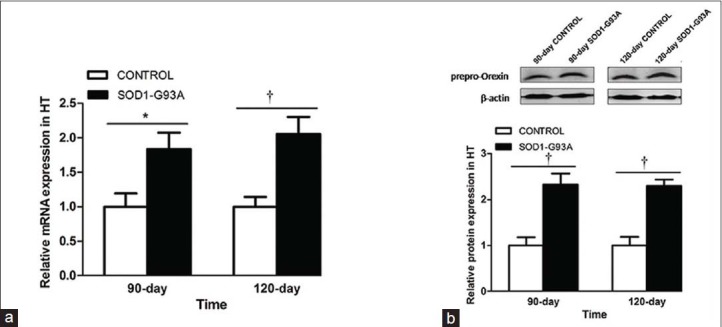
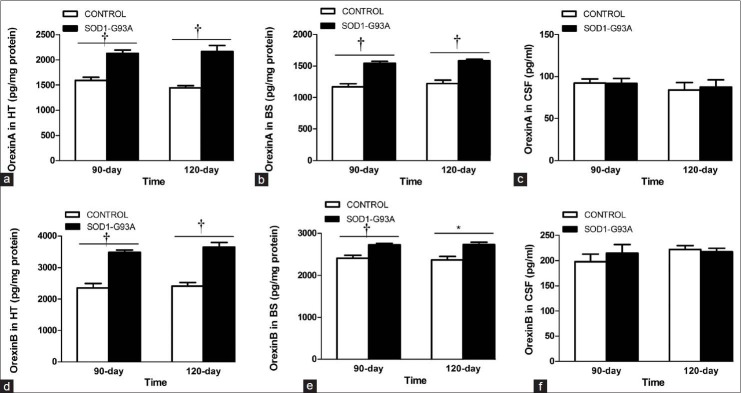
Results: For the first time in SOD1-G93A transgenic mice, we observed significantly increased wakefulness, reduced sleep time, and up-regulated orexins (prepro-orexin, orexin A and B) at both 90 and 120 days. Correlation analysis confirmed moderate to high correlations between sleep/wake time (total sleep time, wakefulness time, rapid eye movement [REM] sleep time, non-REM sleep time, and deep sleep time) and increase in orexins (prepro-orexin, orexin A and B).
Conclusion: Sleep/wake disturbances occur before disease onset in this ALS mouse model. Increased orexins may promote wakefulness and result in these disturbances before and after disease onset, thus making them potential therapeutic targets for amelioration of sleep disturbances in ALS. Further studies are required to elucidate the underlying mechanisms in the future.
Conflict of interest statement
Figures

References
-
- Rowland LP, Shneider NA. Amyotrophic lateral sclerosis. N Engl J Med. 2001;344:1688–700. - PubMed
-
- Feng XH, Yuan W, Peng Y, Liu MS, Cui LY. Therapeutic effects of dl-3-n-butylphthalide in a transgenic mouse model of amyotrophic lateral sclerosis. Chin Med J. 2012;125:1760–6. - PubMed
-
- Hetta J, Jansson I. Sleep in patients with amyotrophic lateral sclerosis. J Neurol. 1997;244:S7–9. - PubMed
-
- Lo Coco D, Mattaliano P, Spataro R, Mattaliano A, La Bella V. Sleep-wake disturbances in patients with amyotrophic lateral sclerosis. J Neurol Neurosurg Psychiatry. 2011;82:839–42. - PubMed
-
- Atalaia A, De Carvalho M, Evangelista T, Pinto A. Sleep characteristics of amyotrophic lateral sclerosis in patients with preserved diaphragmatic function. Amyotroph Lateral Scler. 2007;8:101–5. - PubMed
Publication types
MeSH terms
Substances
LinkOut - more resources
Full Text Sources
Other Literature Sources
Medical
Miscellaneous