


Plasma 25-hydroxyvitamin D and colorectal cancer risk according to tumour immunity status
- PMID: 25591978
- PMCID: PMC4503524
- DOI: 10.1136/gutjnl-2014-308852
Plasma 25-hydroxyvitamin D and colorectal cancer risk according to tumour immunity status
Abstract
Objective: Evidence suggests protective effects of vitamin D and antitumour immunity on colorectal cancer risk. Immune cells in tumour microenvironment can convert 25-hydroxyvitamin D [25(OH)D] to bioactive 1α,25-dihydroxyvitamin D3, which influences neoplastic and immune cells as an autocrine and paracrine factor. Thus, we hypothesised that the inverse association between vitamin D and colorectal cancer risk might be stronger for cancers with high-level immune response than those with low-level immune response.
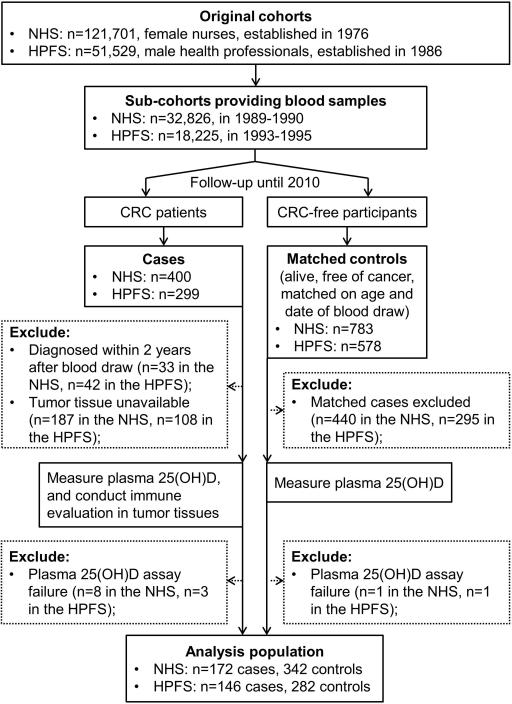
Design: We designed a nested case-control study (318 rectal and colon carcinoma cases and 624 matched controls) within the Nurses' Health Study and Health Professionals Follow-up Study using molecular pathological epidemiology database. Multivariable conditional logistic regression was used to assess the association of plasma 25(OH)D with tumour subtypes according to the degree of lymphocytic reaction, tumour-infiltrating T cells (CD3+, CD8+, CD45RO+ (PTPRC) and FOXP3+ cells), microsatellite instability or CpG island methylator phenotype.
Results: The association of plasma 25(OH)D with colorectal carcinoma differed by the degree of intratumoural periglandular reaction (p for heterogeneity=0.001); high 25(OH)D was associated with lower risk of tumour with high-level reaction (comparing the highest versus lowest tertile: OR 0.10; 95% CI 0.03 to 0.35; p for trend<0.001), but not risk of tumour with lower-level reaction (p for trend>0.50). A statistically non-significant difference was observed for the associations of 25(OH)D with tumour subtypes according to CD3+ T cell density (p for heterogeneity=0.03; adjusted statistical significance level of α=0.006).
Conclusions: High plasma 25(OH)D level is associated with lower risk of colorectal cancer with intense immune reaction, supporting a role of vitamin D in cancer immunoprevention through tumour-host interaction.
Keywords: COLORECTAL CANCER; EPIDEMIOLOGY; IMMUNOLOGY; IMMUNOTHERAPY; NUTRITION.
Published by the BMJ Publishing Group Limited. For permission to use (where not already granted under a licence) please go to http://www.bmj.com/company/products-services/rights-and-licensing/
Figures
References
-
- Ma Y, Zhang P, Wang F, et al. Association between vitamin D and risk of colorectal cancer: a systematic review of prospective studies. J Clin Oncol. 2011;29:3775–82. - PubMed
-
- Feldman D, Krishnan AV, Swami S, et al. The role of vitamin D in reducing cancer risk and progression. Nat Rev Cancer. 2014;14:342–57. - PubMed
-
- Liu PT, Stenger S, Li H, et al. Toll-like receptor triggering of a vitamin D-mediated human antimicrobial response. Science. 2006;311:1770–3. - PubMed
-
- Sigmundsdottir H, Pan J, Debes GF, et al. DCs metabolize sunlight-induced vitamin D3 to ‘program’ T cell attraction to the epidermal chemokine CCL27. Nat Immunol. 2007;8:285–93. - PubMed
Publication types
MeSH terms
Substances
Grants and funding
- K07 CA148894/CA/NCI NIH HHS/United States
- R01 CA118553/CA/NCI NIH HHS/United States
- P01 CA087969/CA/NCI NIH HHS/United States
- U01 CA167552/CA/NCI NIH HHS/United States
- R01 CA49449/CA/NCI NIH HHS/United States
- R01 CA137178/CA/NCI NIH HHS/United States
- K24 DK098311/DK/NIDDK NIH HHS/United States
- UM1 CA186107/CA/NCI NIH HHS/United States
- R01 CA169141/CA/NCI NIH HHS/United States
- P01 CA55075/CA/NCI NIH HHS/United States
- UM1 CA167552/CA/NCI NIH HHS/United States
- R03 CA176717/CA/NCI NIH HHS/United States
- R01 CA049449/CA/NCI NIH HHS/United States
- P50 CA127003/CA/NCI NIH HHS/United States
- K07 CA190673/CA/NCI NIH HHS/United States
- [P01 CA87969/CA/NCI NIH HHS/United States
- P01 CA055075/CA/NCI NIH HHS/United States
- R01 CA151993/CA/NCI NIH HHS/United States
LinkOut - more resources
Full Text Sources
Other Literature Sources
Medical
Research Materials
Miscellaneous
