Review
. 2014 Sep 30:4:29.
doi: 10.1186/s13613-014-0029-5. eCollection 2014.

High-flow nasal cannula: recommendations for daily practice in pediatrics

Affiliations
Review

High-flow nasal cannula: recommendations for daily practice in pediatrics

Christophe Milési et al. Ann Intensive Care. .

Abstract

High-flow nasal cannula (HFNC) is a relatively new device for respiratory support. In pediatrics, HFNC use continues to increase as the system is easily set up and is well tolerated by patients. The use of nasal cannula adapted to the infant's nares size to deliver heated and humidified gas at high flow rates has been associated with improvements in washout of nasopharyngeal dead space, lung mucociliary clearance, and oxygen delivery compared with other oxygen delivery systems. HFNC may also create positive pharyngeal pressure to reduce the work of breathing, which positions the device midway between classical oxygen delivery systems, like the high-concentration face mask and continuous positive airway pressure (CPAP) generators. Currently, most of the studies in the pediatric literature suggest the benefits of HFNC therapy only for moderately severe acute viral bronchiolitis. But, the experience with this device in neonatology and adult intensive care may broaden the pediatric indications to include weaning from invasive ventilation and acute asthma. As for any form of respiratory support, HFNC initiation in patients requires close monitoring, whether it be for pre- or inter-hospital transport or in the emergency department or the pediatric intensive care unit.

Keywords: Asthma; Bronchiolitis; High-flow nasal cannula; PICU.


Figures
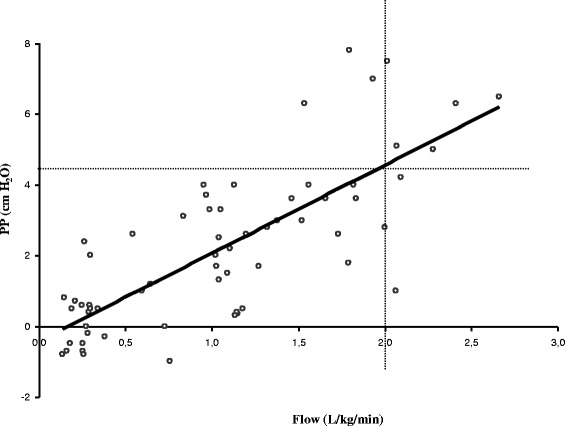
Figure 1
Figure 1
Pharyngeal pressure (PP) over the course of a gradual increase in flow. The flow is indexed to patient weight (R = 0.77, p < 0.001). A flow >2 L/kg/min is associated with mean pharyngeal pressure >4 cm H2O (sensitivity 67%, specificity 96%, positive predictive value 75%, negative predictive value 94.5%). Adapted from Milési et al. [3].
Figure 2
Figure 2
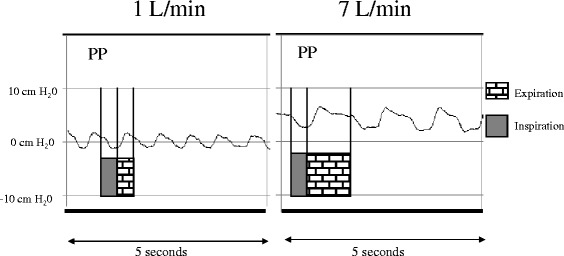
Recording of the pharyngeal pressure (PP) at 1 and 7 L/min in an infant.
Figure 3
Figure 3
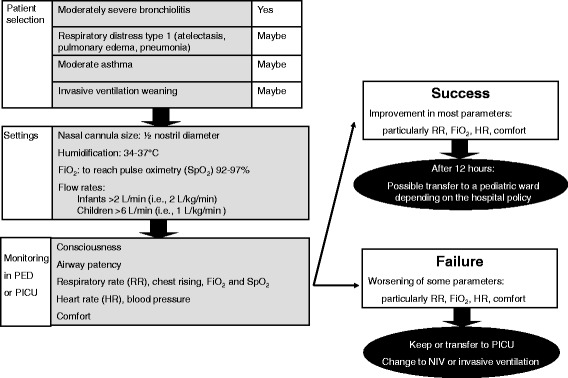
HFNC initiation and monitoring. PED, pediatric emergency department; PICU, pediatric intensive care unit; RR, respiratory rate; HR, heart rate; NIV, noninvasive ventilation.

References

    1. Lee JH, Rehder KJ, Williford L, Cheifetz IM, Turner DA. Use of high flow nasal cannula in critically ill infants, children, and adults: a critical review of the literature. Intensive Care Med. 2013;39:247–257. doi: 10.1007/s00134-012-2743-5. - DOI - PubMed
    1. Mayfield S, Jauncey-Cooke J, Hough JL, Schibler A, Gibbons K, Bogossian F. High-flow nasal cannula therapy for respiratory support in children. Cochrane Database Syst Rev. 2014;3 - PMC - PubMed
    1. Milési C, Baleine J, Matecki S, Durand S, Combes C, Novais AR, Cambonie G. Is treatment with a high flow nasal cannula effective in acute viral bronchiolitis? A physiologic study. Intensive Care Med. 2013;39:1088–1094. doi: 10.1007/s00134-013-2879-y. - DOI - PubMed
    1. ten Brink F, Duke T, Evans J. High-flow nasal prong oxygen therapy or nasopharyngeal continuous positive airway pressure for children with moderate-to-severe respiratory distress? Pediatr Crit Care Med. 2013;14:e326–331. doi: 10.1097/PCC.0b013e31828a894d. - DOI - PubMed
    1. Mayfield S, Bogossian F, O’Malley L, Schibler A. High-flow nasal cannula oxygen therapy for infants with bronchiolitis: pilot study. J Paediatr Child Health. 2014;50:373–378. doi: 10.1111/jpc.12509. - DOI - PubMed