. 2014 Jul 29;1(8):504-12.
doi: 10.18632/oncoscience.67. eCollection 2014.

Pathways driving the endocytosis of mutant and wild-type EGFR in cancer

Affiliations

Pathways driving the endocytosis of mutant and wild-type EGFR in cancer

Kaia K Hampton et al. Oncoscience. .

Abstract

EGFR (epidermal growth factor receptor) is activated through changes in expression or mutations in a number of tumors and is a driving force in cancer progression. EGFR is targeted by numerous inhibitors, including chimeric antibodies targeting the extracellular domain and small molecule kinase domain inhibitors. The kinase domain inhibitors are particularly active against mutant forms of the receptor, and subsequent mutations drive resistance to the inhibitors. Here, we review recent developments on the trafficking of wild-type and mutant EGFR, focusing on the roles of MIG6, SPRY2, ITSN, SHP2, S2R(PGRMC1) and RAK. Some classes of EGFR regulators affect wild-type and mutant EGFR equally, while others are specific for either the wild-type or mutant form of the receptor. Below we summarize multiple signaling-associated pathways that are important in trafficking wild-type and mutant EGFR with the goal being stimulation of new approaches for targeting the distinct forms of the receptor.

Keywords: endocytosis; kinase; receptor; signaling; therapeutics.


Figures
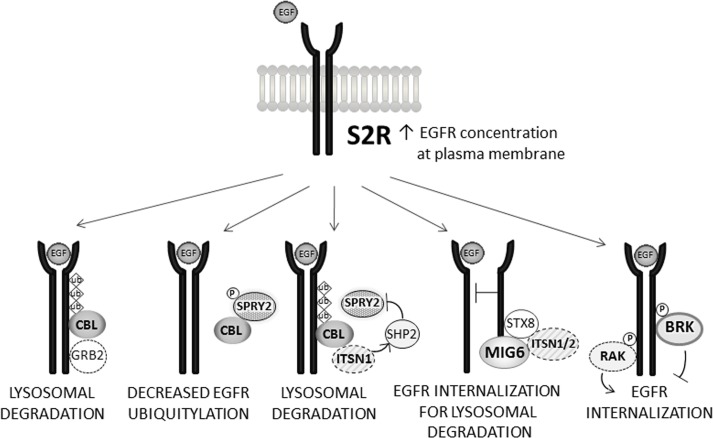
Figure 1
Figure 1. Selected pathways regulating EGFR endocytosis and degradation
In the top panel, EGFR levels at the plasma membrane are increased by S2RPGRMC1. The diagrams, from left to right, below, show different binding partners for EGFR. GRB2 recruits CBL to EGFR resulting in lysosomal degradation. SPRY2 phosphorylation drives its association with CBL, inhibiting CBL binding to EGFR. ITSN1 can recruit SHP2 to dephosphorylate SPRY2, releasing CBL to bind EGFR. MIG6 physically obstructs EGFR dimerization and binds to STX8 and ITSN1/2 to promote lysosomal degradation of EGFR. BRK phosphorylates EGFR to inhibit EGFR internalization, while RAK/FRK has the opposite activity.
Figure 2
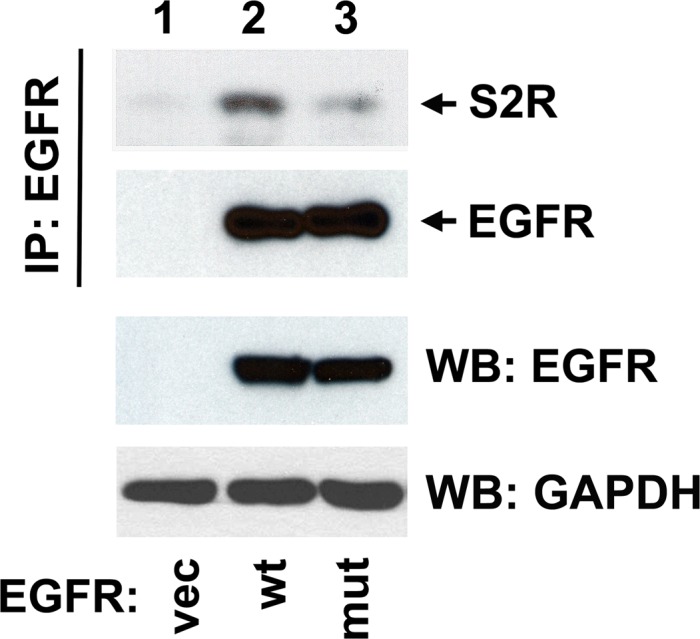
Figure 2. S2RPGRMC1 preferentially associates with wild-type EGFR
MDA-MB-435 human breast cancer cells, which do not express EGFR (lower panel, lane 1), were transfected with a control plasmid (lane 1), the plasmid pcDNA3.1-EGFR (lane 2, a gift from Drs. Penni Black, University of Kentucky, and William Pao, Vanderbilt University) or the plasmid pBabe-EGFR-Δ746-749/A750P Addgene, Cambridge, MA). In the top two panels, lysates were immuno-precipitated using previously described conditions [40] with the anti-EGFR antibody IMC-C225 (Erbitux, ImClone Systems, Branchburg, NJ). Precipitates were then analyzed by western blot with (top panel) the anti-S2RPGRMC1 antibody PGR-UK1 [33] or (middle panel) an anti-EGFR polyclonal antibody (1005, Santa Cruz Biotechnology). Because of the very different molecular weights of the proteins, the blot was cut in half before probing. The bottom panels show the same unprecipitated cell lysates that were used for the precipitation reactions analyzed by western blot using EGFR and GAPDH polyclonal antibodies, the latter as a control for protein loading. The result shown is representative of three independent experiments. We have previously shown that the EGFR-Δ746-749/A750P mutant is highly tyrosine phosphorylated in this system compared to wild-type EGFR [67].

References

    1. Lemmon MA, Schlessinger J. Cell signaling by receptor tyrosine kinases. Cell. 2010;141:1117–1134. - PMC - PubMed
    1. Hynes NE, Lane HA. ERBB receptors and cancer: the complexity of targeted inhibitors. Nature reviews Cancer. 2005;5:341–354. - PubMed
    1. Langdon WY, Hartley JW, Klinken SP, Ruscetti SK, Morse HC. v-cbl, an oncogene from a dual-recombinant murine retrovirus that induces early B-lineage lymphomas. Proceedings of the National Academy of Sciences of the United States of America. 1989;86:1168–1172. - PMC - PubMed
    1. Schmidt MH, Dikic I. The Cbl interactome and its functions. Nature reviews Molecular cell biology. 2005;6:907–918. - PubMed
    1. Levkowitz G, Waterman H, Zamir E, Kam Z, Oved S, Langdon WY, Beguinot L, Geiger B, Yarden Y. c-Cbl/Sli-1 regulates endocytic sorting and ubiquitination of the epidermal growth factor receptor. Genes & development. 1998;12:3663–3674. - PMC - PubMed