


Perinatal pharmacokinetics of azithromycin for cesarean prophylaxis
- PMID: 25595580
- PMCID: PMC4612366
- DOI: 10.1016/j.ajog.2015.01.015
Perinatal pharmacokinetics of azithromycin for cesarean prophylaxis
Abstract
Objective: Postpartum infections are polymicrobial and typically include Ureaplasma, an intracellular microbe that is treated by macrolides such as azithromycin. The aim of this study was to evaluate the perinatal pharmacokinetics of azithromycin after a single preincision dose before cesarean delivery.
Study design: Thirty women who underwent scheduled cesarean delivery were assigned randomly to receive 500 mg of intravenous azithromycin that was initiated 15, 30, or 60 minutes before incision and infused over 1 hour. Serial maternal plasma samples were drawn from the end of infusion up to 8 hours after the infusion. Samples of amniotic fluid, umbilical cord blood, placenta, myometrium, and adipose tissue were collected intraoperatively. Breast milk samples were collected 12-48 hours after the infusion in 8 women who were breastfeeding. Azithromycin was quantified with high performance liquid chromatography separation coupled with tandem mass spectrometry detection. Plasma pharmacokinetic parameters were estimated with the use of noncompartmental analysis and compartmental modeling and simulations.
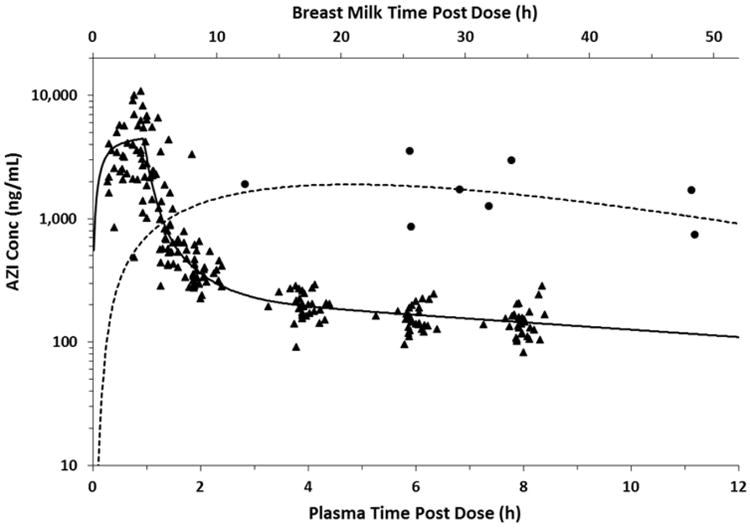
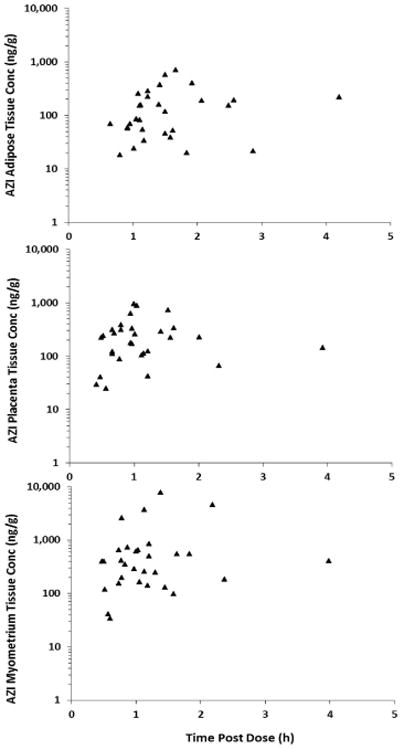
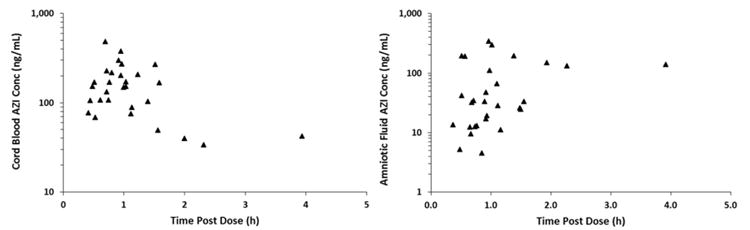
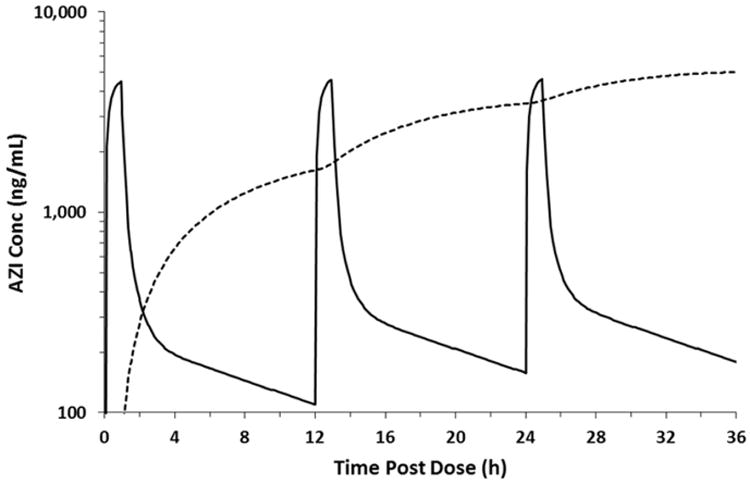
Results: The maximum maternal plasma concentration was reached within 1 hour and exceeded the in vitro minimum inhibitory concentration (MIC50) of 250 ng/mL of Ureaplasma spp in all 30 patients. The concentrations were sustained with a half-life of 6.7 hours. The median concentration of azithromycin in adipose tissue was 102 ng/g, which was below the MIC50. The median concentration in myometrium was 402 ng/g, which exceeded the MIC50. Azithromycin was detectable in both the umbilical cord plasma and amniotic fluid after the single preoperative dose. Azithromycin concentrations in breast milk were high and were sustained up to 48 hours after the single dose. Simulations demonstrated accumulation in breast milk after multiple doses.
Conclusion: A single dose of azithromycin achieves effective plasma and tissue concentrations and is transported rapidly across the placenta. The tissue concentrations that are achieved in the myometrium exceed the MIC50 for Ureaplasma spp.
Keywords: Ureaplasma; azithromycin; breast milk; cesarean delivery; endometritis; pharmacokinetics; wound infection.
Copyright © 2015 Elsevier Inc. All rights reserved.
Conflict of interest statement
Disclosure: The authors report no conflict of interest.
Figures
References
-
- Costantine MM, Rahman M, Ghulmiyah L, et al. Timing of perioperative antibiotics for cesarean delivery: a metaanalysis. Am J Obstet Gynecol. 2008;199:301 e1–6. - PubMed
-
- American College of Obstetricians and Gynecologists. ACOG Practice Bulletin No. 120: Use of prophylactic antibiotics in labor and delivery. Obstet Gynecol. 2011;117:1472–83. - PubMed
-
- Andrews WW, Shah SR, Goldenberg RL, Cliver SP, Haugh JC, Cassell GH. Association of post-cesarean delivery endometritis with colonization of the chorioamnion by Ureaplasma urealyticum. Obstet Gynecol. 1995;85:509–14. - PubMed
-
- Watts DH, Eschenbach DA, Kenny GE. Early postpartum endometritis: the role of bacteria, genital mycoplasmas, and Chlamydia trachomatis. Obstet Gynecol. 1989;73:52–60. - PubMed
Publication types
MeSH terms
Substances
Grants and funding
LinkOut - more resources
Full Text Sources
Other Literature Sources
Medical
Miscellaneous
