


Effects of chronic interpersonal stress exposure on depressive symptoms are moderated by genetic variation at IL6 and IL1β in youth
- PMID: 25596176
- PMCID: PMC4515110
- DOI: 10.1016/j.bbi.2015.01.003
Effects of chronic interpersonal stress exposure on depressive symptoms are moderated by genetic variation at IL6 and IL1β in youth
Abstract
Aims: Close to one third of patients with major depression show increases in pro-inflammatory cytokines, which are in turn associated with risk for inflammatory disease. Genetic variants that enhance immune reactivity may thus enhance inflammatory and depressive reactions to stress. The aim of the present study was to investigate a trio of functional SNPs in the promoter regions of IL6 (-174G>C, rs1800795), IL1β (-511C>T, rs16944), and TNF (-308G>A, rs1800629) as moderators of the relationship between chronic stress exposure and elevations in depressive symptoms.
Methods: Participants were 444 Australian youth (mean age=20.12) whose exposure to chronic stress in the past 6months was assessed using the semi-structured UCLA Life Stress Interview, and who completed the Beck Depression Inventory II at ages 15 and 20. Between ages 22 and 25, all participants in the selected sample provided blood samples for genotyping.
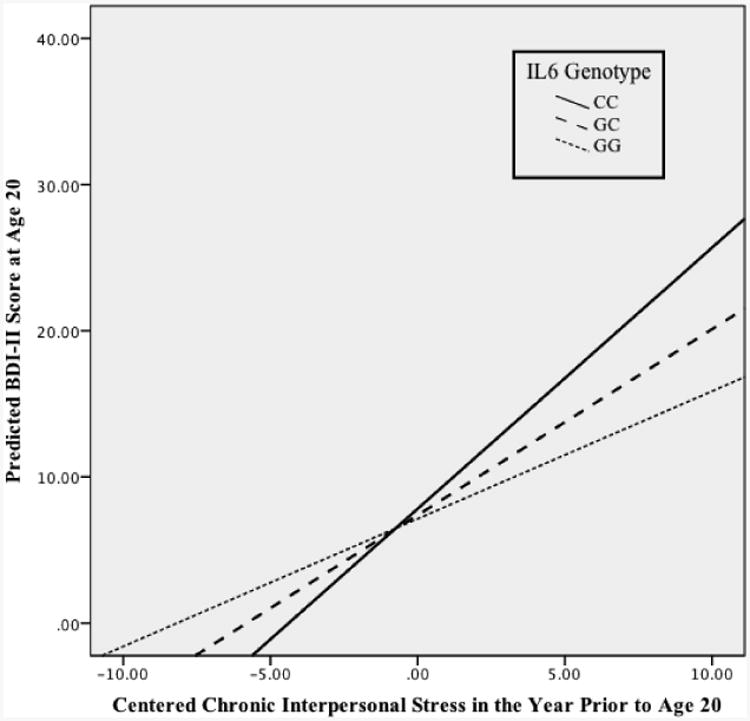
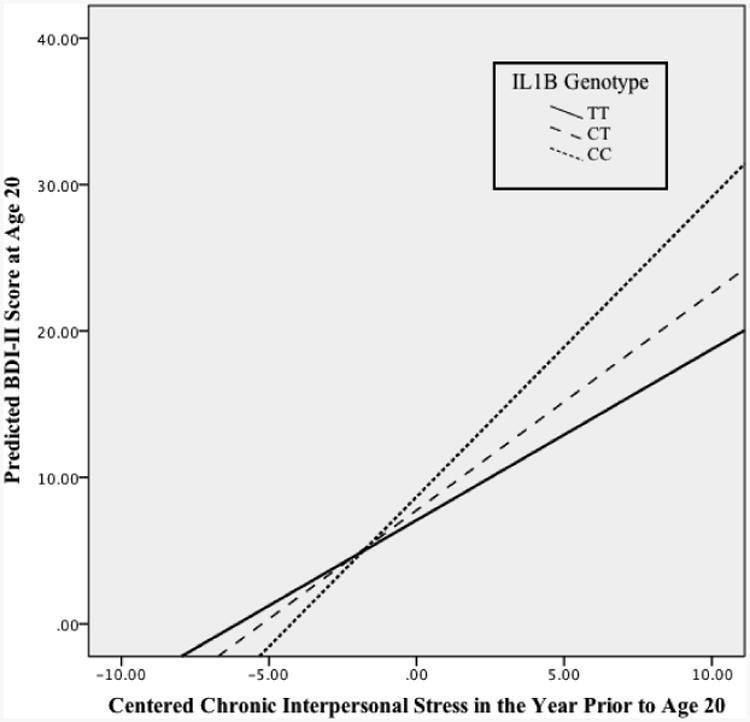
Results: In line with a hypothesized moderation effect, -174G allele carriers at IL6 had fewer depressive symptoms following interpersonal stress, relative to C/C homozygotes with equal interpersonal stress exposure. However, IL6 genotype did not moderate the effects of non-interpersonal stress exposure (i.e., financial, work and health-related difficulties) on depression. Also in line with hypotheses, the -511C allele in IL1β, previously associated with higher IL-1β expression, was associated with more severe depression following chronic interpersonal stress exposure, relative to T/T homozygotes. Again, the moderating effect was specific to interpersonal stressors and did not generalize to non-interpersonal stress. TNF was not a moderator of the effects of either interpersonal or non-interpersonal stress on later depression outcomes.
Conclusion: Findings were consistent with the hypothesis that pro-inflammatory genetic variation increases the risk of stress-induced depression. The present results provide evidence of a genetic mechanism contributing to individual differences in depressive symptomatology following interpersonal stress exposure.
Keywords: Adolescent depression; Depression; Gene–environment interaction; IL1β; IL6; Pro-inflammatory cytokines; TNF.
Published by Elsevier Inc.
Figures
References
-
- Abraham LJ, Kroeger KM. Impact of the -308 TNF promoter polymorphism on the transcriptional regulation of the TNF gene: relevance to disease. J Leukoc Biol. 1999;66(4):562–566. - PubMed
-
- Baune BT, Dannlowski U, Domschke K, Janssen DGA, Jordan MA, Ohrmann P, et al. Suslow T. The interleukin 1 beta (il1b) gene is associated with failure to achieve remission and impaired emotion processing in major depression. Biolog Psychiatry. 2010;67(6):543–9. doi: 10.1016/j.biopsych.2009.11.004. - DOI - PubMed
-
- Beck AT, Steer RA, Carbin MG. Psychometric properties of the Beck Depression Inventory: Twenty-five years of evaluation. Clin Psychol Rev. 1988;8(1):77–100. doi: 10.1016/0272-7358(88)90050-5. - DOI
Publication types
MeSH terms
Substances
Grants and funding
LinkOut - more resources
Full Text Sources
Other Literature Sources
Medical
Miscellaneous
