Cyclin alterations in diverse cancers: Outcome and co-amplification network
- PMID: 25596748
- PMCID: PMC4413635
- DOI: 10.18632/oncotarget.2848
Cyclin alterations in diverse cancers: Outcome and co-amplification network
Abstract
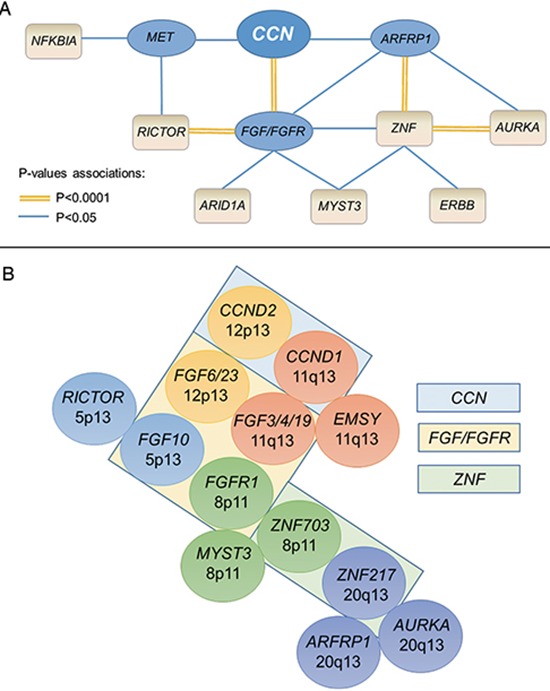
Cyclin genes are key regulatory components of the cell cycle. With the development of new agents, cyclin-related genes are becoming increasingly important as they can be targeted. Yet, the biological implications of these alterations have not been fully studied. Clinical characteristics and outcome parameters were compared for patients harboring cyclin alterations versus not. CCN alterations were found in 13% of our population (50/392; all amplifications) and were associated with breast cancer (P < 0.0001), a higher median number of concomitant molecular alterations (P < 0.0001), and liver metastases (P = 0.046). Harboring a cyclin amplification was not associated with overall survival, the time to metastasis/recurrence, nor with the best progression-free survival. In a Cox regression model, gastrointestinal histology (P < 0.0001), PTEN (P < 0.0001), and CDK alterations (P = 0.041) had a significant association with poorer overall survival. CCN amplifications significantly correlated with alterations in FGF/FGFR family genes as well as in MET and ARFRP1. An extended correlation study shed light on a network of co-amplifications influenced in part by genes that were localized on the same amplicons. CCN amplifications are common across cancers and had distinctive biological associations. Customized combinations targeting the cyclin pathway as well as the extended co- amplification network may be necessary in order to address resistance mechanisms.
Figures
References
-
- Musgrove EA, Caldon CE, Barraclough J, Stone A, Sutherland RL. Cyclin D as a therapeutic target in cancer. Nat Rev Cancer. 2011 Aug;11:558–72. - PubMed
-
- Motokura T, Bloom T, Kim HG, Jüppner H, Ruderman JV, Kronenberg HM, Arnold A. A novel cyclin encoded by a bcl1-linked candidate oncogene. Nature. 1991 Apr 11;350:512–5. - PubMed
-
- Rosenberg CL, Kim HG, Shows TB, Kronenberg HM, Arnold A. Rearrangement and overexpression of D11S287E, a candidate oncogene on chromosome 11q13 in benign parathyroid tumors. Oncogene. 1991 Mar;6:449–53. - PubMed
Publication types
MeSH terms
Substances
LinkOut - more resources
Full Text Sources
Other Literature Sources
Research Materials
Miscellaneous