A comparative review of the hemodynamics and pathogenesis of cerebral and abdominal aortic aneurysms: lessons to learn from each other
- PMID: 25599042
- PMCID: PMC4296046
- DOI: 10.7461/jcen.2014.16.4.335
A comparative review of the hemodynamics and pathogenesis of cerebral and abdominal aortic aneurysms: lessons to learn from each other
Abstract
Objective: Cerebral aneurysms (CAs) and abdominal aortic aneurysms (AAAs) are degenerative vascular pathologies that manifest as abnormal dilations of the arterial wall. They arise with different morphologies in different types of blood vessels under different hemodynamic conditions. Although treated as different pathologies, we examine common pathways in their hemodynamic pathogenesis in order to elucidate mechanisms of formation.
Materials and methods: A systematic review of the literature was performed. Current concepts on pathogenesis and hemodynamics were collected and compared.
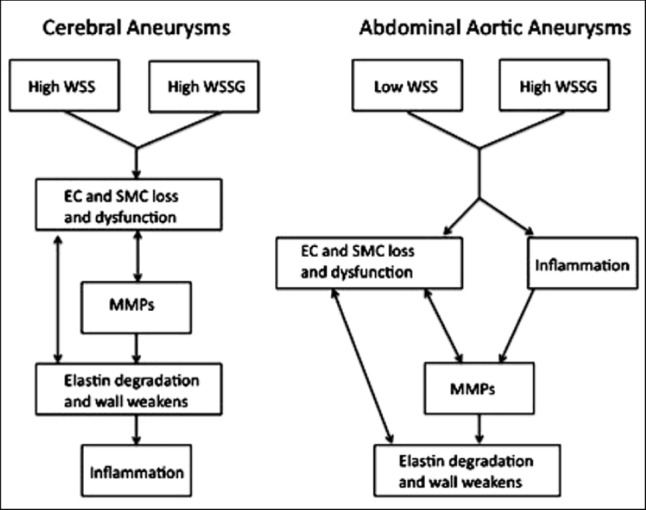
Results: CAs arise as saccular dilations on the cerebral arteries of the circle of Willis under high blood flow, high wall shear stress (WSS), and high wall shear stress gradient (WSSG) conditions. AAAs arise as fusiform dilations on the infrarenal aorta under low blood flow, low, oscillating WSS, and high WSSG conditions. While at opposite ends of the WSS spectrum, they share high WSSG, a critical factor in arterial remodeling. This alone may not be enough to initiate aneurysm formation, but may ignite a cascade of downstream events that leads to aneurysm development. Despite differences in morphology and the structure, CAs and AAAs share many histopathological and biomechanical characteristics. Endothelial cell damage, loss of elastin, and smooth muscle cell loss are universal findings in CAs and AAAs. Increased matrix metalloproteinases and other proteinases, reactive oxygen species, and inflammation also contribute to the pathogenesis of both aneurysms.
Conclusion: Our review revealed similar pathways in seemingly different pathologies. We also highlight the need for cross-disciplinary studies to aid in finding similarities between pathologies.
Keywords: Abdominal aortic aneurysms; Blood flow; Cerebral aneurysms; Endothelial cells; Hemodynamics; Inflammation; Pathogenesis.
Figures
References
-
- Andrews RJ, Spiegel PK. Intracranial aneurysms. Age, sex, blood pressure, and multiplicity in an unselected series of patients. J Neurosurg. 1979 Jul;51(1):27–32. - PubMed
-
- Atlas SW. Magnetic resonance imaging of intracranial aneurysms. Neuroimaging Clin N Am. 1997 Nov;7(4):709–720. - PubMed
-
- Austin G, Fisher S, Dickson D, Anderson D, Richardson S. The significance of the extracellular matrix in intracranial aneurysms. Ann Clin Lab Sci. 1993 Mar-Apr;23(2):97–105. - PubMed
-
- Baharoglu MI, Schirmer CM, Hoit DA, Gao BL, Malek AM. Aneurysm inflow-angle as a discriminant for rupture in sidewall cerebral aneurysms: morphometric and computational fluid dynamic analysis. Stroke. 2010 Jul;41(7):1423–1430. - PubMed
-
- Becske T, Kallmes DF, Saatci I, McDougall CG, Szikora I, Lanzino G, et al. Pipeline for uncoilable or failed aneurysms: results from a multicenter clinical trial. Radiology. 2013 Jun;267(3):858–868. - PubMed
Publication types
LinkOut - more resources
Full Text Sources
Other Literature Sources
Research Materials