


Endocannabinoids and acute pain after total knee arthroplasty
- PMID: 25599456
- PMCID: PMC4299927
- DOI: 10.1097/01.j.pain.0000460315.80981.59
Endocannabinoids and acute pain after total knee arthroplasty
Abstract
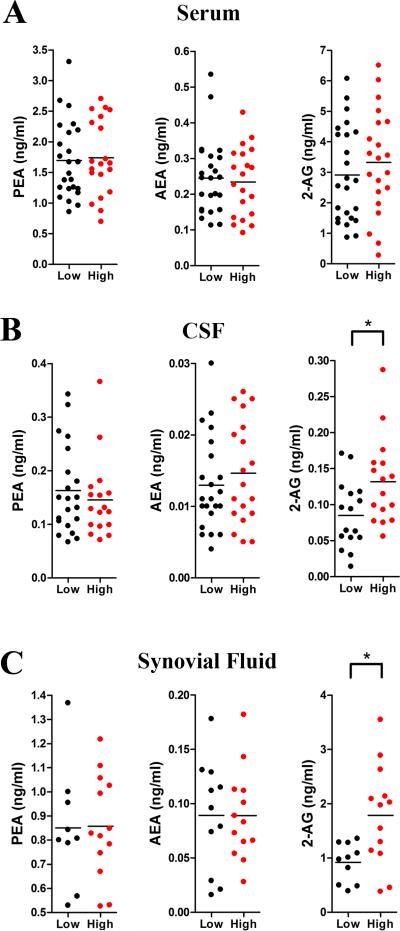
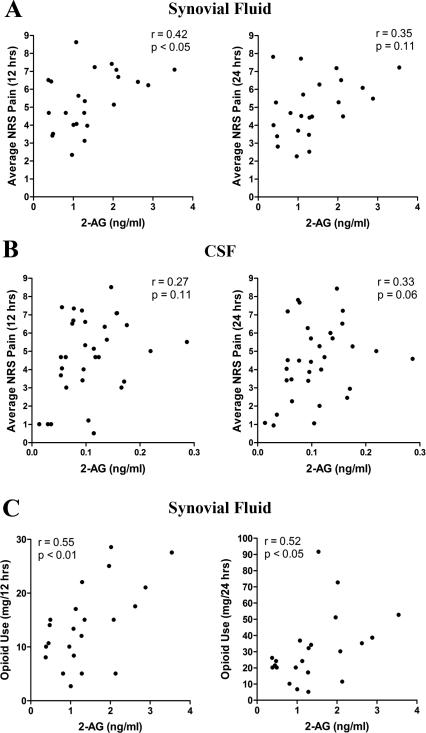
Osteoarthritis (OA) of the knee is a progressive disease that is associated with inflammation of the joints and lower extremity pain. Total knee arthroplasty (TKA) is a surgical procedure that aims to reduce pain and restore motor function in patients suffering from OA. The immediate postoperative period can be intensely painful leading to extended recovery times including persistent pain. The endocannabinoid system regulates nociception, and the activation of cannabinoid receptors produces antinociceptive effects in preclinical models of OA. To date, the influence of the endocannabinoid tone on pain and disability in OA patients and on acute postoperative pain in humans has not been explored. In this study, we provide the first comprehensive profile of endocannabinoids in serum, cerebrospinal fluid, and synovial fluid of patients with painful end-stage OA undergoing TKA and examine correlations between endocannabinoid levels, interleukin 6, functional disability, acute postoperative pain, and postoperative opioid use. Our results reveal that central (cerebrospinal fluid) and peripheral (synovial fluid) levels of the endocannabinoid 2-arachidonoyl glycerol were significantly elevated in patients who developed higher postoperative pain after TKA. In addition, synovial fluid 2-arachidonoyl glycerol levels were positively correlated with postoperative opioid use. Similarly, synovial fluid levels of the anti-inflammatory lipid palmitoylethanolamide correlated with functional disability in OA. Taken together, our results are the first to reveal associations between central and peripheral endocannabinoid levels and postoperative pain. This suggests that endocannabinoid metabolism may serve as a target for the development of novel analgesics both for systemic or local delivery into the joint.
Figures
References
-
- Ahn K, Johnson DS, Mileni M, Beidler D, Long JZ, McKinney MK, Weerapana E, Sadagopan N, Liimatta M, Smith SE, Lazerwith S, Stiff C, Kamtekar S, Bhattacharya K, Zhang Y, Swaney S, Van Becelaere K, Stevens RC, Cravatt BF. Discovery and characterization of a highly selective FAAH inhibitor that reduces inflammatory pain. Chem Biol. 2009;16(4):411–20. - PMC - PubMed
-
- Anagnostis C, Gatchel RJ, Mayer TG. The pain disability questionnaire: a new psychometrically sound measure for chronic musculoskeletal disorders. Spine (Phila Pa 1976) 2004;29(20):2290–302. discussion 303. - PubMed
-
- Benedetti F, Amanzio M, Rosato R, Blanchard C. Nonopioid placebo analgesia is mediated by CB1 cannabinoid receptors. Nat Med. 2011;17(10):1228–30. - PubMed
-
- Benedetti F, Thoen W, Blanchard C, Vighetti S, Arduino C. Pain as a reward: changing the meaning of pain from negative to positive co-activates opioid and cannabinoid systems. Pain. 2013;154(3):361–7. - PubMed
Publication types
MeSH terms
Substances
Grants and funding
LinkOut - more resources
Full Text Sources
Other Literature Sources
Medical
