


Change in opioid dose and change in depression in a longitudinal primary care patient cohort
- PMID: 25599457
- PMCID: PMC4299879
- DOI: 10.1097/01.j.pain.0000460316.58110.a0
Change in opioid dose and change in depression in a longitudinal primary care patient cohort
Abstract
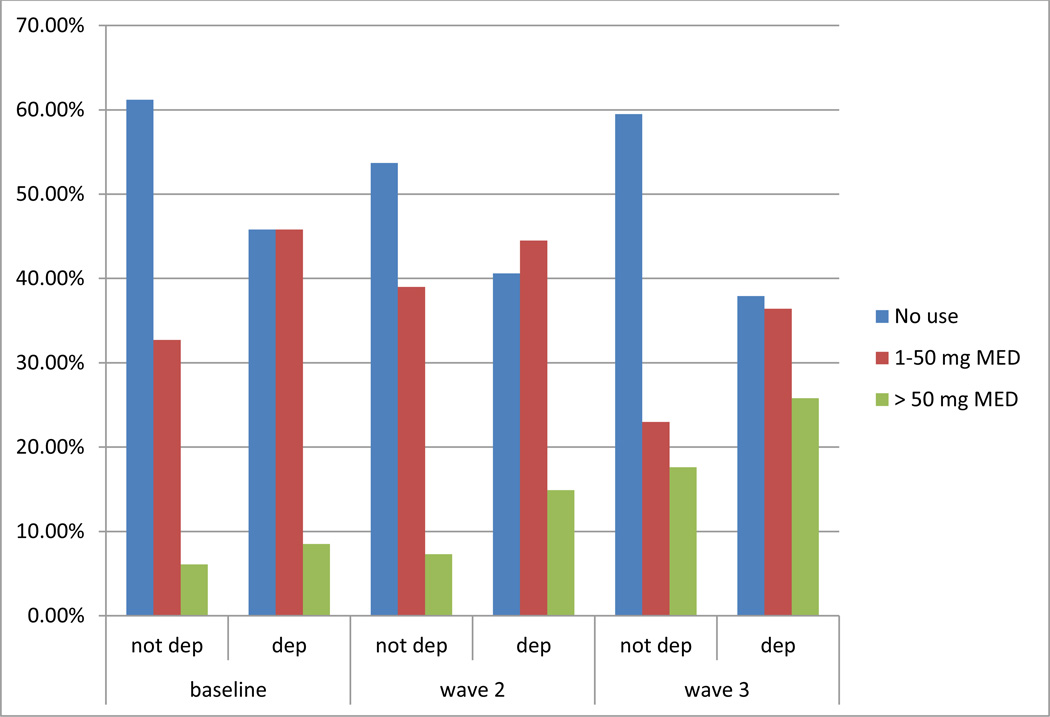
Depression is associated with receipt of higher doses of prescription opioids. It is not known whether the reverse association exists in that an increased opioid dose is associated with increased depression. Questionnaires were administered to 355 patients with chronic low back pain at baseline and 1-year and 2-year follow-up. Depression, pain, anxiety, health-related quality of life, and social support or stress were obtained by survey. Opioid type and dose and comorbid conditions were derived from chart abstraction. Random intercept, generalized linear mixed models were computed to estimate the association between change in opioid morphine equivalent dose (MED) thresholds (0, 1-50, >50 mg) and probability of depression over time. Second, we computed the association between change in depression and odds of an increasing MED over time. After adjusting for covariates, an increase to >50 mg MED from nonuse increased a participant's probability of depression over time (odds ratio [OR] = 2.65; 95% confidence interval [CI], 1.17-5.98). An increase to 1 to 50 mg MED did not increase an individual's probability of depression over time (OR = 1.08; 95% CI, 0.65-1.79). In unadjusted analysis, developing depression was associated with a 2.13 (95% CI, 1.36-3.36) increased odds of a higher MED. This association decreased after adjusting for all covariates (OR = 1.65; 95% CI, 0.97-2.81). Post hoc analysis revealed that depression was significantly associated with a 10.1-mg MED increase in fully adjusted models. Change to a higher MED leads to an increased risk of depression, and developing depression increases the likelihood of a higher MED. We speculate that treating depression or lowering MED may mitigate a bidirectional association and ultimately improve pain management.
Conflict of interest statement
The authors have no conflicts of interest involving the work under consideration for publication, relevant financial activities outside of the submitted work or other relationships or activities that give the appearance of potential conflicts of interest.
Figures
References
-
- IIfH Informatics, editor. The use of medicines in the United States: Review of 2010. 2011.
-
- Burge SK, White D, Bajorek E, Bazaldua O. Correlates of Medication Knowledge and Compliance: Findings from RRNeST. Fam Med. 2005;37(10):712–718. - PubMed
-
- Caudill-Slosberg MA, Schwartz LM, Woloshin S. Office visits and analgesic prescriptions for musculoskeletal pain in US: 1980 vs 2000. Pain. 2004;109:514–519. - PubMed
Publication types
MeSH terms
Substances
Grants and funding
LinkOut - more resources
Full Text Sources
Other Literature Sources
Medical
