


Factors associated with adoption of health information technology: a conceptual model based on a systematic review
- PMID: 25599673
- PMCID: PMC4288077
- DOI: 10.2196/medinform.3106
Factors associated with adoption of health information technology: a conceptual model based on a systematic review
Abstract
Background: The Health Information Technology for Economic and Clinical Health Act (HITECH) allocated $19.2 billion to incentivize adoption of the electronic health record (EHR). Since 2009, Meaningful Use Criteria have dominated information technology (IT) strategy. Health care organizations have struggled to meet expectations and avoid penalties to reimbursements from the Center for Medicare and Medicaid Services (CMS). Organizational theories attempt to explain factors that influence organizational change, and many theories address changes in organizational strategy. However, due to the complexities of the health care industry, existing organizational theories fall short of demonstrating association with significant health care IT implementations. There is no organizational theory for health care that identifies, groups, and analyzes both internal and external factors of influence for large health care IT implementations like adoption of the EHR.
Objective: The purpose of this systematic review is to identify a full-spectrum of both internal organizational and external environmental factors associated with the adoption of health information technology (HIT), specifically the EHR. The result is a conceptual model that is commensurate with the complexity of with the health care sector.
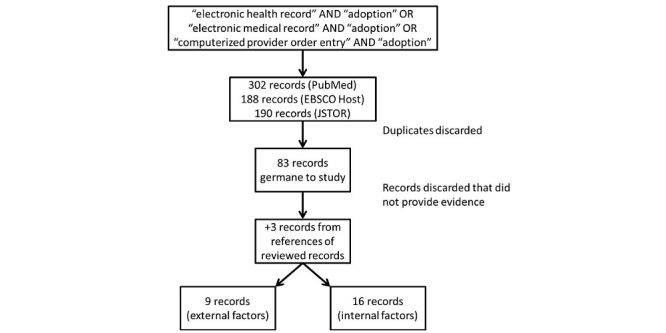
Methods: We performed a systematic literature search in PubMed (restricted to English), EBSCO Host, and Google Scholar for both empirical studies and theory-based writing from 1993-2013 that demonstrated association between influential factors and three modes of HIT: EHR, electronic medical record (EMR), and computerized provider order entry (CPOE). We also looked at published books on organizational theories. We made notes and noted trends on adoption factors. These factors were grouped as adoption factors associated with various versions of EHR adoption.
Results: The resulting conceptual model summarizes the diversity of independent variables (IVs) and dependent variables (DVs) used in articles, editorials, books, as well as quantitative and qualitative studies (n=83). As of 2009, only 16.30% (815/4999) of nonfederal, acute-care hospitals had adopted a fully interoperable EHR. From the 83 articles reviewed in this study, 16/83 (19%) identified internal organizational factors and 9/83 (11%) identified external environmental factors associated with adoption of the EHR, EMR, or CPOE. The conceptual model for EHR adoption associates each variable with the work that identified it.
Conclusions: Commonalities exist in the literature for internal organizational and external environmental factors associated with the adoption of the EHR and/or CPOE. The conceptual model for EHR adoption associates internal and external factors, specific to the health care industry, associated with adoption of the EHR. It becomes apparent that these factors have some level of association, but the association is not consistently calculated individually or in combination. To better understand effective adoption strategies, empirical studies should be performed from this conceptual model to quantify the positive or negative effect of each factor.
Keywords: adoption; computerized provider order entry (CPOE); electronic health record (EHR); electronic medical record (EMR); health information technology (HIT); medical information systems.
Conflict of interest statement
Conflicts of Interest: None declared.
Figures

References
-
- Health Information Technology for EconomicClinical Health Act, 42 U. C. [2014-03-18]. S http://www.healthit.gov/sites/default/files/hitech_act_excerpt_from_arra....
-
- Elnahal SM, Joynt KE, Bristol SJ, Jha AK. Electronic health record functions differ between best and worst hospitals. Am J Manag Care. 2011;17(4):e121–e147. http://www.ajmc.com/pubMed.php?pii=48688 - PMC - PubMed
-
- Song PH, McAlearney AS, Robbins J, McCullough JS. Exploring the business case for ambulatory electronic health record system adoption. J Healthc Manag. 2011;56(3):169–180; discussion 181. - PubMed
-
- Institute of Medicine Key Capabilities of an Electronic Health Record. 2003. [2014-03-20]. http://www.iom.edu/Reports/2003/Key-Capabilities-of-an-Electronic-Health....
-
- Hillestad R, Bigelow J, Bower A, Girosi F, Meili R, Scoville R, Taylor R. Can electronic medical record systems transform health care? Potential health benefits, savings, and costs. Health Aff (Millwood) 2005;24(5):1103–1117. doi: 10.1377/hlthaff.24.5.1103. http://content.healthaffairs.org/cgi/pmidlookup?view=long&pmid=16162551 - DOI - PubMed
Publication types
LinkOut - more resources
Full Text Sources
Other Literature Sources
Research Materials
