


Identifying Predictors of Longitudinal Decline in the Level of Medical Care Received by Adult Survivors of Childhood Cancer: A Report from the Childhood Cancer Survivor Study
- PMID: 25600956
- PMCID: PMC4545345
- DOI: 10.1111/1475-6773.12282
Identifying Predictors of Longitudinal Decline in the Level of Medical Care Received by Adult Survivors of Childhood Cancer: A Report from the Childhood Cancer Survivor Study
Abstract
Objectives: Characterize longitudinal changes in the use of medical care in adult survivors of childhood cancer.
Data sources: The Childhood Cancer Survivor Study, a retrospective cohort study of 5+ year survivors of childhood cancer.
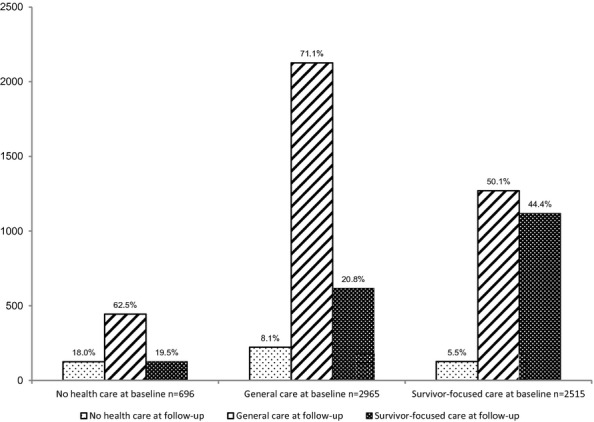
Study design: Medical care was assessed at entry into the cohort (baseline) and at most recent questionnaire completion. Care at each time point was classified as no care, general care, or survivor-focused care.
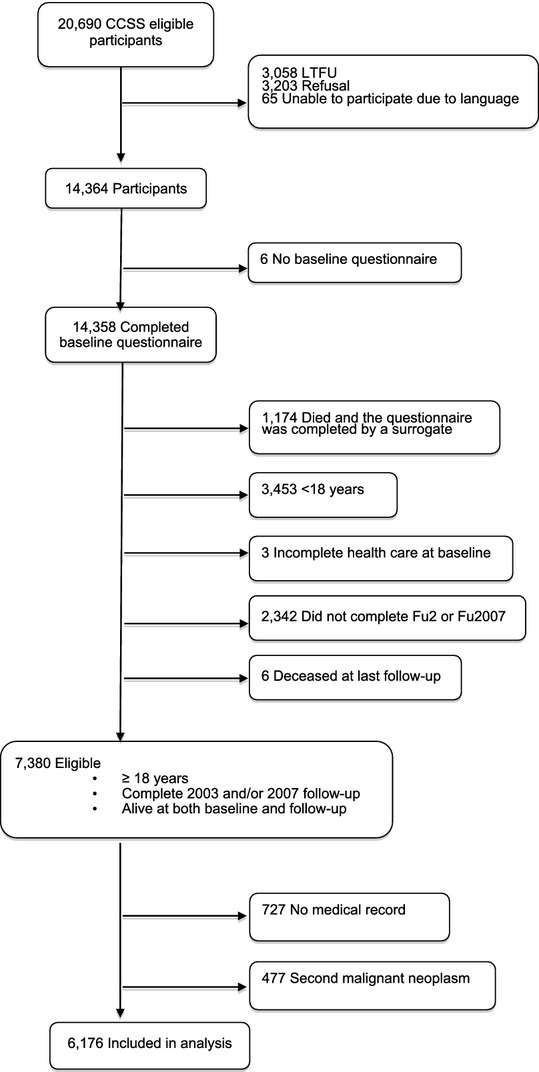
Data collection: There were 6,176 eligible survivors. Multivariable models evaluated risk factors for reporting survivor-focused care or general medical care at baseline and no care at follow-up; and survivor-focused care at baseline and general care at follow-up.
Principal findings: Males (RR, 2.3; 95 percent CI 1.8-2.9), earning <$20,000/year (RR, 1.6; 95 percent CI 1.2-2.3) or ≤ high school education (RR, 2.5; 95 percent CI 1.6-3.8 and RR 2.0; 95 percent CI 1.5-2.7 for <high school and high school, respectively) were associated with no care at follow-up. Survivors with severe or life-threatening conditions at baseline (RR 0.5; 95 percent CI 0.3-0.6) were less likely to report no care at follow-up.
Conclusions: While the incidence of late effects increases over time for survivors, the likelihood of receiving survivor-focused care decreases for vulnerable populations.
Keywords: Childhood cancer survivors; delivery of health care; health care access; health insurance; survivorship.
© Health Research and Educational Trust.
Figures
References
-
- American Academy of Pediatrics Section on Hematology/Oncology, & Children’s Oncology Group. Long-Term Follow-Up Care for Pediatric Cancer Survivors. Pediatrics. 2009;123(3):906–15. doi: 10.1542/peds.2008-3688. - DOI - PMC - PubMed
-
- American Cancer Society. 2008. “ Insurance and Cost-Related Barriers to Cancer Care: Cancer Facts and Figures 2008 ” [accessed on May 29, 2010]. Available at http://www.cancer.org/downloads/accesstocare/CFF2008_Special_Section.pdf.
-
- Armstrong GT, Liu Q, Yasui Y, Neglia JP, Leisenring W, Robison LL. Mertens AC. Late Mortality among 5-Year Survivors of Childhood Cancer: A Summary from the Childhood Cancer Survivor Study. Journal of Clinical Oncology. 2009;27(14):2328–38. doi: 10.1200/JCO.2008.21.1425. - DOI - PMC - PubMed
-
- Armstrong GT, Kawashima T, Leisenring W, Stratton K, Stovall M, Hudson MM. Oeffinger KC. Aging and Risk of Severe, Disabling, Life-Threatening, and Fatal Events in the Childhood Cancer Survivor Study. Journal of Clinical Oncology. 2014;32(12):1218–27. doi: 10.1200/JCO.2013.51.1055. - DOI - PMC - PubMed
-
- Blaauwbroek R, Tuinier W, Meyboom-de Jong B, Kamps WA. Postma A. Shared Care by Paediatric Oncologists and Family Doctors for Long-Term Follow-Up of Adult Childhood Cancer Survivors: A Pilot Study. The Lancet Oncology. 2008;9(3):232–8. doi: 10.1016/S1470-2045(08)70034-2. - DOI - PubMed
Publication types
MeSH terms
Grants and funding
LinkOut - more resources
Full Text Sources
Other Literature Sources
