Review
. 2015 Jan 5:5:672.
doi: 10.3389/fimmu.2014.00672. eCollection 2014.

Antigen Presentation by MHC-Dressed Cells

Affiliations
Review

Antigen Presentation by MHC-Dressed Cells

Masafumi Nakayama. Front Immunol. .

Abstract

Professional antigen-presenting cells (APCs) such as conventional dendritic cells (DCs) process protein antigens to MHC-bound peptides and then present the peptide-MHC complexes to T cells. In addition to this canonical antigen presentation pathway, recent studies have revealed that DCs and non-APCs can acquire MHC class I (MHCI) and/or MHC class II (MHCII) from neighboring cells through a process of cell-cell contact-dependent membrane transfer called trogocytosis. These MHC-dressed cells subsequently activate or regulate T cells via the preformed antigen peptide-MHC complexes without requiring any further processing. In addition to trogocytosis, intercellular transfer of MHCI and MHCII can be mediated by secretion of membrane vesicles such as exosomes from APCs, generating MHC-dressed cells. This review focuses on the physiological role of antigen presentation by MHCI- or MHCII-dressed cells, and also discusses differences and similarities between trogocytosis and exosome-mediated transfer of MHC.

Keywords: MHC; dressing; exosomes; intercellular communication; trogocytosis.


Figures
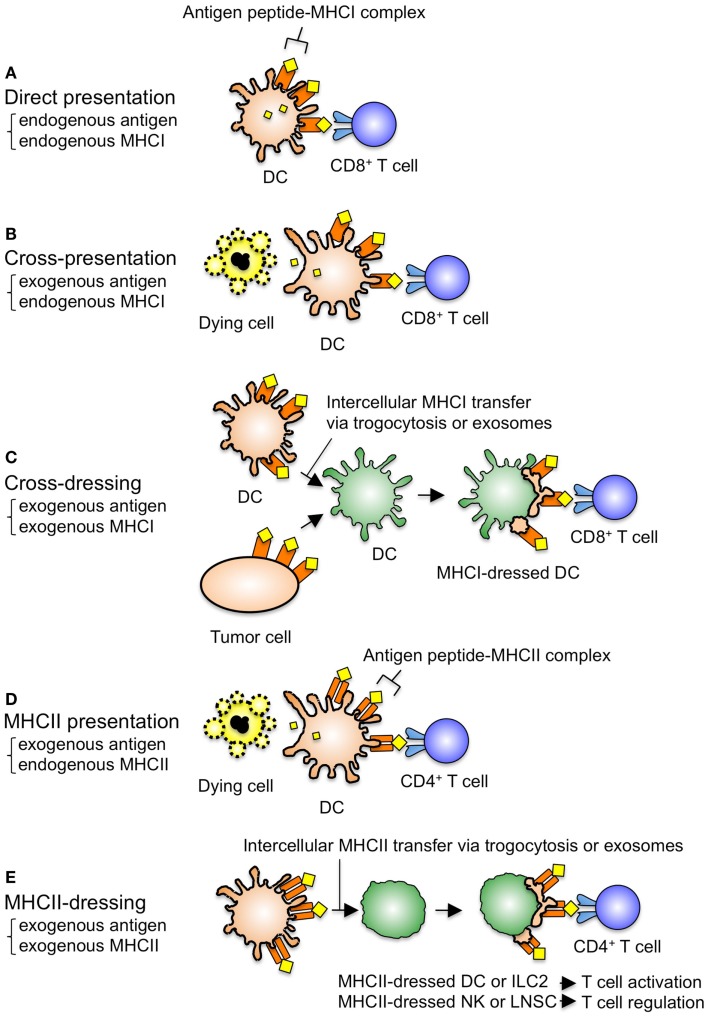
Figure 1
Figure 1
Canonical and non-canonical antigen presentation pathways. (A) When DCs are virally infected, these DCs present the endogenous viral antigens on the endogenous MHCI molecules to CD8+ T cells. (B) When certain DC subsets such as mouse CD8α+ DCs and human BDCA3+ DCs engulf dying cells, these DCs can present the exogenous antigens on the endogenous MHCI molecules to CD8+ T cells, which is called cross-presentation. (C) When DCs acquire the exogenous antigen–MHCI complexes from neighboring DCs and/or tumor cells, these DCs activate CD8+ T cells via the dressed MHCI without requiring processing, which is called cross-dressing. (D) When DCs engulf dying cells, these DCs present the exogenous antigens on the endogenous MHCII molecules to CD4+ T cells. This is the normal presentation of exogenous antigens. (E) When DCs or ILC2s expressing co-stimulatory molecules acquire the exogenous antigen–MHCII complexes from neighboring DCs, these MHCII-dressed cells induce CD4+ T cell activation. On the contrary, when NK cells or LNSCs not expressing co-stimulatory molecules acquire the exogenous antigen–MHCII complexes from neighboring DCs, these MHCII-dressed cells suppress CD4+ T cell activation. Intercellular MHC transfer is mediated via trogocytosis and/or exosomes. Trogocytosis is defined as an intercellular transfer of plasma membrane fragments that occurs rapidly (within minutes) in a cell–cell contact-dependent manner. Exosomes can be transferred at a distance and diffuse slowly (over several hours).

References

    1. Cone RE, Sprent J, Marchalonis JJ. Antigen-binding specificity of isolated cell-surface immunoglobulin from thymus cells activated to histocompatibility antigens. Proc Natl Acad Sci U S A (1972) 69:2556–60. 10.1073/pnas.69.9.2556 - DOI - PMC - PubMed
    1. Huang JF, Yang Y, Sepulveda H, Shi W, Hwang I, Peterson PA, et al. TCR-mediated internalization of peptide-MHC complexes acquired by T cells. Science (1999) 286:952–4. 10.1126/science.286.5441.952 - DOI - PubMed
    1. Hwang I, Huang JF, Kishimoto H, Brunmark A, Peterson PA, Jackson MR, et al. T cells can use either T cell receptor or CD28 receptors to absorb and internalize cell surface molecules derived from antigen-presenting cells. J Exp Med (2000) 191:1137–48. 10.1084/jem.191.7.1137 - DOI - PMC - PubMed
    1. Trambas CM, Griffiths GM. Delivering the kiss of death. Nat Immunol (2003) 4:399–403 10.1038/ni0503-399 - DOI - PubMed
    1. Sprent J. Swapping molecules during cell-cell interactions. Sci STKE (2005) 2005:e8. 10.1126/stke.2732005pe8 - DOI - PubMed
