


Interferon-α and angiogenic dysregulation in pregnant lupus patients who develop preeclampsia
- PMID: 25603823
- PMCID: PMC4380868
- DOI: 10.1002/art.39029
Interferon-α and angiogenic dysregulation in pregnant lupus patients who develop preeclampsia
Abstract
Objective: To investigate whether an elevated interferon-α (IFNα) level early in pregnancy is associated with poor pregnancy outcomes and to examine the relationship of an elevated IFNα level to angiogenic imbalance.
Methods: Women were enrolled in a longitudinal case-control study of pregnant patients with lupus. Serum samples obtained monthly throughout pregnancy were assayed for IFNα and for the antiangiogenic factor soluble Flt-1 and the proangiogenic factor placenta growth factor (PlGF). Each of 28 patients with systemic lupus erythematosus (SLE) with a poor pregnancy outcome was matched to an SLE patient with an uncomplicated pregnancy and to a pregnant healthy control. The effects of IFNα and/or soluble Flt-1 on human endothelial cells and endothelial cell-trophoblast interactions were assessed.
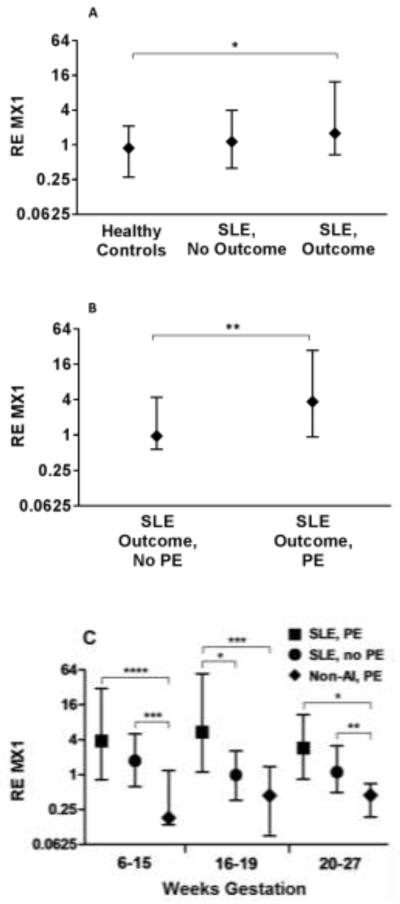
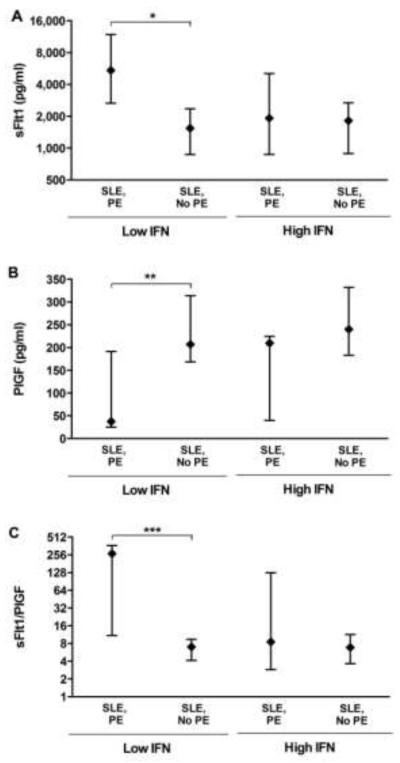
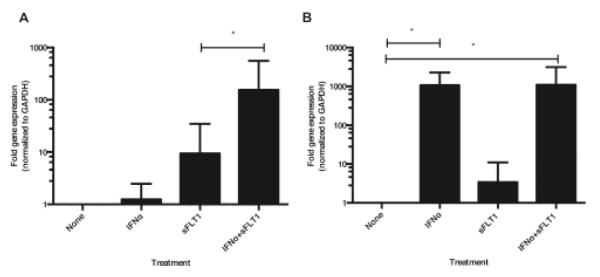
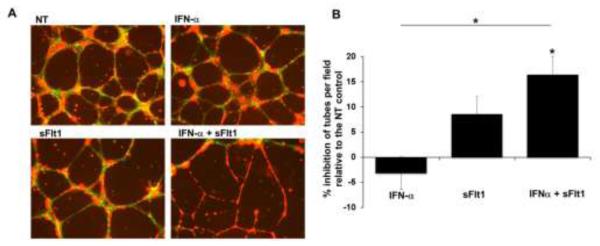
Results: Compared to SLE patients with uncomplicated pregnancies, patients with preeclampsia had increased IFNα levels before clinical symptoms. Patients without autoimmune disease who developed preeclampsia did not have increased IFNα levels. In SLE patients with low IFNα levels, marked angiogenic imbalance (higher soluble Flt-1, lower PlGF, and higher soluble Flt-1:PlGF ratios) preceded maternal manifestations of preeclampsia, whereas in SLE patients with high IFNα levels, preeclampsia occurred without evidence of systemic angiogenic imbalance. Treatment of human endothelial cells with soluble Flt-1 induced expression of sFLT1 messenger RNA, and IFNα dramatically amplified responses to soluble Flt-1. In a model of spiral artery transformation, only the combination of IFNα and soluble Flt-1 disrupted the ability of trophoblast cells to remodel endothelial tube structures.
Conclusion: Our findings identify a new mechanism by which IFNα induces an antiangiogenic milieu and increases the sensitivity of endothelial cells to soluble Flt-1, and suggest that elevated IFNα levels may contribute to the pathogenesis of preeclampsia in some pregnant patients with SLE.
Trial registration: ClinicalTrials.gov NCT00198068.
Copyright © 2015 by the American College of Rheumatology.
Figures

Comment in
-
Editorial: "Interfering" with preeclampsia.Arthritis Rheumatol. 2015 Apr;67(4):862-4. doi: 10.1002/art.39028. Arthritis Rheumatol. 2015. PMID: 25605672 No abstract available.
References
-
- Petri M, Allbritton J. Fetal outcome of lupus pregnancy: a retrospective case-control study of the Hopkins Lupus Cohort. The Journal of rheumatology. 1993;20(4):650–6. - PubMed
-
- Georgiou PE, Politi EN, Katsimbri P, Sakka V, Drosos AA. Outcome of lupus pregnancy: a controlled study. Rheumatology (Oxford) 2000;39(9):1014–9. - PubMed
-
- Lam C, Lim KH, Karumanchi SA. Circulating angiogenic factors in the pathogenesis and prediction of preeclampsia. Hypertension. 2005;46(5):1077–85. - PubMed
-
- Ferrara N, Gerber HP, LeCouter J. The biology of VEGF and its receptors. Nat Med. 2003;9(6):669–76. - PubMed
Publication types
MeSH terms
Substances
Associated data
Grants and funding
LinkOut - more resources
Full Text Sources
Other Literature Sources
Medical
