


Guideline-concordant lung cancer care and associated health outcomes among elderly patients in the United States
- PMID: 25604094
- PMCID: PMC4450093
- DOI: 10.1016/j.jgo.2015.01.001
Guideline-concordant lung cancer care and associated health outcomes among elderly patients in the United States
Abstract
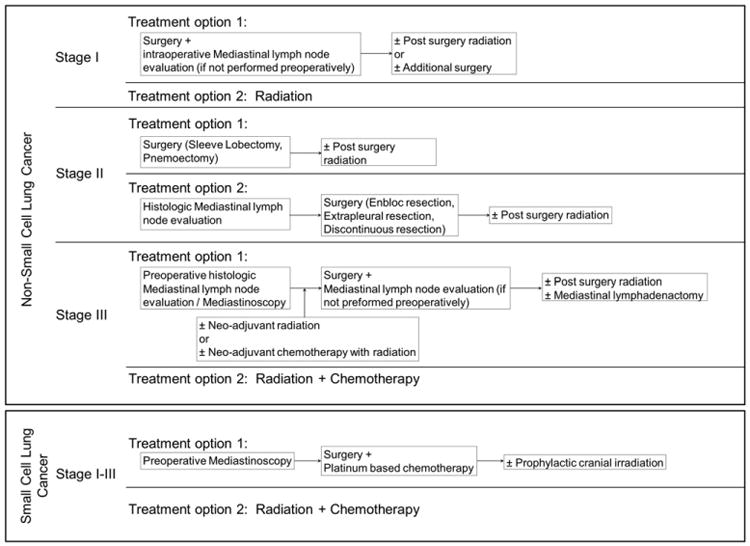
Objectives: In the United States (US), the elderly carry a disproportionate burden of lung cancer. Although evidence-based guidelines for lung cancer care have been published, lack of high quality care still remains a concern among the elderly. This study comprehensively evaluates the variations in guideline-concordant lung cancer care among elderly in the US.
Materials and methods: Using the Surveillance, Epidemiology, and End Results (SEER)-Medicare database (2002-2007), we identified elderly patients (aged ≥65 years) with lung cancer (n = 42,323) and categorized them by receipt of guideline-concordant care, using evidence-based guidelines from the American College of Chest Physicians. A hierarchical generalized logistic model was constructed to identify variables associated with receipt of guideline-concordant care. Kaplan-Meier analysis and Log Rank test were used for estimation and comparison of the three-year survival. Multivariate Cox proportional hazards model was constructed to estimate lung cancer mortality risk associated with receipt of guideline-discordant care.
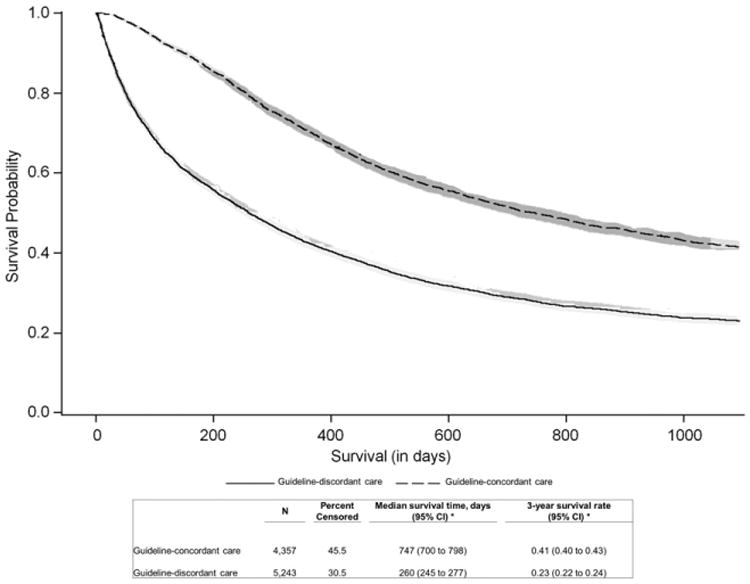
Results: Only less than half of all patients (44.7%) received guideline-concordant care in the study population. The likelihood of receiving guideline-concordant care significantly decreased with increasing age, non-white race, higher comorbidity score, and lower income. Three-year median survival time significantly increased (exceeded 487 days) in patients receiving guideline-concordant care. Adjusted lung cancer mortality risk significantly increased by 91% (HR = 1.91, 95% CI: 1.82-2.00) among patients receiving guideline-discordant care.
Conclusion: This study highlights the critical need to address disparities in receipt of guideline-concordant lung cancer care among elderly. Although lung cancer diagnostic and management services are covered under the Medicare program, underutilization of these services is a concern.
Keywords: Cancer; Disparities; Elderly; Guidelines; Lung; Medicare; Treatment.
Copyright © 2015 Elsevier Inc. All rights reserved.
Conflict of interest statement
Figures
References
-
- U.S. National Institutes of Health. National Cancer Institute. SEER Cancer Statistics Review, 1973–2008. [Accessed on: October 1, 2014]; Available at, http://seer.cancer.gov/csr/1975_2009_pops09/index.html.
-
- Day JC. Population Projections of the United States by Age, Sex, Race, and Hispanic Origin: 1995–2050. US Bureau of the Census, Current Population Reports; Washington, DC: 1996. pp. 25–1130.
-
- Pfister DG, Johnson DH, Azzoli CG, Sause W, Smith TJ, Baker S, et al. American Society of Clinical Oncology treatment of unresectable non-small-cell lung cancer guideline: update 2003. J Clin Oncol. 2004 Jan 15;22(2):330–353. - PubMed
-
- Diagnosis and management of lung cancer: Chest. 1 Suppl. Vol. 123. American College of Chest Physicians; Jan, 2003. ACCP evidence-based guidelines; p. D-337S. - PubMed
-
- Clinical practice guidelines for the treatment of unresectable non-small-cell lung cancer. J Clin Oncol. 1997 Aug;15(8):2996–3018. Adopted on May 16, 1997 by the American Society of Clinical Oncology. - PubMed
Publication types
MeSH terms
Grants and funding
LinkOut - more resources
Full Text Sources
Other Literature Sources
Medical
