


Type VI Collagen Regulates Pericellular Matrix Properties, Chondrocyte Swelling, and Mechanotransduction in Mouse Articular Cartilage
- PMID: 25604429
- PMCID: PMC4414817
- DOI: 10.1002/art.39034
Type VI Collagen Regulates Pericellular Matrix Properties, Chondrocyte Swelling, and Mechanotransduction in Mouse Articular Cartilage
Abstract
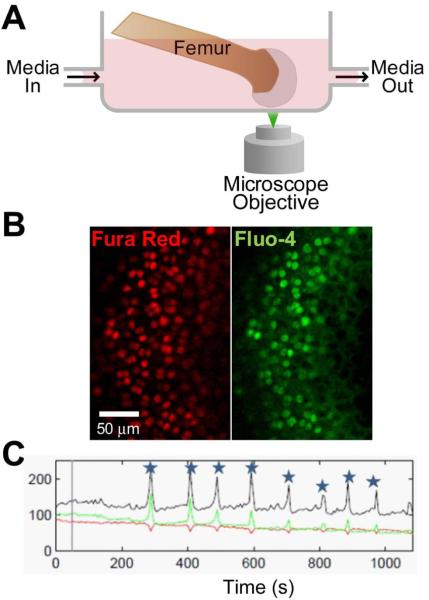
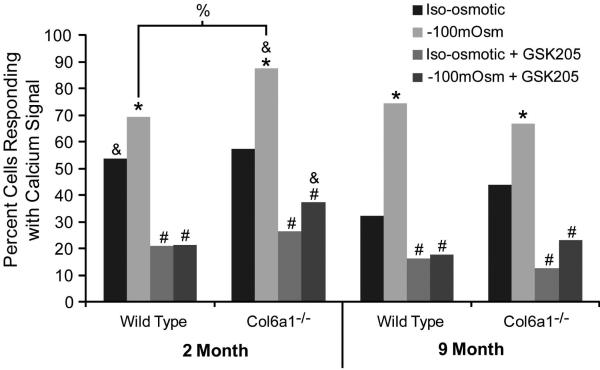
Objective: Mechanical factors play a critical role in the physiology and pathology of articular cartilage, although the mechanisms of mechanical signal transduction are not fully understood. We undertook this study to test the hypothesis that type VI collagen is necessary for mechanotransduction in articular cartilage by determining the effects of type VI collagen knockout on the activation of the mechano-osmosensitive, calcium-permeable channel TRPV4 (transient receptor potential vanilloid channel 4) as well as on osmotically induced chondrocyte swelling and pericellular matrix (PCM) mechanical properties.
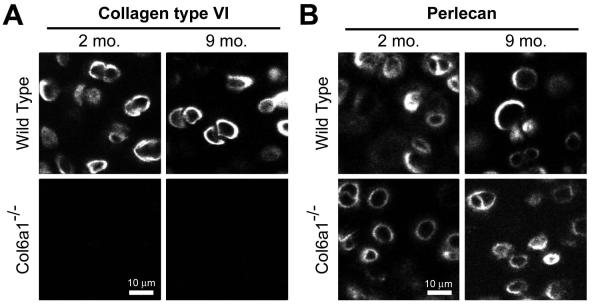
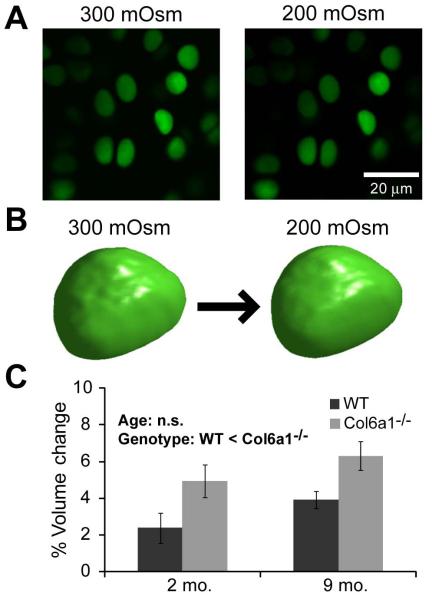
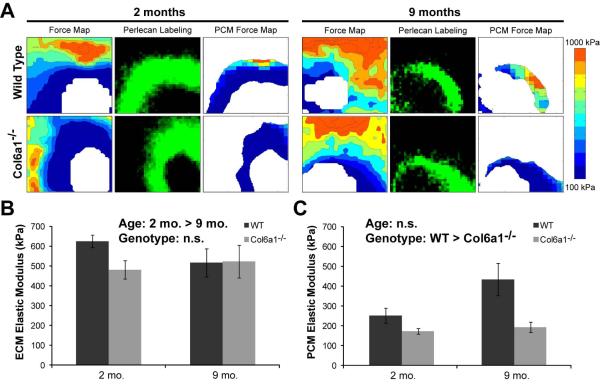
Methods: Confocal laser scanning microscopy was used to image TRPV4-mediated calcium signaling and osmotically induced cell swelling in intact femora from 2- and 9-month-old wild-type (WT) and type VI collagen-deficient (Col6a1(-/-)) mice. Immunofluorescence-guided atomic force microscopy was used to map PCM mechanical properties based on the presence of perlecan.
Results: Hypo-osmotic stress-induced TRPV4-mediated calcium signaling was increased in Col6a1(-/-) mice relative to WT controls at 2 months. Col6a1(-/-) mice exhibited significantly increased osmotically induced cell swelling and decreased PCM moduli relative to WT controls at both ages.
Conclusion: In contrast to our original hypothesis, type VI collagen was not required for TRPV4-mediated Ca(2+) signaling; however, knockout of type VI collagen altered the mechanical properties of the PCM, which in turn increased the extent of cell swelling and osmotically induced TRPV4 signaling in an age-dependent manner. These findings emphasize the role of the PCM as a transducer of mechanical and physicochemical signals, and they suggest that alterations in PCM properties, as may occur with aging or osteoarthritis, can influence mechanotransduction via TRPV4 or other ion channels.
© 2015, American College of Rheumatology.
Figures
References
-
- Turkiewicz A, Petersson IF, Bjork J, Hawker G, Dahlberg LE, Lohmander LS, et al. Current and future impact of osteoarthritis on health care: a population-based study with projections to year 2032. Osteoarth Cartilage. 2014;22(11):1826–32. - PubMed
-
- Helminen H, Jurvelin J, Kiviranta I, Paukkonen K, Saamanen A, Tammi M. Joint loading effects on articular cartilage: A historical review. In: Helminen HJ, Kiviranta I, Tammi M, Saamanen AM, K P, Jurvelin J, editors. Joint Loading: Biology and Health of Articular Structures. Wright and Sons; Bristol: 1987. pp. 1–46.
-
- Lohmander LS, Englund PM, Dahl LL, Roos EM. The long-term consequence of anterior cruciate ligament and meniscus injuries: osteoarthritis. Am J Sports Med. 2007;35(10):1756–69. - PubMed
-
- Leroux MA, Cheung HS, Bau JL, Wang JY, Howell DS, Setton LA. Altered mechanics and histomorphometry of canine tibial cartilage following joint immobilization. Osteoarth Cartilage. 2001;9(7):633–40. - PubMed
Publication types
MeSH terms
Substances
Grants and funding
LinkOut - more resources
Full Text Sources
Other Literature Sources
Molecular Biology Databases
Miscellaneous
