


Measuring naturally acquired ex vivo IFN-γ responses to Plasmodium falciparum cell-traversal protein for ookinetes and sporozoites (CelTOS) in Ghanaian adults
- PMID: 25604473
- PMCID: PMC4308902
- DOI: 10.1186/s12936-014-0539-5
Measuring naturally acquired ex vivo IFN-γ responses to Plasmodium falciparum cell-traversal protein for ookinetes and sporozoites (CelTOS) in Ghanaian adults
Abstract
Background: A malaria vaccine that targets the sporozoite/liver stage parasites could potentially prevent blood stage infection and the associated clinical symptoms. Identification of sporozoite/liver stage antigens is, therefore, crucial for the development of effective vaccines. Cell-traversal protein for ookinetes and sporozoites (CelTOS) is a highly conserved antigen involved in sporozoite motility and hepatocyte invasion and has been shown to induce significant IFN-γ production in PBMCs from radiation-attenuated sporozoite-immunized malaria-naïve individuals. The aim of this study was to ascertain whether such CelTOS-specific recall responses are also induced in individuals with natural exposure to Plasmodium falciparum.
Methods: Ex vivo IFN-γ responses to 15mer overlapping peptide pools covering the entire sequence of CelTOS and five other candidate antigens, CSP, AMA1, MSP1, TRAP and LSA1, were characterized using PBMCs from 35 malaria exposed adults. Responses to four CelTOS peptide pools (CelTp1, CelTp2, CelTp3 and CelTp4), a pool containing peptides from the entire CelTOS antigen (CelTTp), and pools comprised of overlapping peptides from each of the other five malaria antigens were assessed by ex vivo ELISpot assay. A positive IFN-γ response for stimulants was defined by two criteria; a stimulation index of two or greater relative to the unstimulated control, and a difference of 10 or greater in spot forming cells between stimulant and the unstimulated control.
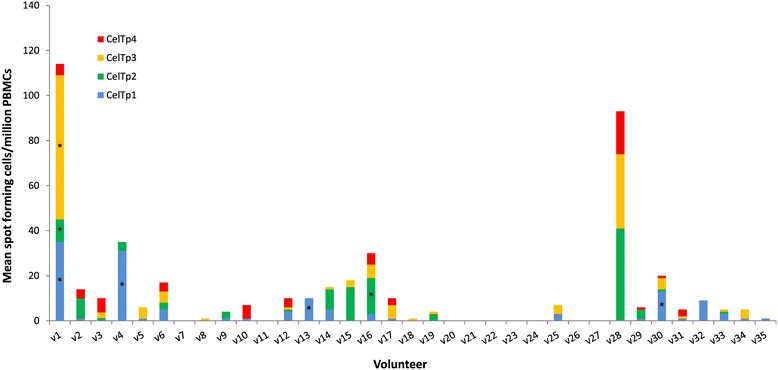
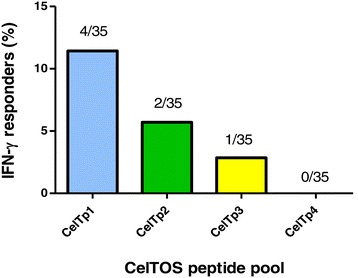
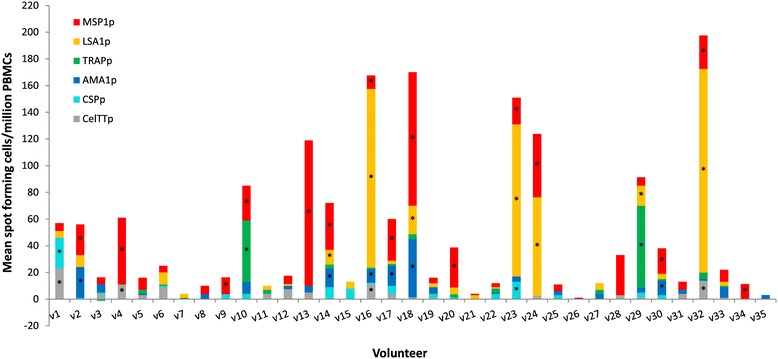
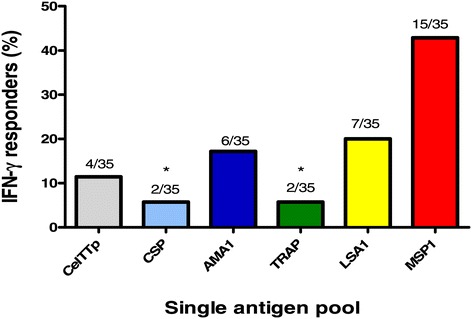
Results: Of the 35 volunteers tested, five had positive IFN-γ recall responses against the four different CelTOS pools while four volunteers made responses against the CelTTp pool; six volunteers were, therefore, positive with CelTOS. By contrast, six volunteers responded to AMA1, seven to LSA1, 15 to MSP1 and two volunteers responded against CSP and TRAP.
Conclusions: These results suggest natural malaria transmission induces CelTOS-specific ex vivo IFN-γ in Ghanaian adults and that the frequency of these responses was similar to those of other previously characterized malaria antigens. These findings support the further evaluation of CelTOS as a pre-erythrocytic candidate antigen for inclusion in a potential multi-antigen vaccine.
Figures
References
-
- WHO . World Malaria Report. Geneva: World Health Organization; 2013.
-
- Clyde DF. Immunization of man against falciparum and vivax malaria by use of attenuated sporozoites. Am J Trop Med Hyg. 1975;24:397–401. - PubMed
Publication types
MeSH terms
Substances
Grants and funding
LinkOut - more resources
Full Text Sources
Other Literature Sources
