Review
. 2015 Feb;129(2):183-206.
doi: 10.1007/s00401-015-1386-3. Epub 2015 Jan 22.

Amyloid β oligomers in Alzheimer's disease pathogenesis, treatment, and diagnosis

Affiliations
Review

Amyloid β oligomers in Alzheimer's disease pathogenesis, treatment, and diagnosis

Kirsten L Viola et al. Acta Neuropathol. 2015 Feb.

Abstract

Protein aggregation is common to dozens of diseases including prionoses, diabetes, Parkinson's and Alzheimer's. Over the past 15 years, there has been a paradigm shift in understanding the structural basis for these proteinopathies. Precedent for this shift has come from investigation of soluble Aβ oligomers (AβOs), toxins now widely regarded as instigating neuron damage leading to Alzheimer's dementia. Toxic AβOs accumulate in AD brain and constitute long-lived alternatives to the disease-defining Aβ fibrils deposited in amyloid plaques. Key experiments using fibril-free AβO solutions demonstrated that while Aβ is essential for memory loss, the fibrillar Aβ in amyloid deposits is not the agent. The AD-like cellular pathologies induced by AβOs suggest their impact provides a unifying mechanism for AD pathogenesis, explaining why early stage disease is specific for memory and accounting for major facets of AD neuropathology. Alternative ideas for triggering mechanisms are being actively investigated. Some research favors insertion of AβOs into membrane, while other evidence supports ligand-like accumulation at particular synapses. Over a dozen candidate toxin receptors have been proposed. AβO binding triggers a redistribution of critical synaptic proteins and induces hyperactivity in metabotropic and ionotropic glutamate receptors. This leads to Ca(2+) overload and instigates major facets of AD neuropathology, including tau hyperphosphorylation, insulin resistance, oxidative stress, and synapse loss. Because different species of AβOs have been identified, a remaining question is which oligomer is the major pathogenic culprit. The possibility has been raised that more than one species plays a role. Despite some key unknowns, the clinical relevance of AβOs has been established, and new studies are beginning to point to co-morbidities such as diabetes and hypercholesterolemia as etiological factors. Because pathogenic AβOs appear early in the disease, they offer appealing targets for therapeutics and diagnostics. Promising therapeutic strategies include use of CNS insulin signaling enhancers to protect against the presence of toxins and elimination of the toxins through use of highly specific AβO antibodies. An AD-dependent accumulation of AβOs in CSF suggests their potential use as biomarkers and new AβO probes are opening the door to brain imaging. Overall, current evidence indicates that Aβ oligomers provide a substantive molecular basis for the cause, treatment and diagnosis of Alzheimer's disease.


Figures

Fig. 1
Fig. 1
Aβ oligomers (AβOs) instigate neuron damage in Alzheimer’s disease. a Oligomeric Aβ, rather than insoluble amyloid species, instigates neuron damage in AD (adapted from the “2004/2005 Progress Report on Alzheimer’s disease” Health and Human Services). b AD-associated changes attributed to AβOs
Fig. 2
Fig. 2
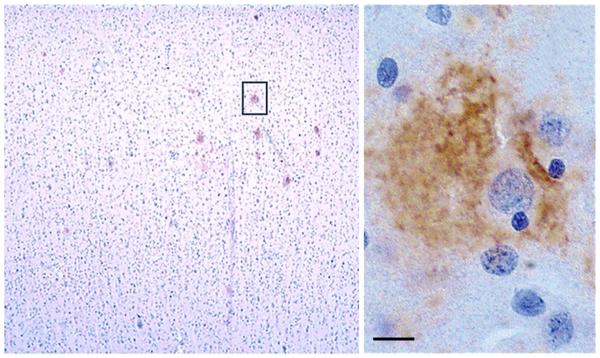
Perisomatic AβOs consistent with synapse binding are present early in human neuropathology. Left Low magnification of human cortical brain section stained with an anti-oligomer antibody. Scattered individual neurons are surrounded by AβOs in early AD, before the appearance of amyloid plaques. The perineuronal distribution of these AβOs (right) is consistent with a binding site within the dendritic arbor. Scale bar 10 µm. Adapted from Lacor et al. [91]
Fig. 3
Fig. 3
Dysfunctional insulin signaling induced by AβOs provides one link to AD etiology. Diabetes causes a reduction in brain insulin and brain insulin signaling as well as an increase in glucose and lipids. This leads to an increase in Aβ production and a reduction in AβO clearance, causing a buildup of oligomers in the brain. As AβO levels rise, they bind synapses and cause neuronal damage, resulting in a decrease in insulin receptors and further reducing insulin signaling in brain cells. This vicious cycle results in cognitive failure and AD
Fig. 4
Fig. 4
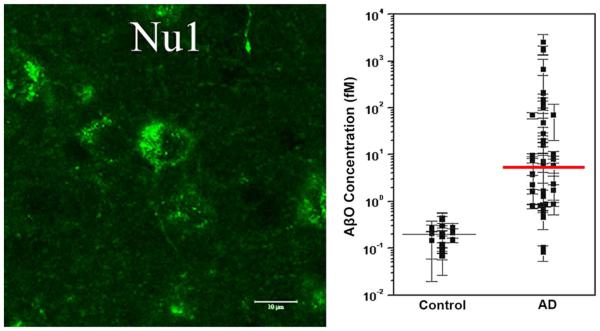
AβOs can accumulate in intracellular and extracellular pools. Intracellular AβOs are detectable in animal models overproducing APP and Aβ; however, the presence of extracellular AβOs on dendrites and in CSF suggests they are also important in AD. Left A representative micrograph of confocal fluorescence labeling of amyloid-β peptide (Aβ)-oligomer-specific antibody NU1 immunoreaction in young, pre-plaque Tg mice shows intracellular localization of AβOs. Adapted from Ferretti et al. [40]. Right A scatter plot from the ultrasensitive scanometric detection of AβOs in cerebrospinal fluid. Adapted from Georganopoulou et al. [45]. The response for the negative human control subject (brain extract) was similar to that observed for the chip control. The data points are averages of several separate experiments normalized for each assay based on the highest response in a series of runs. The mean values for ADDL concentrations (solid lines) are estimated for each group based on a calibration curve
Fig. 5
Fig. 5
Synthetic and brain-derived AβOs are ligands that target synapses. AβOs extracted from AD brain or prepared in vitro show punctate binding to neuronal cell surface proteins. Cultured hippocampal neurons were incubated with synthetic AβOs or soluble extracts of human brain. Binding was visualized by immunofluorescence microscopy by using a polyclonal anti-Aβ oligomer antibody, M93. Synthetic AβOs (Left), soluble extracts of non-AD control brains (Center), and soluble AD-brain extracts (Right) are shown. Small puncta, bound largely along neurites, are evident for AD extracts and synthetic AβOs but not for control extracts. Bar 10 µm. Adapted from Gong et al. [47]
Fig. 6
Fig. 6
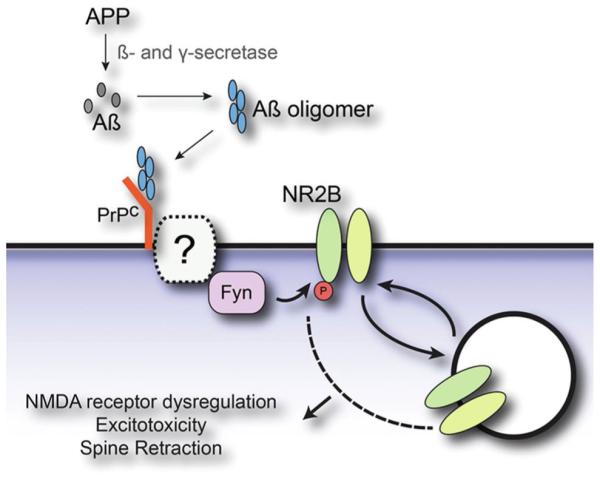
Model for Aβ oligomer-induced synaptic dysfunction involving PrPc and Fyn. Extracellular Aβ monomer, produced through cleavage of the amyloid precursor protein (APP) by both β- and γ-secretase, assembles into toxic Aβ oligomers. These AβOs bind to cellular prion protein (PrPC) and activate Fyn tyrosine kinase, possibly through a yet to be identified transmembrane protein. AβO activation of Fyn signaling drives the tyrosine phosphorylation of NMDA receptors, which in turn produces altered surface expression, dysregulation of receptor function, excitotoxicity and dendritic spine retraction. Adapted from Um and Strittmatter [170]
Fig. 7
Fig. 7
A surfeit of toxin receptor candidates. Provided is a current list of candidate Aβ/Aβ oligomer receptors that have been proposed over the last 20 years. No single candidate has been shown to be necessary and sufficient to account for all aspects of AβO binding and toxicity
Fig. 8
Fig. 8
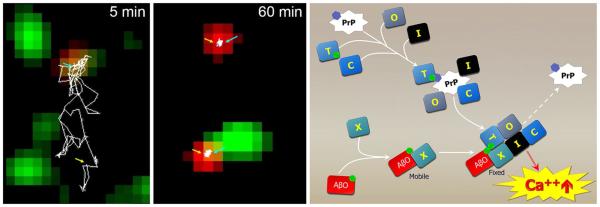
Single molecule trafficking shows AβOs stop diffusion of mGluR5 and “highjack” membrane proteins that can lead to elevated Ca2+. Left panels Dual-color single-particle tracking was used to monitor mGluR5 (red) and biotin-AβO (green) diffusion at syn- apses over time. Following the tracings of mGluR5, mGluR5 diffuses together with an AβO (5 min) outside synapses before both become stabilized at a synaptic site (60 min). Adapted from Renner et al. [143]. Right Clustering of membrane proteins, possibly involving PrPc, leads to AβO binding recruitment and membrane receptor reorganization that instigates toxic signaling. AβO binding to an unidentified receptor, X, and the recruitment of effector protein co-receptors leads to hyperactive Ca2+ signaling and downstream toxicity
Fig. 9
Fig. 9
AβOs cause pathological tau redistribution. AβOs (ADDLs) induce missorting of Tau and neurofilaments into the somatodendritic compartment of primary hippocampal neurons that suggests a mechanism for AD nerve cell death. Left, top There is no colocalization of Tau and MAP2 in vehicle-treated control cells. Tau is predominantly localized to the axonal compartment (antibody K9JA—green), while MAP2 is localized to the somatodendritic compartment (antibody AP20—red). Left, bottom In ADDL-treated cells (5 μM for 3 h), Tau is redistributed into soma and dendrites (green), where it colocalizes with MAP2 (red). Arrows indicate colocalization of MAP2 and Tau. Adapted from Zempel et al. [191]. Right Data suggest a mechanism for AD neuronal cell death that involves AβO-induced breakdown of Tau sorting and neuronal polarity. Aβ induces missorting of Tau, which in turn leads to a loss of microtubules, impaired trafficking (e.g., of mitochondria), and loss of spines, ultimately leading to neuronal death. Adapted from Zempel and Mandelkow [190]
Fig. 10
Fig. 10
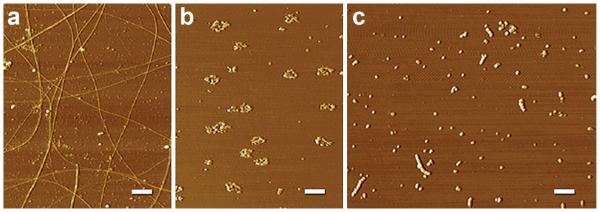
Diverse structural outcomes from different aggregation protocols. AFM images revealing a spectrum of Aβ structures are shown. a Fibrils: Aβ1–42 aged in ddH2O for one week contains periodic and smooth fibrils throughout the field of diverse sizes and lengths. b Rings: Aβ1–42 aged in F12 at 37 °C for 24 h and not centrifuged contains many ring-like structures and a few short linear protofibrils. c AβOs/protofibrils: Aβ1–42 aged in PBS for 48 h at RT contains many linear protofibrillar structures and small, spherical structures. Protofibrillar structures appear to contain bead-by-bead assemblies of multiple globular structures. The results suggest that temperature and chemical environment are critical during Aβ aggregation. Scale bar 400 nm. From Chromy et al. [16]
Fig. 11
Fig. 11
Capture of receptors for Aβ oligomers in nanodiscs and a high-throughput assay to screen for unknown therapeutic targets. Top Schematic of Nanodisc formation using synaptic plasma membranes. Each Nanodisc consists of a discoidal lipid bilayer stabilized by artificial membrane scaffold proteins (MSP) with His tags. A small fraction of the population contains AβO-binding proteins. His tags on Nanodiscs and biotin on AβOs provide a means for conducting binding assays. Bottom Aurin tricarboxylic acid (ATA) potently reduces synaptic AβO accumulation in culture. ATA was assayed at 1 µM for a preventative effect on AβO accumulation at synapses in cultured rat hippocampal neurons. Images shown are of typical neurons after treatment with AβOs (left panel) or AβOs following ATA pre-treatment (right panel). AβOs are shown in green, neurons identified by β3 tubulin fluorescence are white, and DAPI is blue to indicate nuclei. Selected neurites are enlarged below each image to illustrate the distribution of bound AβO. Scale bar 10 µm. Adapted from Wilcox et al. [180]
Fig. 12
Fig. 12
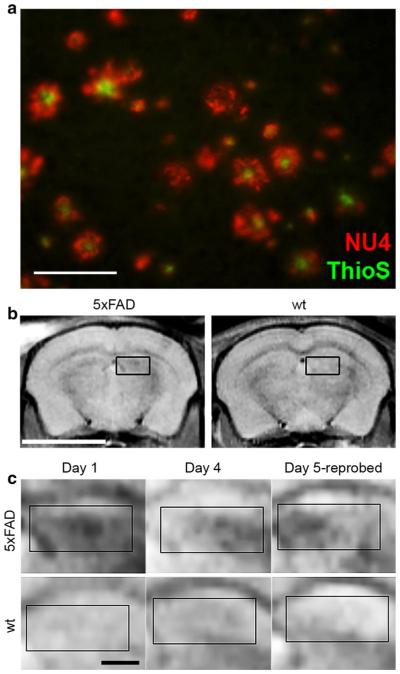
Diagnostic assays for Aβ oligomer levels provide AβO-relevant MRI signals in brain. a Sagittal brain sections, 50 µm thick, from 8-month-old 5xFAD and wt mice were probed with 568-NU4 and counterstained with Thioflavin S. Image shows a 5xFAD cortical region stained with both NU4 (red) and thioflavin S (green). NU4 labeling is more abundant than the ThioS staining. Findings demonstrate that NU4 labeling is often associated with, yet distinct from, amyloid plaques. Scale 25 µm. b In vivo imaging of NU4MNS distribution in live mice 4 h after intranasal inoculation shows labeling by the probe in the hippocampal region of the Tg mice, but not the wt controls. Scale bar 5 mm. c Higher magnification of the hippocampal region of the Tg and wt mice shows probe distribution 4 h after inoculation, the changes in distribution 96 h later, and the distribution of the target after re-administering the probe on Day 5. Data suggest that non oligomer-associated probe is clearing the brain. Scale bar 1 mm. Adapted from Viola et al. [174]

References

    1. Adolfsson O, Pihlgren M, Toni N, Varisco Y, Buccarello AL, Antoniello K, Lohmann S, Piorkowska K, Gafner V, Atwal JK, Maloney J, Chen M, Gogineni A, Weimer RM, Mortensen DL, Friesenhahn M, Ho C, Paul R, Pfeifer A, Muhs A, Watts RJ. An effector-reduced anti-beta-amyloid (Abeta) antibody with unique abeta binding properties promotes neuroprotection and glial engulfment of Abeta. J Neurosci Off J Soc Neurosci. 2012;32(28):9677–9689. doi:10.1523/jneurosci.4742-11.2012. - PMC - PubMed
    1. Aggarwal BB, Gupta SC, Sung B. Curcumin: an orally bioavailable blocker of TNF and other pro-inflammatory biomarkers. Br J Pharmacol. 2013;169(8):1672–1692. doi:10.1111/ bph.12131. - PMC - PubMed
    1. Arispe N. Architecture of the Alzheimer’s A beta P ion channel pore. J Membr Biol. 2004;197(1):33–48. doi:10.1007/ s00232-003-0638-7. - PubMed
    1. Bartl J, Meyer A, Brendler S, Riederer P, Grunblatt E. Different effects of soluble and aggregated amyloid beta42 on gene/protein expression and enzyme activity involved in insulin and APP pathways. J Neural Trans Vienna Austria 1996. 2013;120(1):113–120. doi:10.1007/s00702-012-0852-5. - PubMed
    1. Benilova I, Karran E, De Strooper B. The toxic Abeta oligomer and Alzheimer’s disease: an emperor in need of clothes. Nat Neurosci. 2012;15(3):349–357. doi:10.1038/nn.3028. - PubMed

Publication types

Substances