


Medulloblastoma subgroup-specific outcomes in irradiated children: who are the true high-risk patients?
- PMID: 25605817
- PMCID: PMC4724171
- DOI: 10.1093/neuonc/nou357
Medulloblastoma subgroup-specific outcomes in irradiated children: who are the true high-risk patients?
Abstract
Background: The advent of integrated genomics has fundamentally changed our understanding of medulloblastoma. Although survival differences exist among the 4 principal subgroups, this has yet to be elucidated in a North American cohort of irradiated patients.
Methods: Ninety-two consecutive patients between the ages of 3 and 17 treated with surgery, craniospinal irradiation, and chemotherapy were identified at the Hospital for Sick Children. Molecular subgrouping was performed using nanoString.
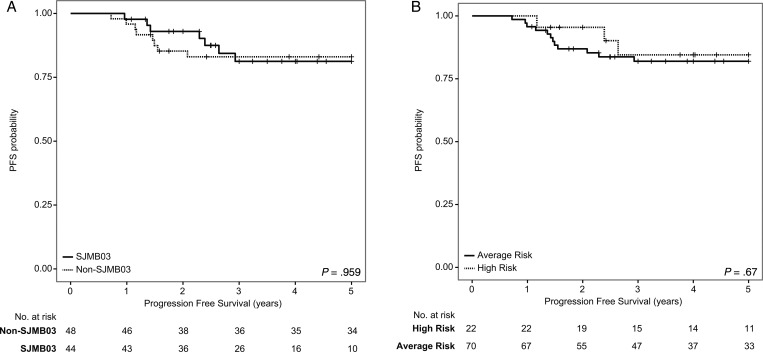
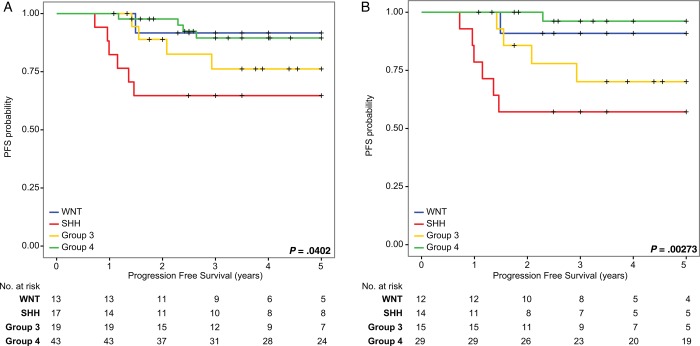
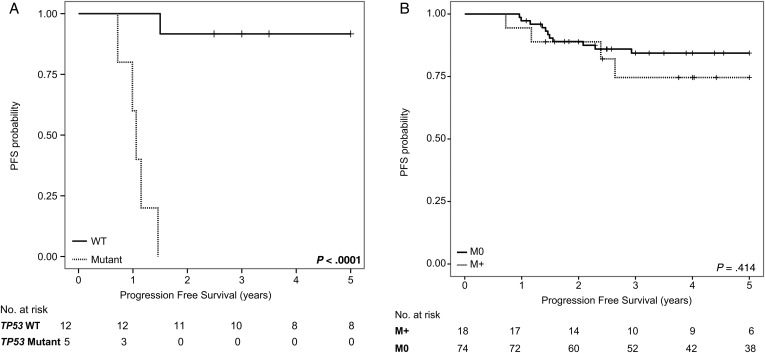
Results: Two treatment periods were identified: prior to 2006 as per the protocols of the Children's Oncology Group, and after 2006 per the St Jude Medulloblastoma 03 protocol. Five-year progression-free survival (PFS) over the entire cohort was 0.801 (95% CI: 0.692-0.875) with no significant difference between treatment protocols. Strikingly, we found that Group 4 patients had excellent 5-year PFS of 0.959 (95% CI: 0.744-0.994) for average risk and 0.887 (95% CI: 0.727-0.956) across all Group 4 patients. Group 3 patients had 5-year PFS of 0.733 (95% CI: 0.436-0.891). Sonic hedgehog patients did poorly across both treatment protocols, with 5-year PFS of 0.613 (95% CI: 0.333-0.804), likely owing to a high proportion of TP53 mutated patients in this age group.
Conclusions: In a cohort of irradiated patients over 3 years of age, PFS for Group 4 patients was significantly improved compared with initial reports. The impact of subgroup affiliation in these children needs to be assessed in large prospectively treated cooperative protocols to determine if more than just WNT patients can be safely selected for de-escalation of therapy.
Keywords: chemotherapy; medulloblastoma; radiation; subgroups.
© The Author(s) 2015. Published by Oxford University Press on behalf of the Society for Neuro-Oncology. All rights reserved. For permissions, please e-mail: journals.permissions@oup.com.
Figures
References
-
- Ramaswamy V, Northcott PA, Taylor MD. FISH and chips: the recipe for improved prognostication and outcomes for children with medulloblastoma. Cancer genetics. 2011;204(11):577–588. - PubMed
-
- Packer RJ, Gajjar A, Vezina G, et al. Phase III study of craniospinal radiation therapy followed by adjuvant chemotherapy for newly diagnosed average-risk medulloblastoma. J Clin Oncol. 2006;24(25):4202–4208. - PubMed
-
- Gajjar A, Chintagumpala M, Ashley D, et al. Risk-adapted craniospinal radiotherapy followed by high-dose chemotherapy and stem-cell rescue in children with newly diagnosed medulloblastoma (St Jude Medulloblastoma-96): long-term results from a prospective, multicentre trial. Lancet Oncol. 2006;7(10):813–820. - PubMed
Publication types
MeSH terms
Grants and funding
LinkOut - more resources
Full Text Sources
Other Literature Sources
Research Materials
Miscellaneous
