


Utility of early screening magnetic resonance imaging for extensive hip osteonecrosis in pediatric patients treated with glucocorticoids
- PMID: 25605853
- PMCID: PMC4322260
- DOI: 10.1200/JCO.2014.57.5480
Utility of early screening magnetic resonance imaging for extensive hip osteonecrosis in pediatric patients treated with glucocorticoids
Abstract
Purpose: Hip osteonecrosis frequently complicates treatment with glucocorticoids. When extensive (affecting ≥ 30% of the epiphyseal surface), 80% of joints collapse within 2 years, so interventions are needed to prevent this outcome.
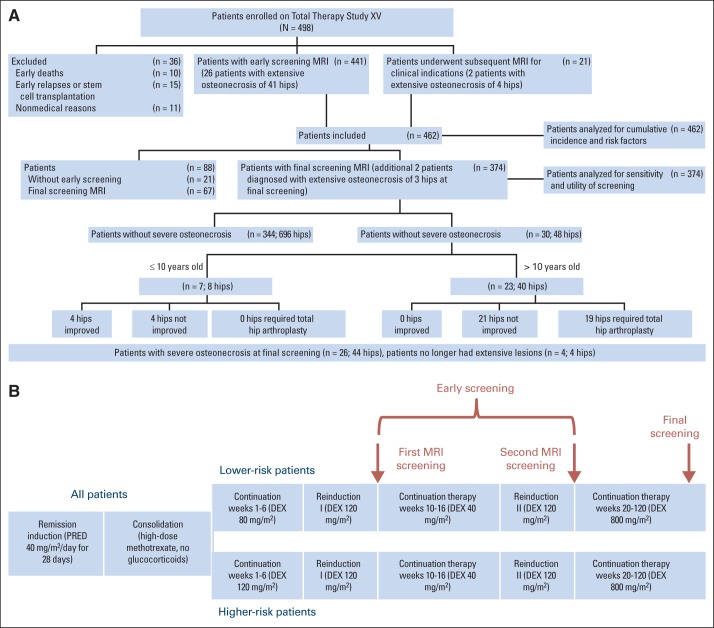
Patients and methods: This prospective cohort magnetic resonance imaging (MRI) screening study included all consecutive children treated for acute lymphoblastic leukemia on a single protocol. Hip MRI was performed at 6.5 and 9 months from diagnosis (early screening) and at completion of chemotherapy (final evaluation) to determine whether screening could identify extensive hip osteonecrosis before symptom development.
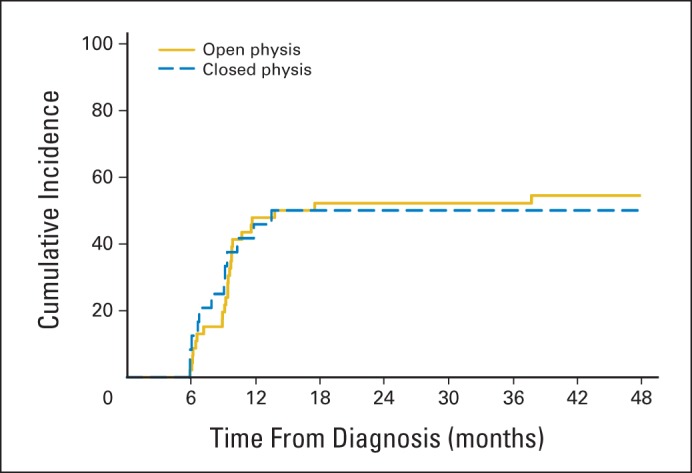
Results: Of 498 patients, 462 underwent screening MRI. Extensive asymptomatic osteonecrosis was identified by early screening in 26 patients (41 hips); another four patients (seven hips) were detected after the screening period, such that screening sensitivity was 84.1% and specificity was 99.4%. The number of joints screened to detect one lesion was 20.1 joints for all patients, 4.4 joints for patients older than 10 years, and 198 joints for patients ≤ 10 years old (P < .001). Of the 40 extensive lesions in patients older than 10 years, 19 required total hip arthroplasty and none improved. Of eight extensive lesions in younger patients, none required arthroplasty and four improved.
Conclusion: In patients age 10 years old or younger who require prolonged glucocorticoid therapy, screening for extensive hip osteonecrosis is unnecessary because their risk is low and lesions tend to heal. In children older than 10 years, early screening successfully identifies extensive asymptomatic lesions in patients who would be eligible for studies of interventions to prevent or delay joint collapse.
Trial registration: ClinicalTrials.gov NCT00137111.
© 2015 by American Society of Clinical Oncology.
Conflict of interest statement
Authors' disclosures of potential conflicts of interest are found in the article online at
Figures
References
-
- Okazaki S, Nagoya S, Yamamoto M, et al. High risk of osteonecrosis of the femoral head in autoimmune disease patients showing no immediate increase in hepatic enzyme under steroid therapy. Rheumatol Int. 2013;33:51–55. - PubMed
-
- Schroer WC. Current concepts on the pathogenesis of osteonecrosis of the femoral head. Orthop Rev. 1994;23:487–497. - PubMed
-
- Bürger B, Beier R, Zimmermann M, et al. Osteonecrosis: A treatment related toxicity in childhood acute lymphoblastic leukemia (ALL)—Experiences from trial ALL-BFM 95. Pediatr Blood Cancer. 2005;44:220–225. - PubMed
Publication types
MeSH terms
Substances
Associated data
Grants and funding
LinkOut - more resources
Full Text Sources
Medical
