


Nociceptive neurons detect cytokines in arthritis
- PMID: 25606597
- PMCID: PMC4289196
- DOI: 10.1186/s13075-014-0470-8
Nociceptive neurons detect cytokines in arthritis
Abstract
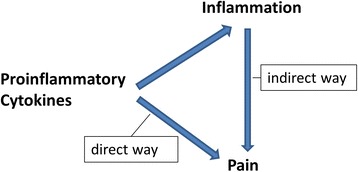
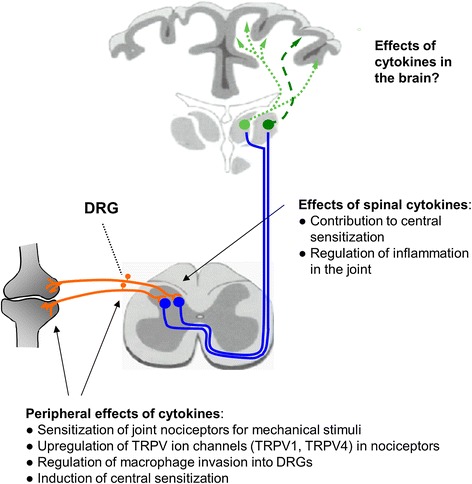
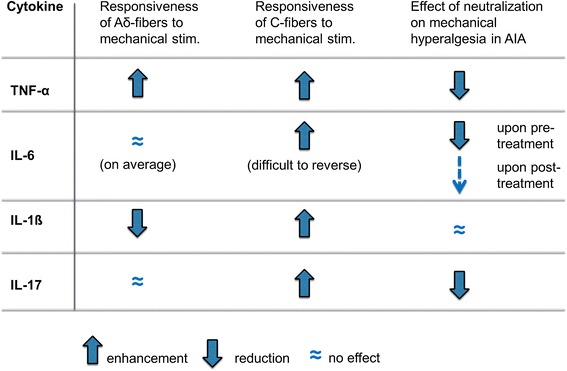
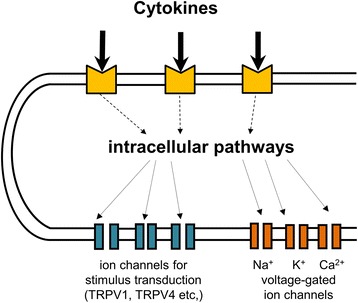
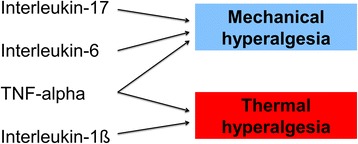
Proinflammatory cytokines are major mediators in the pathogenesis of diseases of joints such as rheumatoid arthritis and osteoarthritis. This review emphasizes that proinflammatory cytokines such as tumor necrosis factor-alpha, interleukin-1 beta, interleukin-6 and interleukin-17 are also mediators of pain by directly acting on the nociceptive system. Proportions of nociceptive sensory neurons express receptors for these cytokines, and the application of cytokines rapidly changes the excitability, ion currents and second messenger systems of these neurons. By inducing persistent sensitization of nociceptive sensory neurons (C- and a proportion of Aδ-fibers) for mechanical stimuli in the joint (a process called peripheral sensitization), these cytokines significantly contribute to the persistent hyperalgesia typical for many disease states of the joint. In addition, the disease-associated release of cytokines in the spinal cord supports the generation of central sensitization. The therapeutic neutralization of proinflammatory cytokines thus not only reduces the process of inflammation but may directly reduce hyperalgesia and pain by reversing the neuronal effects of cytokines. It is emerging that different cytokines have different actions on neurons. The neutralization of tumor necrosis factor-alpha reduces both mechanical and thermal hyperalgesia of the joint. The neutralization of interleukin-1 beta attenuates thermal hyperalgesia whereas the neutralization of interleukin-6 and interleukin-17 mainly reduces mechanical hyperalgesia. These different effects are partly explained by influencing different target molecules in sensory neurons. For example, in cultured sensory neurons tumor necrosis factor-alpha and interleukin-1 beta upregulate the TRPV1 ion channel, which is involved in the transduction of heat stimuli, consistent with an effect of these cytokines in thermal hyperalgesia. By contrast, interleukin-17 upregulates the TRPV4 ion channel, which has a role in the transduction of mechanical stimuli. Thus, the analgesic potential of neutralizing cytokines seems to depend on which cytokine is mainly involved in the particular pain state.
Figures
References
-
- Boettger MK, Hensellek S, Richter F, Gajda M, Stöckigt R, Segond von Banchet G, Bräuer R, Schaible HG. Antinociceptive effects of tumor necrosis factor alpha neutralization in a rat model of antigen-induced arthritis: evidence of a neuronal target. Arthritis Rheum. 2008;58:2368–2378. doi: 10.1002/art.23608. - DOI - PubMed
-
- Hess A, Axmann R, Rech J, Finzel S, Heindl C, Kreitz S, Sergeeva M, Saake M, Garcia M, Kollias G, Straub RH, Sporns O, Doerfler A, Brune K, Schett G. Blockade of TNF-α rapidly inhibits pain responses in the central nervous system. Proc Natl Acad Sci U S A. 2011;108:3731–3736. doi: 10.1073/pnas.1011774108. - DOI - PMC - PubMed
Publication types
MeSH terms
Substances
LinkOut - more resources
Full Text Sources
Other Literature Sources
Medical
