Ineffectiveness of using the pressure relief valve technique during cuff inflation
- PMID: 25607265
- PMCID: PMC4304464
- DOI: 10.5935/0103-507X.20140056
Ineffectiveness of using the pressure relief valve technique during cuff inflation
Abstract
Objective: To test the effectiveness of using a cuff pressure relief valve technique to maintain cuff pressure levels within the normal in vitro range (Phase 1) in patients admitted to the intensive care unit (Phase 2) and to test the reproducibility of the technique using different syringes.
Methods: In Phase 1, a tracheal tube was inserted into a trachea model. Ten- and 20mL syringes were used to inflate the cuff through the tracheal tube. The cuff was slowly and steadily inflated until the syringe plunger would move in the opposite direction of the application. After the plunger stopped, the cuff pressures were recorded. In Phase 2, the same maneuvers for inflating the cuff were performed on 20 patients using 5, 10, and 20mL syringes and were compared with manometer measurements. The intraclass correlation coefficient and Bland-Altman analysis were employed to determine the reproducibility and agreement between syringes. Data were expressed as medians (interquartile range).
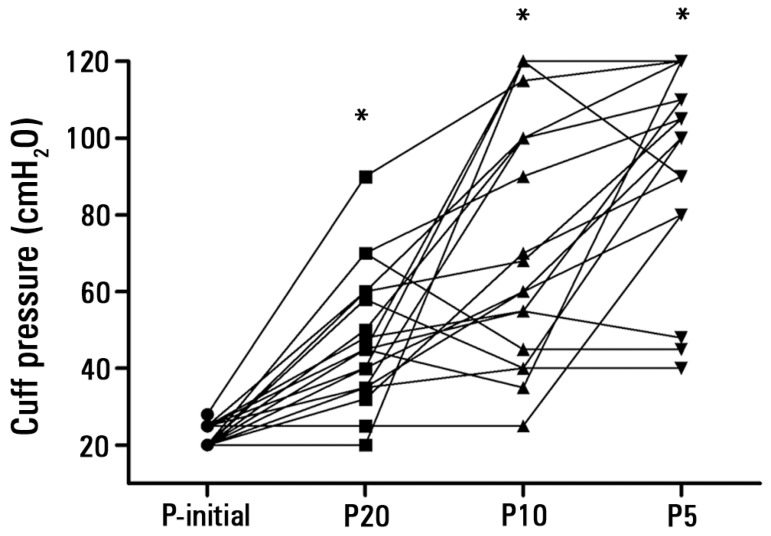
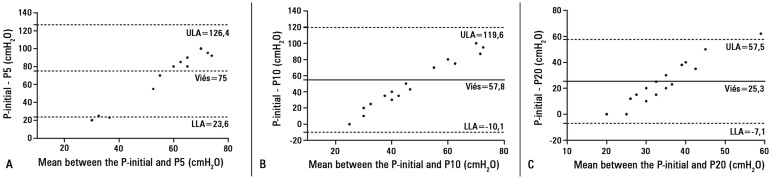
Results: There was no reproducibility between syringes with an intraclass correlation coefficient ranging between -0.33 and 0.8 (p>0.05). The pressures generated with the syringes were higher than the pressures generated using a standard manometer: the 5mL syringe pressure was 105cmH2O (82.5-120cmH2O), the 10mL syringe pressure was 69cmH2O (47.5-111.3cmH2O), and the 20mL syringe pressure was 45cmH2O (35-59.5cmH2O). The Bland-Altman analysis confirmed the large bias and variability between the syringes used, compared with the manometer.
Conclusion: The use of syringes is not an effective technique for determining the cuff pressure in patients admitted to the intensive care unit.
Objetivo: Testar a eficácia da técnica de alívio de pressão de cuff por meio de uma válvula em manter níveis de pressão de cuff dentro da normalidade in vitro (Fase 1) e em pacientes internados em unidade de terapia intensiva (Fase 2), bem como testar a reprodutibilidade da técnica utilizando diferentes seringas.
Métodos: Na Fase 1, uma cânula orotraqueal foi inserida em um modelo de traqueia. Seringas de 10 e 20mL foram utilizadas para insuflar o cuff da cânula. O cuff foi insuflado lenta e progressivamente até que o êmbolo da seringa se deslocasse em direção contrária da aplicação. Após a pausa do êmbolo, as pressões do balonete foram registradas. Na Fase 2, a mesma manobra de insuflação do cuff foi realizada em 20 pacientes, utilizando-se seringas de 5, 10 e 20mL, e foi comparada com as medidas de um manômetro. O índice de correlação intraclasse e a análise de Bland-Altman foram realizados para verificar a reprodutibilidade e a concordância entre as seringas. Os dados foram expressos como mediana (intervalo interquartil).
Resultados: A reprodutibilidade entre as seringas foi nula, com índice de correlação intraclasse variando entre -0,33 e 0,8 (p>0,05). As pressões geradas com as seringas foram superiores à pressão obtida com o manômetro padrão: seringa de 5mL teve 105cmH2O (82,5-120cmH2O); seringa de 10mL teve 69cmH2O (47,5-111,3cmH2O) e seringa de 20mL teve 45cmH2O (35-59,5cmH2O). O teste de Bland-Altman verificou grandes vieses e variabilidade entre as seringas utilizadas, quando estas foram comparadas ao manômetro.
Conclusão: O uso de seringas não é eficaz em determinar valores de pressão de cuff seguros em pacientes internados em unidade de terapia intensiva.
Conflict of interest statement
Figures
References
-
- Rello J, Soñora R, Jubert P, Artigas A, Rué M, Vallés J. Pneumonia in intubated patients: role of respiratory airway care. Am J Respir Crit Care Med. 1996;154(1):111–115. - PubMed
-
- Barbosa PM, Santos BM. Alterações morfológicas em traqueias de pacientes intubados em função do tempo de intubação. Rev Latinoam Enferm. 2003;11(6):727–733. - PubMed
-
- Curiel García JA, Guerrero-Romero F, Rodríguez-Morán M. Cuff pressure in endotracheal intubation: should it be routinely measured? Gac Med Mex. 2001;137(2):179–182. Spanish. - PubMed
-
- Castilho EC, Braz JR, Catâneo AJ, Martins RH, Gregório EA, Monteiro ER. Efeitos da pressão limite (25cmH2O) e mínima de “selo” do balonete de tubos traqueais sobre a mucosa traqueal do cão. Rev Bras Anestesiol. 2003;53(6):743–755. - PubMed
Publication types
MeSH terms
LinkOut - more resources
Full Text Sources
Other Literature Sources