


Amphetamine-type stimulants and HIV infection among men who have sex with men: implications on HIV research and prevention from a systematic review and meta-analysis
- PMID: 25609214
- PMCID: PMC4302169
- DOI: 10.7448/IAS.18.1.19273
Amphetamine-type stimulants and HIV infection among men who have sex with men: implications on HIV research and prevention from a systematic review and meta-analysis
Abstract
Introduction: HIV infections and the use of amphetamine-type stimulants (ATS) among men who have sex with men (MSM) have been increasing internationally, but the role of ATS use as a co-factor for HIV infection remains unclear. We aimed to summarize the association between ATS use and HIV infection among MSM.
Methods: We conducted a systematic search of MEDLINE, EMBASE, GLOBAL HEALTH and PsycINFO for relevant English, peer-reviewed articles of quantitative studies published between 1980 and 25 April 2013. Pooled estimates of the association--prevalence rate ratios (PRR, cross-sectional studies), odds ratio (OR, case-control studies) and hazard ratio (HR, longitudinal studies), with 95% Confidence Intervals (CI)--were calculated using random-effects models stratified by study design and ATS group (meth/amphetamines vs. ecstasy). We assessed the existence of publication bias in funnel plots and checked for sources of heterogeneity using meta-regression and subgroup analysis.
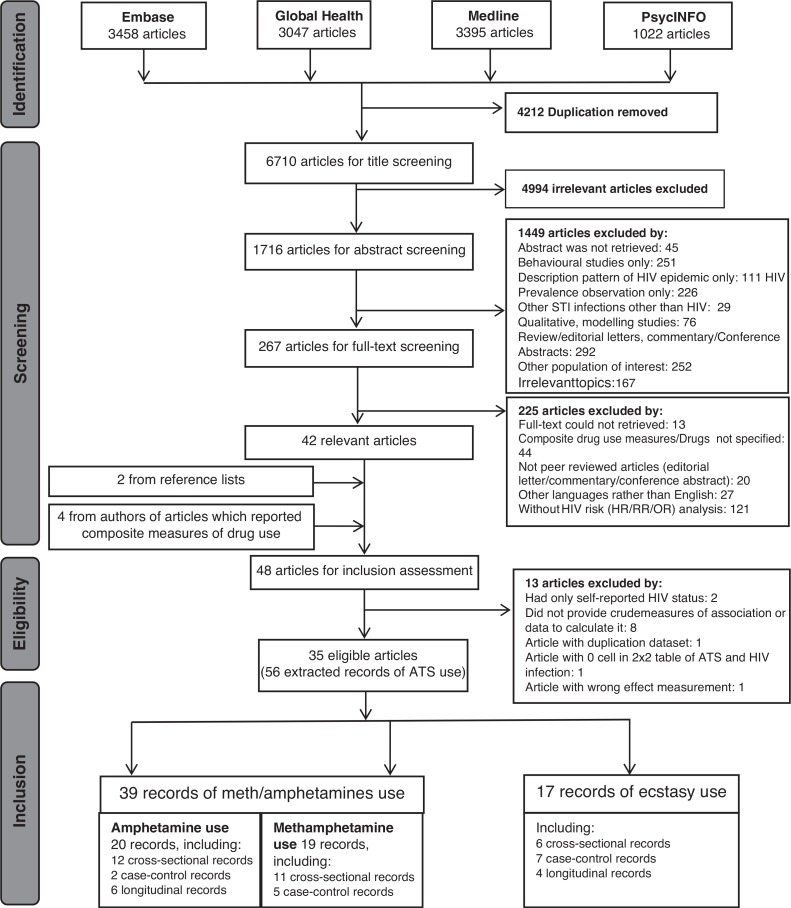
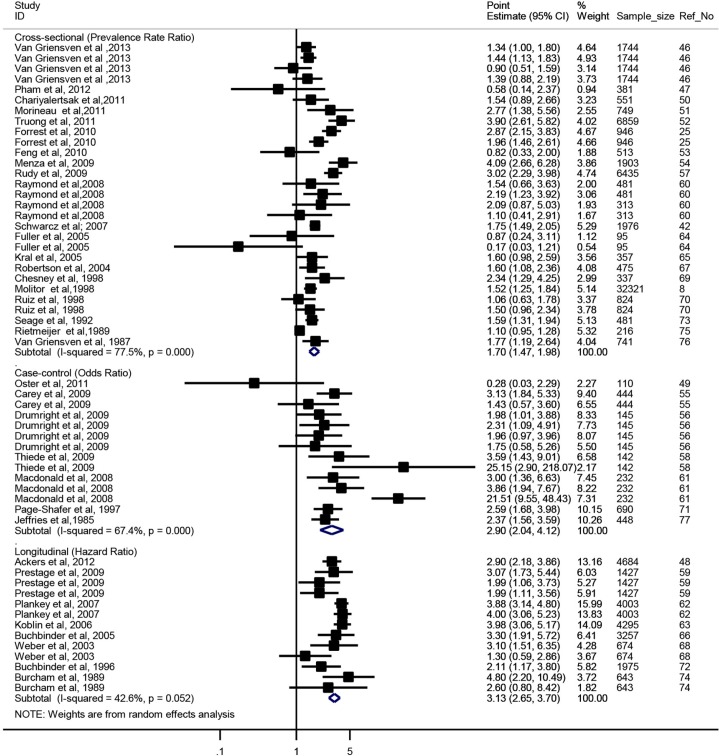
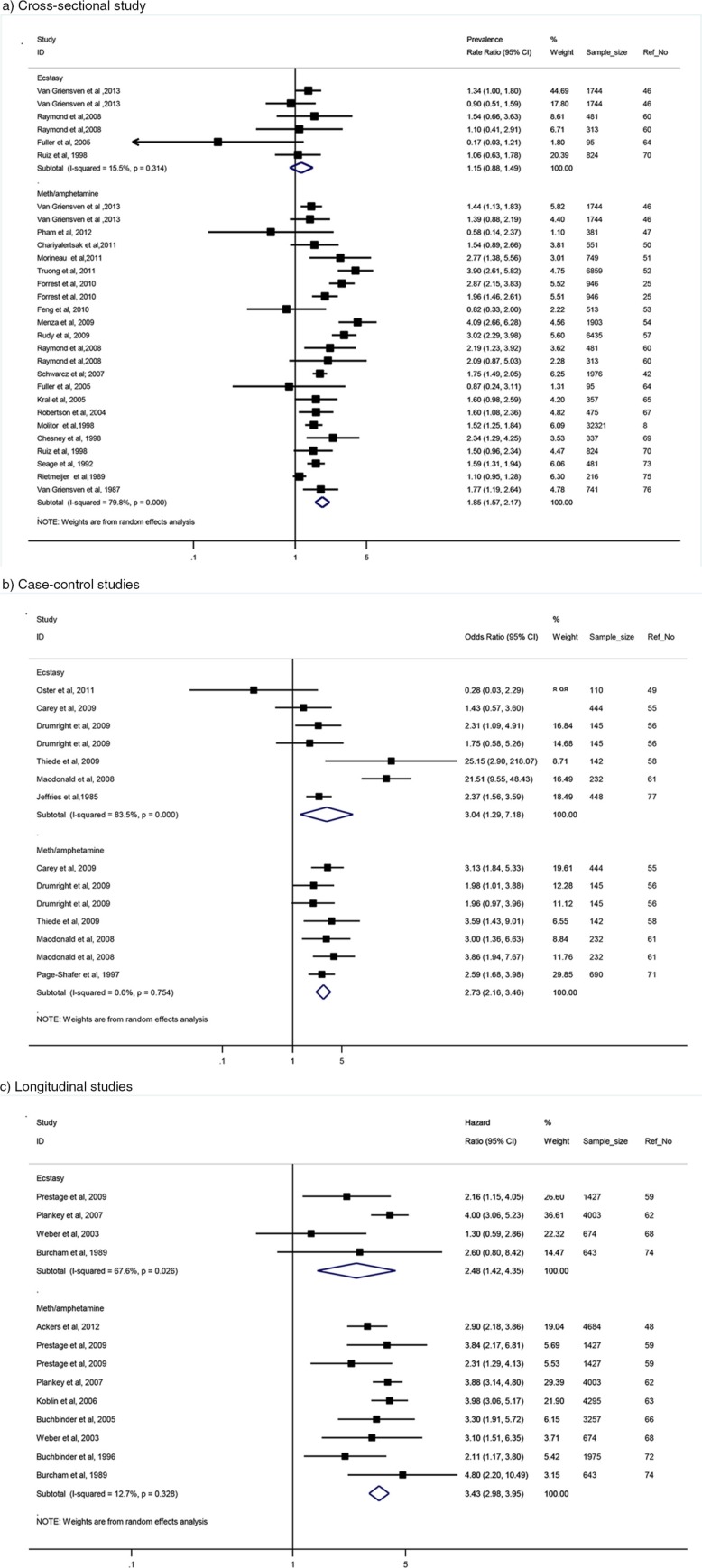
Results: We identified 6710 article titles, screened 1716 abstracts and reviewed 267 full text articles. A total of 35 publications were eligible for data abstraction and meta-analysis, resulting in 56 records of ATS use. Most studies (31/35) were conducted in high-income countries. Published studies used different research designs, samples and measures of ATS use. The pooled association between meth/amphetamine use and HIV infection was statistically significant in all three designs (PRR = 1.86; 95% CI: 1.57-2.17; OR = 2.73; 95% CI: 2.16-3.46 and HR = 3.43; 95% CI: 2.98-3.95, respectively, for cross-sectional, case-control and longitudinal studies). Ecstasy use was not associated with HIV infection in cross-sectional studies (PRR = 1.15; 95% CI: 0.88-1.49; OR = 3.04; 95% CI: 1.29-7.18 and HR = 2.48; 95% CI: 1.42-4.35, respectively, for cross-sectional, case-control and longitudinal studies). RESULTS in cross-sectional studies were highly heterogeneous due to issues with ATS measurement and different sampling frames.
Conclusions: While meth/amphetamine use was significantly associated with HIV infection among MSM in high-income countries in all study designs, evidence of the role of ecstasy in HIV infection was lacking in cross-sectional studies. Cross-sectional study design, measurement approaches and source populations may also be important modifiers of the strength and the direction of associations. Event-specific measure of individual drug is required to establish temporal relationship between ATS use and HIV infection. HIV prevention programmes targeting MSM should consider including interventions designed to address meth/amphetamine use.
Keywords: HIV; MSM; amphetamine-type stimulants; ecstasy; meta-analysis; meth/amphetamine; risk behaviour; systematic review.
Figures
References
-
- United Nations Office on Drugs and Crime. New York: United Nations; 2010. World drug report 2010.
-
- United Nations Office on Drugs and Crime. New York: United Nations; 2013. World drug report 2013.
-
- Ministerial Council on Drug Strategy. Australia: Ministerial Council on Drug Strategy; 2008. National amphetamine-type stimulants strategy, 2008–2011.
-
- Colfax G, Guzman R. Club drugs and HIV infection: a review. Clin Infect Dis. 2006;42(10):1463–9. - PubMed
-
- Colfax G, Santos GM, Chu P, Vittinghoff E, Pluddemann A, Kumar S, et al. Amphetamine-group substances and HIV. Lancet. 2010;376(9739):458–74. - PubMed
Publication types
MeSH terms
Substances
LinkOut - more resources
Full Text Sources
Medical
Miscellaneous
