. 2015 Apr;106(4):352-8.
doi: 10.1111/cas.12611. Epub 2015 Mar 3.

Cold-inducible RNA-binding protein promotes the development of liver cancer

Affiliations

Cold-inducible RNA-binding protein promotes the development of liver cancer

Toshiharu Sakurai et al. Cancer Sci. 2015 Apr.

Abstract

Most hepatocellular carcinomas (HCCs) develop in the context of chronic liver inflammation. Oxidative stress is thought to play a major role in the pathogenesis of HCC development. In this study, we examined whether cold-inducible RNA-binding protein (Cirp) controls reactive oxygen species (ROS) accumulation and development of HCC by using murine models of hepatocarcinogenesis and human liver samples. Cirp expression, ROS accumulation, and CD133 expression were increased in the liver of tumor-harboring mice. Cirp deficiency reduced production of interleukin-1β and interleukin-6 in Kupffer cells, ROS accumulation, and CD133 expression, leading to attenuated hepatocarcinogenesis. Thioacetamide treatment enhanced hepatic expression of CD133 and phosphorylated signal transducer and activator of transcription 3 (STAT3), which was prevented by treatment with the antioxidant butylated hydroxyanisole. Intriguingly, the risk of human HCC recurrence is positively correlated with Cirp expression in liver. Cirp appears to play a critical carcinogenic function and its expression might be a useful biomarker for HCC risk prediction.

Keywords: CD133; HCC; ROS; recurrence; stem cell.


Figures

Fig 1
Fig 1
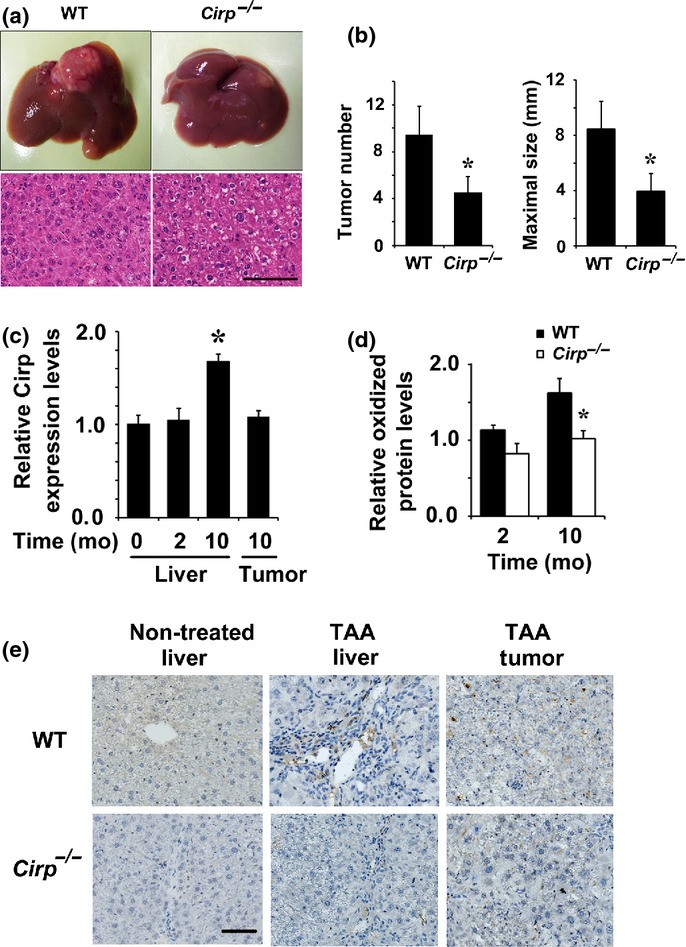
Attenuated hepatocarcinogenesis in Cirp−/− mice. (a) Wild-type and Cirp−/− mice were treated with thioacetamide (TAA) for 10 months. Typical examples of macroscopic tumorigenesis in the TAA model are shown. In the lower panels, liver tumor sections were examined using H&E staining. Scale bar = 200 μm. (b) Numbers and maximum sizes of tumors in mice were determined (WT mice, n = 8; Cirp−/− mice, n = 8). Results are means ± SEM. *P < 0.05 versus WT mice. (c) WT mice were treated with TAA for 2 or 10 months (mo) and liver RNA was extracted from non-cancerous tissues (liver) and tumors. Relative mRNA amounts of Cirp were determined by real-time quantitative PCR and normalized to the amount of actin mRNA. The amount of mRNA in untreated liver was given an arbitrary value of 1.0. Results are means ± SEM (n = 5). *P < 0.05 versus non-treated liver. (d) Lysates of non-tumor liver tissue from TAA-treated mice were extracted at the indicated time points and assessed by immunoblotting and quantified using image analysis software. The amount of protein oxidation in untreated liver was given an arbitrary value of 1.0. Results are means ± SEM (n = 4). *P < 0.05 versus WT mice. (e) Representative immunostaining images of non-tumor and tumor tissues with anti-8-hydroxy-2′-deoxyguanosine antibody.
Fig 2
Fig 2
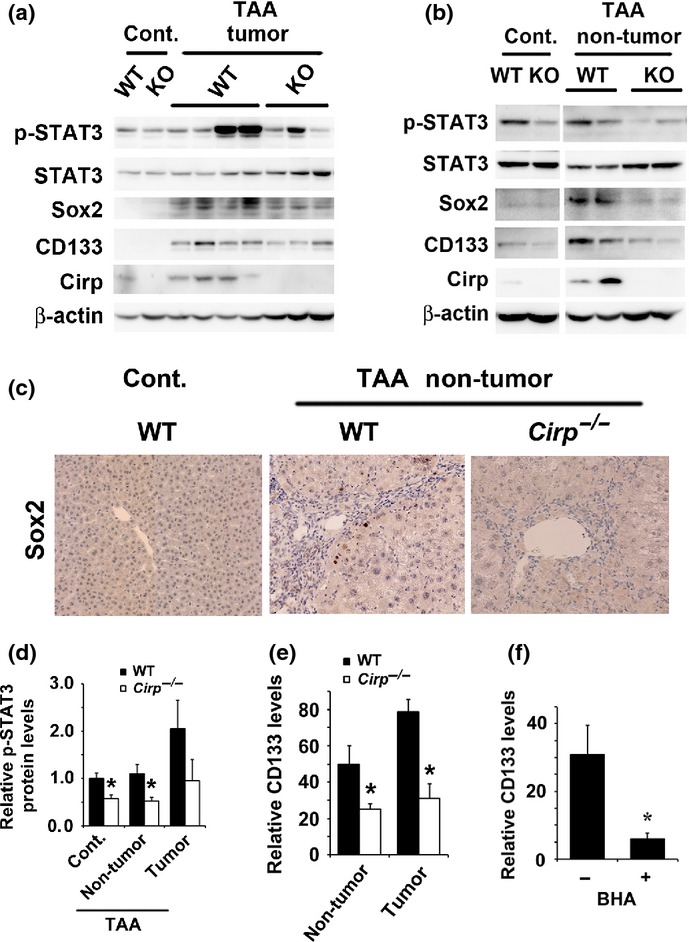
Decreased expression of phosphorylated (p-)STAT3, Sox2, and CD133 in Cirp−/− mice. Wild-type and Cirp−/− mice were treated with thioacetamide (TAA) for 10 months. (a, b) Homogenates of tumors (a) and non-tumor liver tissues (b) were gel-separated and immunoblotted with the indicated antibodies. Representative data are shown. Cont., non-treated liver. (c) Representative immunostaining images of non-tumor tissues with anti-Sox2 antibody. Cont., non-treated liver. (d) The p-STAT3/actin ratio was measured. Quantification of Western blot bands was carried out using densitometry. *P < 0.05 compared with WT mice. (e) RNA was extracted from tumors and non-tumor tissues. Relative mRNA amounts of CD133 were determined by real-time quantitative PCR and normalized to the amount of actin mRNA. The amount of mRNA in untreated liver was given an arbitrary value of 1.0. Results are means ± SEM (n = 6 per group). *P < 0.05 compared with WT mice. (f) WT mice were fed either butylated hydroxyanisole (BHA)-containing (0.7%) or regular chow and treated with TAA for 8 weeks. Relative amounts of mRNA were determined by real-time quantitative PCR and normalized to the amount of actin mRNA. The amount of CD133 mRNA in untreated liver was given an arbitrary value of 1.0. Results are means ± SEM (n = 4). *P < 0.05 compared with mice fed regular chow.
Fig 3
Fig 3
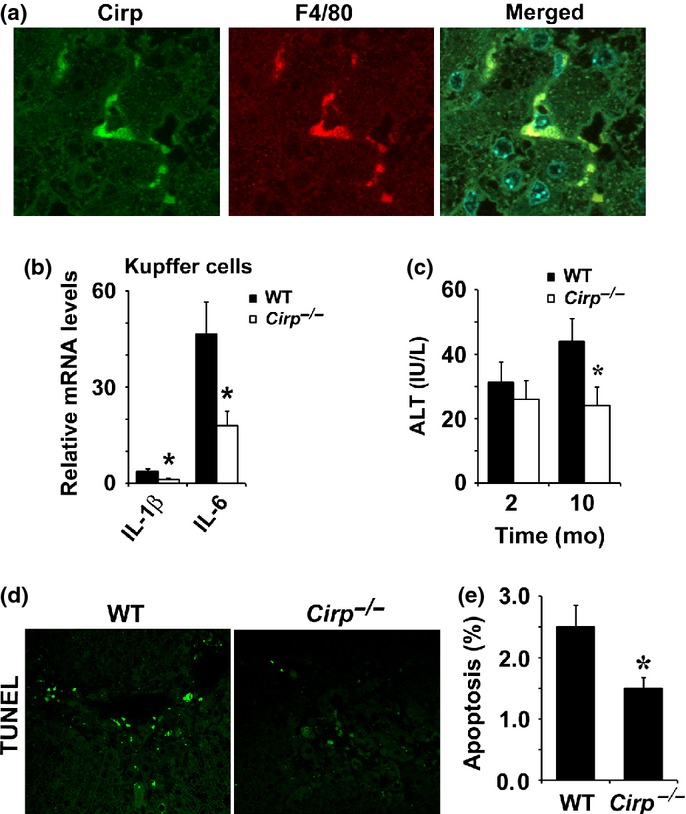
Cold-inducible RNA-binding protein (Cirp) deficiency attenuated proinflammatory cytokine production in Kupffer cells. (a) Immunohistochemistry was carried out on liver sections of thioacetamide (TAA)-treated WT mice. Cells stained with indicated antibodies were identified by confocal microscopy. (b) Production of interleukin (IL)-1β and IL-6 mRNA was measured by real-time quantitative PCR in Kupffer cells from WT and Cirp−/− mice. The amount of mRNA in hepatocytes was given an arbitrary value of 1.0. Results are means ± SEM (n = 4). *P < 0.05 compared with WT mice. (c) ALT levels in serum were determined after 2 and 10 months (mo) of TAA treatment. Results are means ± SEM (n = 5). *P < 0.05 compared with WT mice. (d, e) Extent of hepatocyte apoptosis was determined by TUNEL staining. Results are means ± SEM (n = 6). *P < 0.05 compared with WT mice.
Fig 4
Fig 4
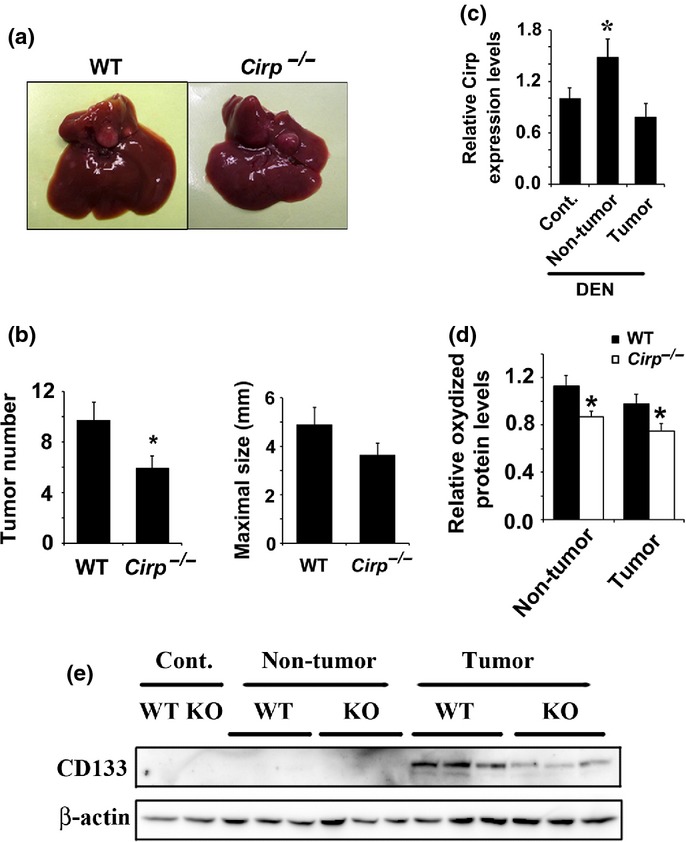
Cold-inducible RNA-binding protein (Cirp) deficiency inhibited DEN-induced hepatocarcinogenesis. WT and Cirp−/− mice were injected with diethylnitrosamine (DEN) injection (25 mg/kg) and killed 8 months later. (a) Representative livers of WT and Cirp−/− mice. (b) Tumor number (>0.5 mm) and tumor size in livers of WT (n = 8) and Cirp−/− mice (n = 8). Data are means ± SEM. *P < 0.05 compared with WT mice. (c) Liver RNA was extracted from non-treated livers (Cont.), non-tumor tissues, and tumors. Relative mRNA amounts of Cirp were determined by real-time quantitative PCR and normalized to the amount of actin mRNA. The amount of mRNA in untreated liver was given an arbitrary value of 1.0. Results are means ± SEM (n = 5). *P < 0.05 compared with non-treated liver (Cont.). (d) Lysates of non-tumor liver tissue from DEN-injected mice were extracted, assessed by immunoblotting, and quantified using image analysis software. The amount of protein oxidation in untreated liver was given an arbitrary value of 1.0. Results are means ± SEM (n = 4). *P < 0.05 versus WT mice. (e) Lysates of non-treated liver (Cont.), tumor, and non-cancerous liver tissue were assessed by immunoblotting with the indicated antibodies.
Fig 5
Fig 5
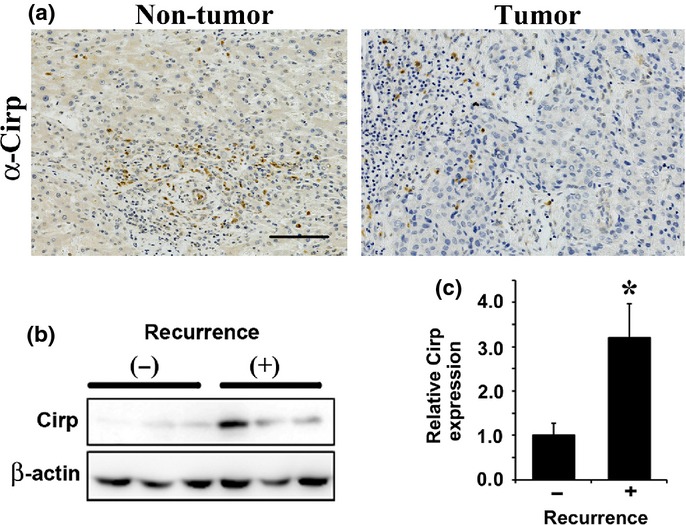
Association between risk of hepatocellular carcinoma (HCC) recurrence and cold-inducible RNA-binding protein (Cirp) expression in human liver. (a) Representative immunostaining images of non-tumor and HCC tissues with anti-Cirp antibody. Scale bar = 100 μm. (b) Lysates of non-cancerous liver tissue from patients who underwent partial hepatectomy for HCC with (+) or without (−) HCC recurrence in the future were extracted and assessed by immunoblotting with the indicated antibodies. Representative data are shown. (c) Cirp protein levels in the liver were quantified using image analysis software. Results are means ± SEM (n = 6 per group). *P < 0.05 versus patients without HCC recurrence.

References

    1. Thorgeirsson SS, Grisham JW. Molecular pathogenesis of human hepatocellular carcinoma. Nat Genet. 2002;31:339–46. - PubMed
    1. Moudgil V, Redhu D, Dhanda S, Singh J. A review of molecular mechanisms in the development of hepatocellular carcinoma by aflatoxin and hepatitis B and C viruses. J Environ Pathol Toxicol Oncol. 2013;32:165–75. - PubMed
    1. White DL, Kanwal F, El-Serag HB. Association between nonalcoholic fatty liver disease and risk for hepatocellular cancer, based on systematic review. Clin Gastroenterol Hepatol. 2012;10:1342–59. .e2. - PMC - PubMed
    1. Ames BN. Dietary carcinogens and anticarcinogens. Oxygen radicals and degenerative diseases. Science. 1983;221:1256–64. - PubMed
    1. Woo RA, Poon RY. Activated oncogenes promote and cooperate with chromosomal instability for neoplastic transformation. Genes Dev. 2004;18:1317–30. - PMC - PubMed

Publication types

MeSH terms