. 2015 Jan 22;6(1):e1608.
doi: 10.1038/cddis.2014.569.

NF-κB-dependent and -independent epigenetic modulation using the novel anti-cancer agent DMAPT

Affiliations

NF-κB-dependent and -independent epigenetic modulation using the novel anti-cancer agent DMAPT

H Nakshatri et al. Cell Death Dis. .

Abstract

The transcription factor nuclear factor-kappaB (NF-κB) is constitutively active in several cancers and is a target of therapeutic development. We recently developed dimethylaminoparthenolide (DMAPT), a clinical grade water-soluble analog of parthenolide, as a potent inhibitor of NF-κB and demonstrated in vitro and in vivo anti-tumor activities in multiple cancers. In this study, we show DMAPT is an epigenetic modulator functioning in an NF-κB-dependent and -independent manner. DMAPT-mediated NF-κB inhibition resulted in elevated histone H3K36 trimethylation (H3K36me3), which could be recapitulated through genetic ablation of the p65 subunit of NF-κB or inhibitor-of-kappaB alpha super-repressor overexpression. DMAPT treatment and p65 ablation increased the levels of H3K36 trimethylases NSD1 (KMT3B) and SETD2 (KMT3A), suggesting that NF-κB directly represses their expression and that lower H3K36me3 is an epigenetic marker of constitutive NF-κB activity. Overexpression of a constitutively active p65 subunit of NF-κB reduced NSD1 and H3K36me3 levels. NSD1 is essential for DMAPT-induced expression of pro-apoptotic BIM, indicating a functional link between epigenetic modification and gene expression. Interestingly, we observed enhanced H4K20 trimethylation and induction of H4K20 trimethylase KMT5C in DMAPT-treated cells independent of NF-κB inhibition. These results add KMT5C to the list NF-κB-independent epigenetic targets of parthenolide, which include previously described histone deacetylase 1 (HDAC-1) and DNA methyltransferase 1. As NSD1 and SETD2 are known tumor suppressors and loss of H4K20 trimethylation is an early event in cancer progression, which contributes to genomic instability, we propose DMAPT as a potent pharmacologic agent that can reverse NF-κB-dependent and -independent cancer-specific epigenetic abnormalities.


Figures

Figure 1
Figure 1
The effect of DMAPT on the expression of epigenetic regulators and on histones. (a) DMAPT reduced the levels of EZH2, HDAC-1, CtBP1, and PARP1 in a cell type-dependent manner. Cells were treated with 10 μM DMAPT for the indicated time, and cell lysates were subjected to western blotting. Representative data from two or more experiments are shown. (b) DMAPT induced the expression of p21 and BIM. (c) The effect of DMAPT treatment on histone modifications. H3K36me3 blots were reprobed with histone H4 as a quality control
Figure 2
Figure 2
The role of NF-κB in DMAPT-mediated histone modifications. (a) NF-κB DNA-binding activity in MDA-MB-231 with or without IκBαSR overexpression and in MEFs with and without p65 deletion. Cells were incubated with or without TNFα for 15 min, and NF-κB and SP-1 (as a control) DNA-binding activity was measured by electrophoretic mobility gel shift assay. Antibody supershift assay with extracts from wild-type and p65−/− cells is shown in the right side (lanes 13–20). (b) The effect of IκBαSR overexpression on DMAPT-induced histone modification in MDA-MB-231 cells. Basal H3K36me3 was higher in cells with IκBαSR overexpression compared with parental cells with empty lentivirus (pCL6), and it was further increased by DMAPT. (c) P65−/− MEFs showed elevated basal H3K36me3 but not H4K20me3 compared with wild-type MEFs. DMAPT increased H3K36me3 and H4K20me3 in wild-type MEFs
Figure 3
Figure 3
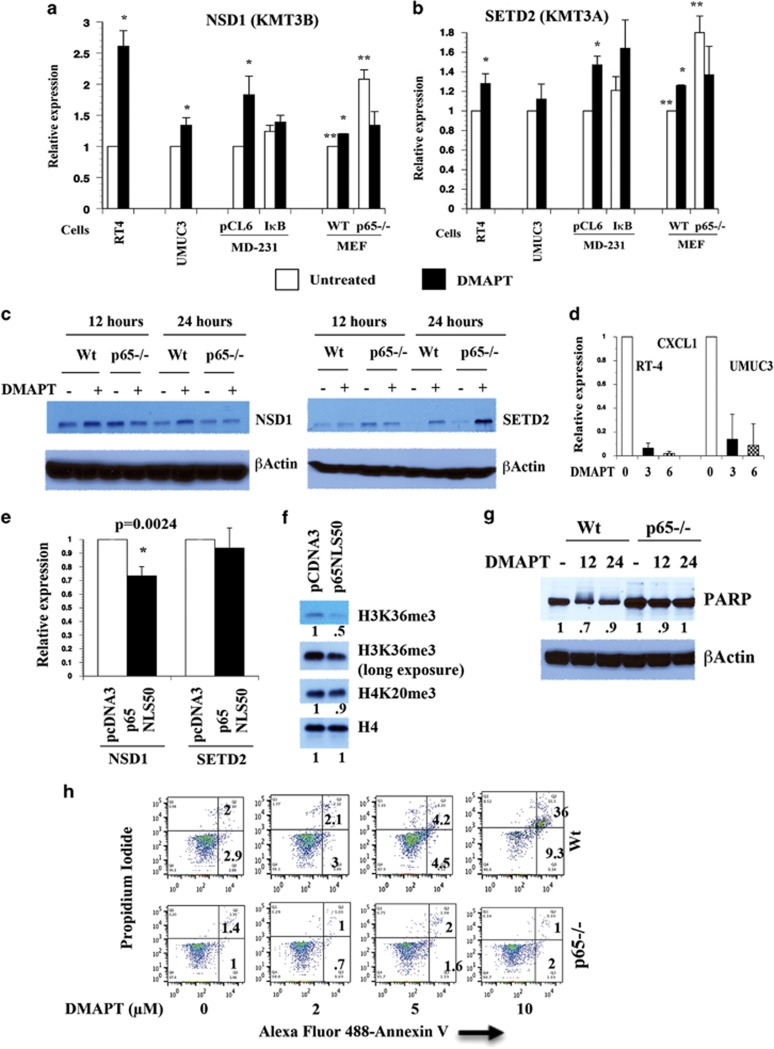
DMAPT induced histone H3K36 methyltransferases NSD1 and SETD2. (a) The effect of DMAPT on NSD1 expression. Cells were treated with 10 μM DMAPT for 12 h, and qRT-PCR was performed to measure NSD1 mRNA. Average±S.E.M. from biological replicates is shown. Asterisk in this and subsequent figures denotes statistically significant differences with a P-value of <0.05. (b) The effect of DMAPT on SETD2 expression. Basal SETD2 level was significantly higher in p65−/− cells compared with wild-type cells. (c) The effect of DMAPT on NSD1 and SETD2 proteins in wild-type and p65−/− MEFs. (d) DMAPT reduced CXCL1 mRNA in RT-4 and UMUC-3 cells. (e) The effect of p65NLS50 expression on NSD1 and SETD2 expression in p65−/− cells. Cells were transfected with empty vector pcDNA3 or p65NLS50 vector (10 μgs), and RNA was analyzed for NSD1 and SETD2 levels 48 h after transfection. (f) H3K36me3 and H4K20me3 levels in pcDNA3- and p65NLS50-transfected cells. Experiments were done as in panel (e). (g) DMAPT (10 μM) reduced PARP-1 in wild-type but not p65−/− cells. (h) Wild-type but not p65−/− cells were sensitive to DMAPT-induced apoptosis. Cells were treated with the indicated concentration of DMAPT for 24 h, and apoptosis was measured using Annexin V labeling. Representative results are shown
Figure 4
Figure 4
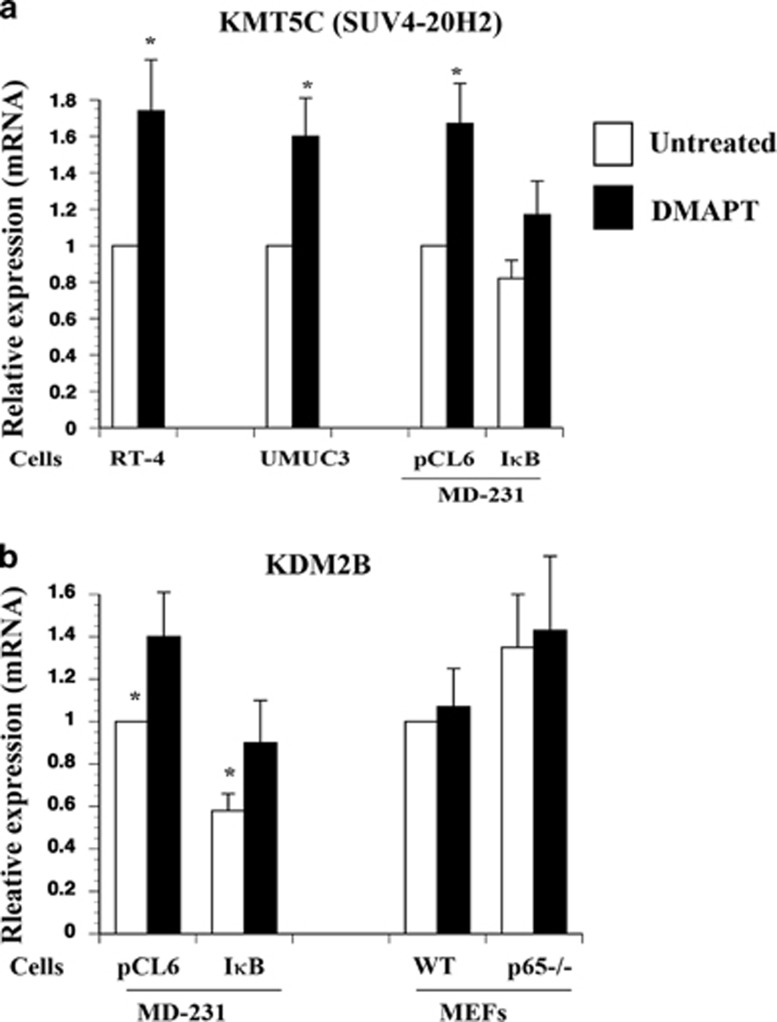
DMAPT increased histone H4K20 trimethyltransferase KMT5C in a cell type-dependent but NF-κB-independent manner. (a) KMT5C expression in DMAPT-treated cells. Cells were treated with DMAPT for 6 h. Note that IκBαSR overexpression had minimum effect on KMT5C expression in MDA-MB-231 cells. (b) NF-κB activity is required for KDM2B expression in MDA-MB-231 but not in MEFs. IκBαSR overexpression caused significant drop in basal KDM2B levels in MD-MB-231 cells, whereas p65 knockout did not have an effect on its expression in MEFs
Figure 5
Figure 5
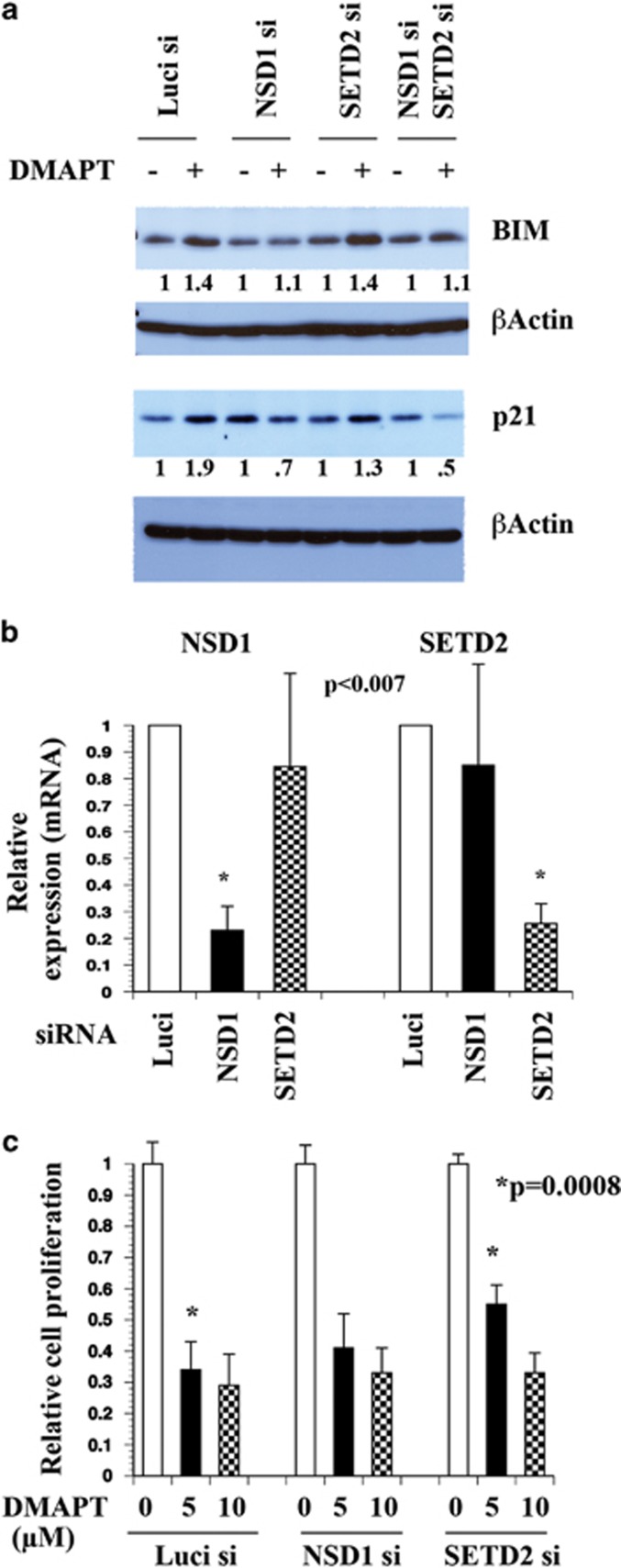
NSD1 is essential for DMAPT-induced BIM and p21 expression. (a) BIM and p21 levels in untreated and DMAPT-treated UMUC-3 cells additionally transfected with siRNA against luciferase as a negative control, NSD1, SETD2, or both NSD1 and SETD2. Cells were treated after 3 days of siRNA transfection with DMAPT and harvested for proteins after 24 h of DMAPT treatment. NSD1 siRNA prevented DMAPT-induced BIM and p21. For unknown reasons, basal p21 levels in NSD1 siRNA-treated cells showed remarkable experimental variability in UMUC-3 cells. Densitometry values show comparison between untreated controls and DMAPT-treated cells with respective controls normalized to 1. (b) NSD1 and SETD2 mRNA levels in siRNA-transfected cells. Respective mRNAs were measured 4 days after siRNA transfection. (c) SETD2 is required for DMAPT-mediated growth inhibition. Cells were plated in a 96-well plate and treated with DMAPT for 48 h. Cell proliferation was measured using BrDU-incorportation ELISA
Figure 6
Figure 6
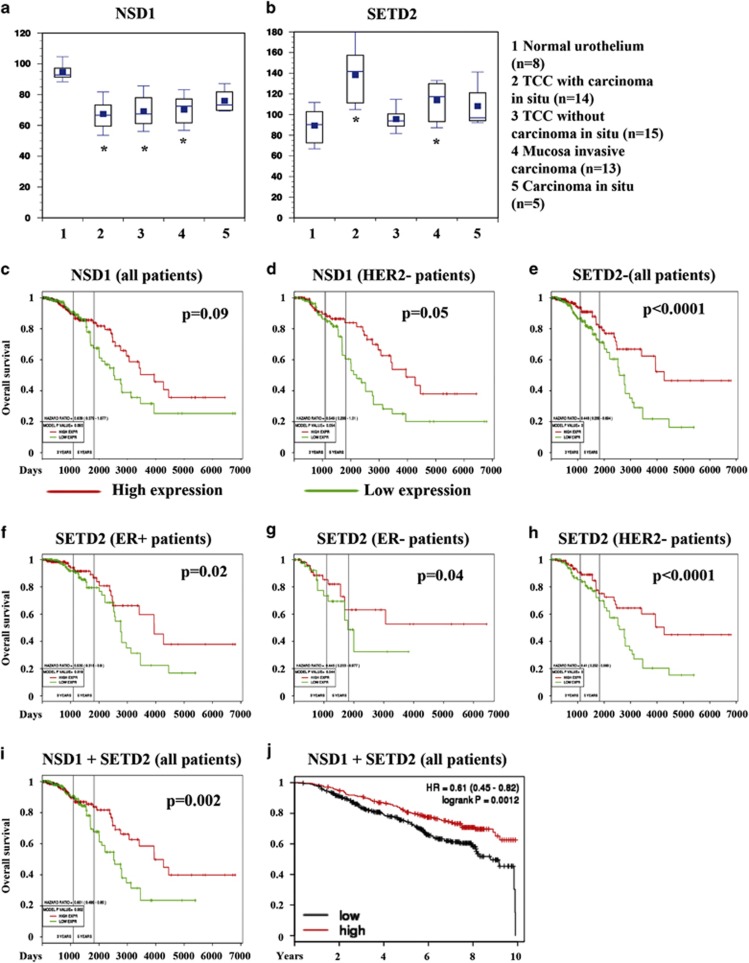
Prognostic value of NSD1 and SETD2 in cancer. (a) Levels of NSD1 in normal urothelium and various stages of bladder cancer. NCBI GEO data set GDS1479, which contains NSD1 expression levels (one probe set) in normal urothelium and different stages of bladder cancer, was used to generate this figure. (b) Levels of SETD2 in normal urothelium and various stages of bladder cancer. Data were generated using the same data set as in panel (a) except that signals were average of three probes that measured SETD2 mRNA. (cj) Prognostic value of NSD1, SETD2, or combination in different subtypes of breast cancer. Public databases created by us (ci) and others (j) were used to generate these figures

References

    1. Sharma S, Kelly TK, Jones PA. Epigenetics in cancer. Carcinogenesis 2010; 31: 27–36. - PMC - PubMed
    1. Jones PA, Baylin SB. The epigenomics of cancer. Cell 2007; 128: 683–692. - PMC - PubMed
    1. Ben-Porath I, Thomson MW, Carey VJ, Ge R, Bell GW, Regev A et al. An embryonic stem cell-like gene expression signature in poorly differentiated aggressive human tumors. Nat Genet 2008; 40: 499–507. - PMC - PubMed
    1. Kanno R, Janakiraman H, Kanno M. Epigenetic regulator polycomb group protein complexes control cell fate and cancer. Cancer Sci 2008; 99: 1077–1084. - PMC - PubMed
    1. Schuettengruber B, Chourrout D, Vervoort M, Leblanc B, Cavalli G. Genome regulation by polycomb and trithorax proteins. Cell 2007; 128: 735–745. - PubMed

Publication types

MeSH terms

Substances