


Deciphering the transcriptional switches of innate lymphoid cell programming: the right factors at the right time
- PMID: 25611557
- PMCID: PMC4409422
- DOI: 10.1038/gene.2014.83
Deciphering the transcriptional switches of innate lymphoid cell programming: the right factors at the right time
Abstract
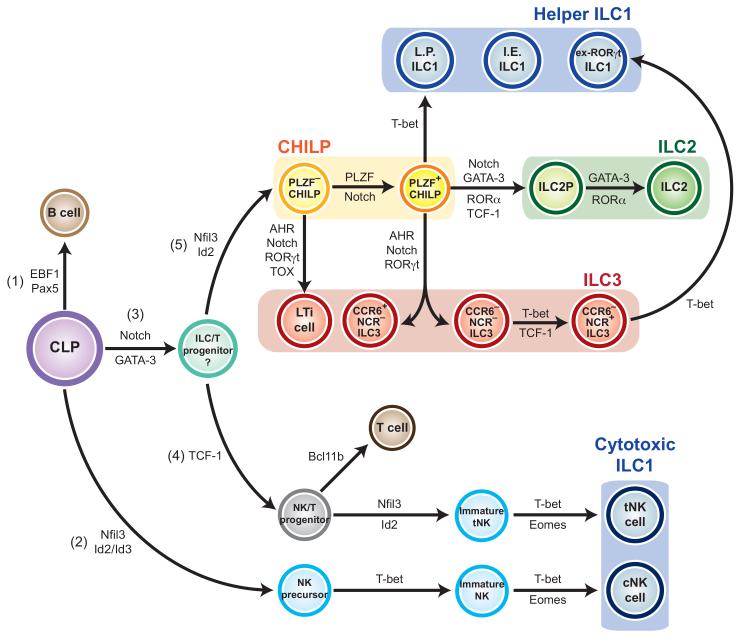
Innate lymphoid cells (ILCs) are increasingly recognised as an innate immune counterpart of adaptive T-helper (TH) cells. In addition to their similar effector cytokine production, there is a strong parallel between the transcription factors that control the differentiation of T(H)1, T(H)2 and T(H)17 cells and ILC groups 1, 2 and 3, respectively. Here, we review the transcriptional circuit that specifies the development of a common ILC progenitor and its subsequent programming into distinct ILC groups. Notch, GATA-3 (GATA-binding protein 3), Nfil3 (nuclear factor interleukin-3) and Id2 (inhibitor of DNA-binding 2) are identified as early factors that suppress B- and T-cell potentials and are turned on in favour of ILC commitment. Natural killer cells, which are the cytotoxic ILCs, develop along a pathway distinct from the rest of the helper-like ILCs that are derived from a common progenitor to all helper-like ILCs (CHILPs). PLZF(-) (promyelocytic leukaemia zinc-finger) CHILPs give rise to lymphoid tissue inducer cells, while PLZF(+) CHILPs have multilineage potential and could give rise to ILCs 1, 2 and 3. Such lineage specificity is dictated by the controlled expression of T-bet (T-box expressed in T cells), RORα (retinoic acid receptor-related orphan nuclear receptor-α), RORγt (retinoic acid receptor-related orphan nuclear receptor-γt) and AHR (aryl hydrocarbon receptor). In addition to the type of transcription factors, the developmental stages at which these factors are expressed are crucial in specifying the fate of the ILCs.
Figures
References
-
- Vosshenrich CAJ, Di Santo JP. Developmental programming of natural killer and innate lymphoid cells. Curr Opin Immunol. 2013;25:130–138. - PubMed
-
- Spits H, Artis D, Colonna M, Diefenbach A, Di Santo JP, Eberl G, et al. Innate lymphoid cells--a proposal for uniform nomenclature. Nat Rev Immunol. 2013;13:145–149. - PubMed
-
- Herberman RB, Nunn ME, Holden HT, Lavrin DH. Natural cytotoxic reactivity of mouse lymphoid cells against syngeneic and allogeneic tumors. II. Characterization of effector cells. Int J Cancer. 1975;16:230–239. - PubMed
Publication types
MeSH terms
Substances
Grants and funding
LinkOut - more resources
Full Text Sources
Other Literature Sources
