Clinical Trial
. 2015 Apr 9;125(15):2349-58.
doi: 10.1182/blood-2014-09-599423. Epub 2015 Jan 22.

γδ T-cell reconstitution after HLA-haploidentical hematopoietic transplantation depleted of TCR-αβ+/CD19+ lymphocytes

Affiliations
Clinical Trial

γδ T-cell reconstitution after HLA-haploidentical hematopoietic transplantation depleted of TCR-αβ+/CD19+ lymphocytes

Irma Airoldi et al. Blood. .

Erratum in

Abstract

We prospectively assessed functional and phenotypic characteristics of γδ T lymphocytes up to 7 months after HLA-haploidentical hematopoietic stem cell transplantation (haplo-HSCT) depleted of αβ(+) T cells and CD19(+) B cells in 27 children with either malignant or nonmalignant disorders. We demonstrate that (1) γδ T cells are the predominant T-cell population in patients during the first weeks after transplantation, being mainly, albeit not only, derived from cells infused with the graft and expanding in vivo; (2) central-memory cells predominated very early posttransplantation for both Vδ1 and Vδ2 subsets; (3) Vδ1 cells are specifically expanded in patients experiencing cytomegalovirus reactivation and are more cytotoxic compared with those of children who did not experience reactivation; (4) these subsets display a cytotoxic phenotype and degranulate when challenged with primary acute myeloid and lymphoid leukemia blasts; and (5) Vδ2 cells are expanded in vitro after exposure to zoledronic acid (ZOL) and efficiently lyse primary lymphoid and myeloid blasts. This is the first detailed characterization of γδ T cells emerging in peripheral blood of children after CD19(+) B-cell and αβ(+) T-cell-depleted haplo-HSCT. Our results can be instrumental to the development of clinical trials using ZOL for improving γδ T-cell killing capacity against leukemia cells. This trial was registered at www.clinicaltrials.gov as #NCT01810120.


Figures

Figure 1
Figure 1
Phenotype of γδ T cells emerging in recipients of haplo-HSCT. Flow cytometry analyses of γδ (gated in CD3+ T cells) (A) and of Vδ1, Vδ2, and Vδ1Vδ2 cells (gated in CD3+γδ+ T cells) (B) 1, 3, and 6 months after HSCT. (C) Percentage of Vδ1, Vδ2, and Vδ1Vδ2 subsets was evaluated by flow cytometry in transplanted patients 1 month after HSCT, and compared with those found either in their donors or in healthy adults. Comparative analyses of γδ T cells (D) and Vδ1, Vδ2, and Vδ1Vδ2 subsets (E) in patients transplanted with either αβ/CD19 depleted grafts or with CD34+ positively selected cells at 3 and 6 months after transplantation. Pooled results are shown. Whisker lines represent highest and lowest values; horizontal lines represent median values.
Figure 2
Figure 2
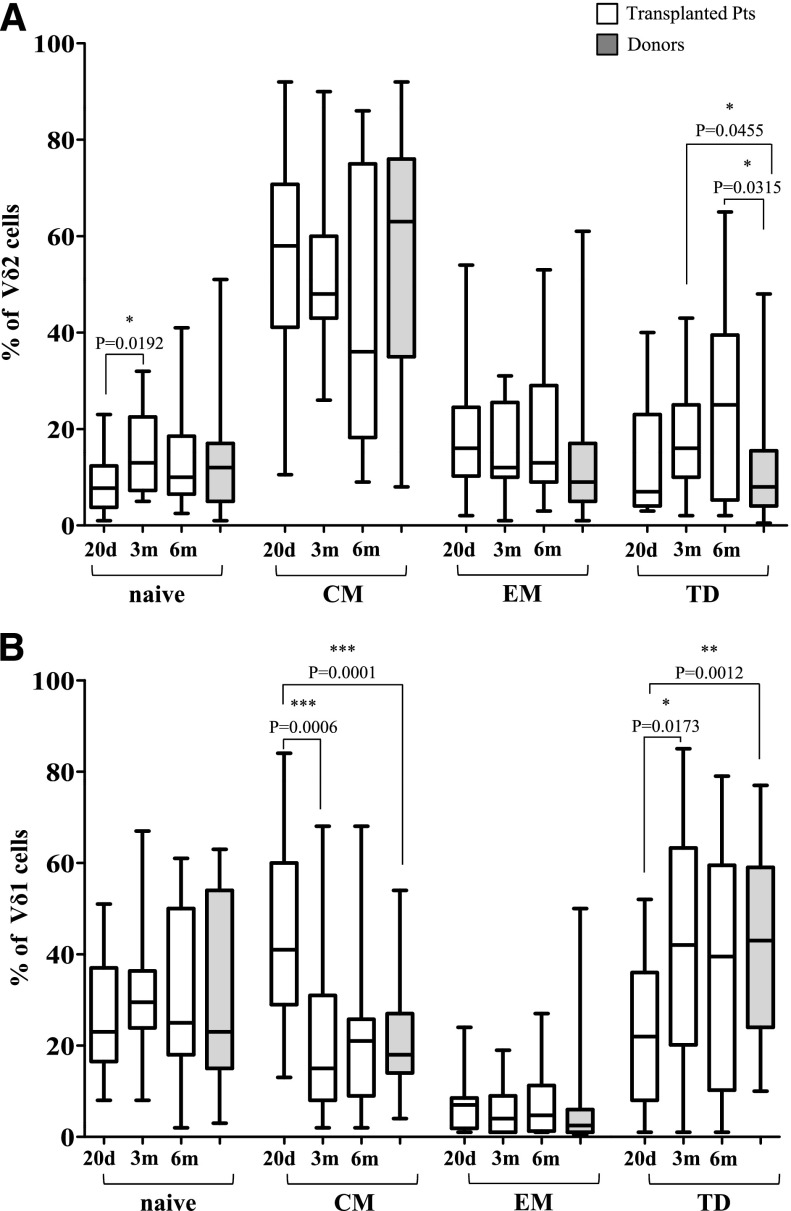
Analysis of γδ differentiation subsets. Percentage of naïve, CM, EM, and TD subsets was evaluated by flow cytometry in gated CD3+γδ+Vδ2+T cells (A) or gated CD3+γδ+Vδ1+T cells (B) at 20 days (d) and 3 and 6 months (m) post-HSCT. Gray plots show results from haplo-HSCT donors. Pooled results are shown. Whisker lines represent highest and lowest values; horizontal lines represent median values.
Figure 3
Figure 3
Circulating γδ T cells in patients experiencing CMV reactivation. (A) Vδ1 and Vδ2 subsets (percentages are indicated) were identified in gated CD45+CD3+γδ+ cells by flow cytometry using PBMCs from 2 representative cases, evaluating both donors and patients 1, 3, and 6 months post-HSCT. Patient 7 did experience CMV reactivation, whereas patient 2 did not. (B) Comparative analysis of Vδ1 (left panel) and Vδ2 (right panel) T cells was performed in patients who did experience CMV reactivation (white plots) and in those who did not (gray plots). Vδ1 and Vδ2 cells were identified in gated CD45+CD3+γδ+ cells. (C) Intranuclear expression of Ki-67 (filled profiles) shows proliferating status in CD45+CD3+γδ+, CD45+CD3+γδ+Vδ1+, and CD45+CD3+γδ+Vδ2+ cells. Empty profiles represent staining with isotype control. (D) Percentage of naïve, CM, EM, and TD was evaluated by flow cytometry in gated CD45+CD3+γδ+Vδ1+ T cells collected from patients who did experience CMV reactivation (white plots) and in those who did not (gray plots) 3 months after HSCT. Pooled results are shown. Whisker lines represent the highest and lowest values; horizontal lines represent median values.
Figure 4
Figure 4
Cytotoxic activity of γδ T cells after in vitro expansion with ZOL. (A) Cytotoxicity of Vγ9Vδ2 cells against AML, BCP-ALL, or T-ALL blasts at 20:1 E:T ratio is shown. One representative experiment using cells collected from patient 2 is reported. Vγ9Vδ2 cells were tested against leukemic blasts left untreated (medium), ZOL sensitized (ZOL), or treated with ZOL and MEV (ZOL+Mev). In some experiments, Vγ9Vδ2 cells were preincubated with an anti-TCR Vγ9 (ZOL+αVγ9) or an anti-NKG2D (ZOL+αNKG2D) mAb. Inset shows 1 representative experiment performed at different E:T ratios (from 20:1 to 1.2:1) using Vγ9Vδ2 cells collected from patient 2 against 1 AML sample treated with ZOL. (B) CD107a degranulation assay was performed using Vγ9Vδ2 cells (n = 10) against myeloid and lymphoid leukemia cells untreated (medium) or ZOL sensitized. Pooled results are shown. Whisker lines represent the highest and lowest values; horizontal lines represent median values. (C) One representative experiment with Vγ9Vδ2 T cells after in vitro expansion of PBMCs from patient 6. Double staining with anti-Vδ2 phycoerythrin and anti-CD107a allophycocyanin is shown on gated γδ+Vδ2+ T cells.
Figure 5
Figure 5
Cytotoxicity of circulating γδ T cells. (A) CD107a expression in gated γδ+Vδ1+ and γδ+Vδ2+ T cells of PBMCs from patients cultured with AML blasts untreated (medium) or ZOL sensitized was investigated by flow cytometry. (B) One representative experiment using PBMCs obtained from patient 7. (C) Flow cytometric expression of CD107a in gated γδ+Vδ1+ and Vδ2+ T cells in patients’ PBMCs upon coculture with either BCP-ALL or T-ALL blasts, either untreated (medium) or ZOL sensitized. (D) CD107a expression in gated CD3+γδ+Vδ1+ cells from PBMCs collected from patients who did experience CMV reactivation (n = 10) and those who did not (n = 10) was evaluated. Pooled results are shown. Whisker lines represent the highest and lowest values; horizontal lines represent median values. One representative experiment performed with PBMCs from patients 18 and 9 is shown in dot plots in the right.

Comment in

References

    1. Aversa F, Tabilio A, Velardi A, et al. Treatment of high-risk acute leukemia with T-cell-depleted stem cells from related donors with one fully mismatched HLA haplotype. N Engl J Med. 1998;339(17):1186–1193. - PubMed
    1. Aversa F, Terenzi A, Tabilio A, et al. Full haplotype-mismatched hematopoietic stem-cell transplantation: a phase II study in patients with acute leukemia at high risk of relapse. J Clin Oncol. 2005;23(15):3447–3454. - PubMed
    1. Ciceri F, Labopin M, Aversa F, et al. Acute Leukemia Working Party (ALWP) of European Blood and Marrow Transplant (EBMT) Group. A survey of fully haploidentical hematopoietic stem cell transplantation in adults with high-risk acute leukemia: a risk factor analysis of outcomes for patients in remission at transplantation. Blood. 2008;112(9):3574–3581. - PubMed
    1. Klingebiel T, Cornish J, Labopin M, et al. Pediatric Diseases and Acute Leukemia Working Parties of the European Group for Blood and Marrow Transplantation (EBMT) Results and factors influencing outcome after fully haploidentical hematopoietic stem cell transplantation in children with very high-risk acute lymphoblastic leukemia: impact of center size: an analysis on behalf of the Acute Leukemia and Pediatric Disease Working Parties of the European Blood and Marrow Transplant group. Blood. 2010;115(17):3437–3446. - PubMed
    1. Bari R, Rujkijyanont P, Sullivan E, et al. Effect of donor KIR2DL1 allelic polymorphism on the outcome of pediatric allogeneic hematopoietic stem-cell transplantation. J Clin Oncol. 2013;31(30):3782–3790. - PMC - PubMed

Publication types

Substances

Associated data