


Water distribution in dentin matrices: bound vs. unbound water
- PMID: 25612786
- PMCID: PMC4332395
- DOI: 10.1016/j.dental.2014.12.007
Water distribution in dentin matrices: bound vs. unbound water
Abstract
Objective: This work measured the amount of bound versus unbound water in completely-demineralized dentin.
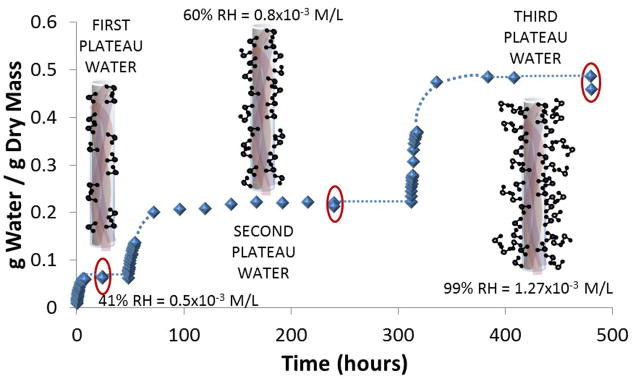
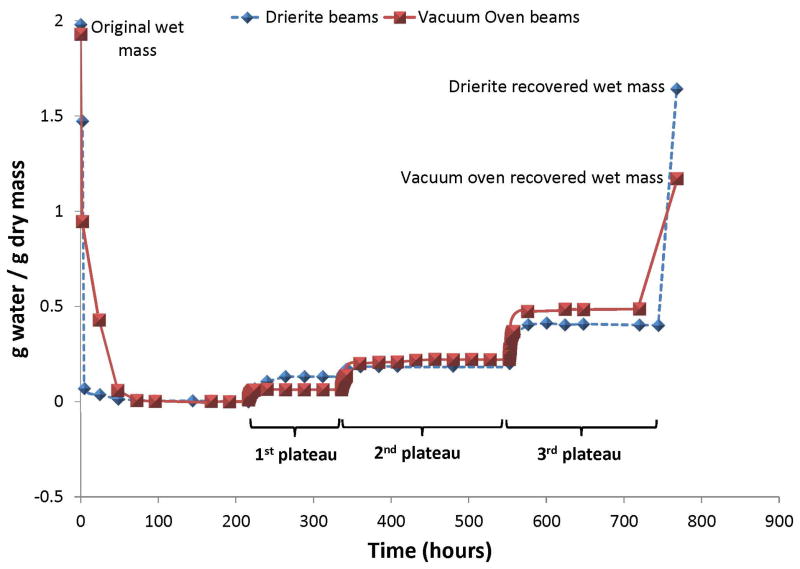
Methods: Dentin beams prepared from extracted human teeth were completely demineralized, rinsed and dried to constant mass. They were rehydrated in 41% relative humidity (RH), while gravimetrically measuring their mass increase until the first plateau was reached at 0.064 (vacuum) or 0.116 gH2O/g dry mass (Drierite). The specimens were then exposed to 60% RH until attaining the second plateau at 0.220 (vacuum) or 0.191 gH2O/g dry mass (Drierite), and subsequently exposed to 99% RH until attaining the third plateau at 0.493 (vacuum) or 0.401 gH2O/g dry mass (Drierite).
Results: Exposure of the first layer of bound water to 0% RH for 5 min produced a -0.3% loss of bound water; in the second layer of bound water it caused a -3.3% loss of bound water; in the third layer it caused a -6% loss of bound water. Immersion in 100% ethanol or acetone for 5 min produced a 2.8 and 1.9% loss of bound water from the first layer, respectively; it caused a -4 and -7% loss of bound water in the second layer, respectively; and a -17 and -23% loss of bound water in the third layer. Bound water represented 21-25% of total dentin water. Chemical dehydration of water-saturated dentin with ethanol/acetone for 1 min only removed between 25 and 35% of unbound water, respectively.
Significance: Attempts to remove bound water by evaporation were not very successful. Chemical dehydration with 100% acetone was more successful than 100% ethanol especially the third layer of bound water. Since unbound water represents between 75 and 79% of total matrix water, the more such water can be removed, the more resin can be infiltrated.
Keywords: Adhesive dentistry; Bound water; Bulk water; Collagen; Dentin; Hydrogen bonding.
Copyright © 2014 Academy of Dental Materials. Published by Elsevier Ltd. All rights reserved.
Figures
References
-
- Ramachandran GN, Chandrasekharan R. Interchain hydrogen bonds via bound water molecules in the collagen triple helix. Biopolymers. 1968;6:1649–1658. - PubMed
-
- Bella J, Eaton M, Brodsky B, Berman HM. Crystal and molecular structure of a collagen-like peptide at 1. 9 Å resolution. Science. 1994;226:75–81. - PubMed
-
- Bella J, Brodsky B, Berman HM. Hydration structure of a collagen peptide. Structure. 1995;3:893–906. - PubMed
-
- Bella J, Bermam HM. Crystallographic evidence for C alpha-H—O hydrogen bonds in the collagen triple helix. J Mol Biol. 1996;264:734–742. - PubMed
-
- Kramer RZ, Vitagliano L, Bella J, Berisio B, Mazzarella L, Brodsky B, Zagari A, Berman HM. X-ray crystallographic determination of a collagen-like peptide with the repeating sequence (Pro-Pro-Gly) J Mol Biol. 1998;280:623–638. - PubMed
Publication types
MeSH terms
Substances
Grants and funding
LinkOut - more resources
Full Text Sources
Other Literature Sources
