. 2015 Jan 23;46(1):5.
doi: 10.1186/s13567-014-0132-5.

Immune responses associated with homologous protection conferred by commercial vaccines for control of avian pathogenic Escherichia coli in turkeys

Affiliations

Immune responses associated with homologous protection conferred by commercial vaccines for control of avian pathogenic Escherichia coli in turkeys

Jean-Rémy Sadeyen et al. Vet Res. .

Abstract

Avian pathogenic Escherichia coli (APEC) infections are a serious impediment to sustainable poultry production worldwide. Licensed vaccines are available, but the immunological basis of protection is ill-defined and a need exists to extend cross-serotype efficacy. Here, we analysed innate and adaptive responses induced by commercial vaccines in turkeys. Both a live-attenuated APEC O78 ΔaroA vaccine (Poulvac® E. coli) and a formalin-inactivated APEC O78 bacterin conferred significant protection against homologous intra-airsac challenge in a model of acute colibacillosis. Analysis of expression levels of signature cytokine mRNAs indicated that both vaccines induced a predominantly Th2 response in the spleen. Both vaccines resulted in increased levels of serum O78-specific IgY detected by ELISA and significant splenocyte recall responses to soluble APEC antigens at post-vaccination and post-challenge periods. Supplementing a non-adjuvanted inactivated vaccine with Th2-biasing (Titermax® Gold or aluminium hydroxide) or Th1-biasing (CASAC or CpG motifs) adjuvants, suggested that Th2-biasing adjuvants may give more protection. However, all adjuvants tested augmented humoral responses and protection relative to controls. Our data highlight the importance of both cell-mediated and antibody responses in APEC vaccine-mediated protection toward the control of a key avian endemic disease.


Figures

Figure 1
Figure 1
Recoveries of strain EC34195nal R from organs of vaccinated turkeys at 24 h post-challenge. Turkey poults were given sterile saline (mock) as a coarse spray (open bars), a formalin-inactivated vaccine of the parent strain EC34195 formulated in aluminium hydroxide adjuvant via the subcutaneous route (black bars) or Poulvac® E. coli as a coarse spray (checked black and white bars) starting at one day-old as indicated in the Materials and methods. All turkeys were challenged via the intra-airsac route at day 41 post-primary vaccination with EC34195nalR and the indicated tissues recovered 24 h later. The data are expressed as mean log10 CFU/g tissue ± standard error of the mean. The limit of detection by direct plating was 1.79 and limit of detection by enrichment was 1 log10 CFU/g tissue; + denotes values after enrichment of tissue homogenates. *denotes P ≤ 0.05 relative to mock-vaccinated controls.
Figure 2
Figure 2
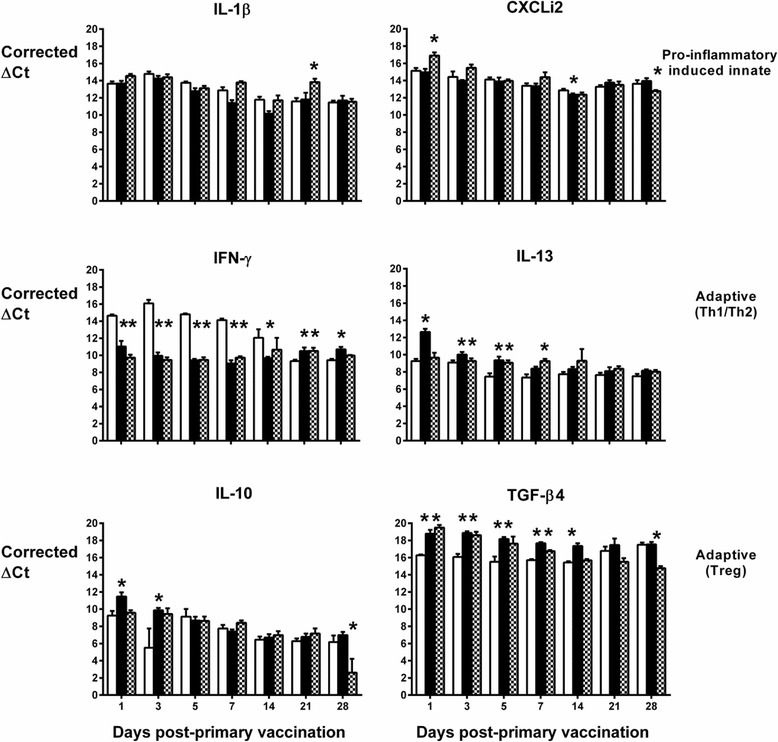
Levels of cytokine transcripts in the spleens of vaccinated turkeys as measured by real-time qRT-PCR. Results are expressed as corrected ΔCt values ± standard error of the mean after normalization with the Ct value of 28S rRNA product of each sample. Turkey poults were given sterile saline (mock) as a coarse spray (open bars), a formalin-inactivated vaccine based on the parent strain EC34195 formulated in aluminium hydroxide adjuvant via the subcutaneous route (black bars) or Poulvac® E. coli as a coarse spray (checked black and white bars) starting at one day-old. Five birds from each group were sampled per time-point. *denotes P ≤ 0.05 relative to mock-vaccinated controls.
Figure 3
Figure 3
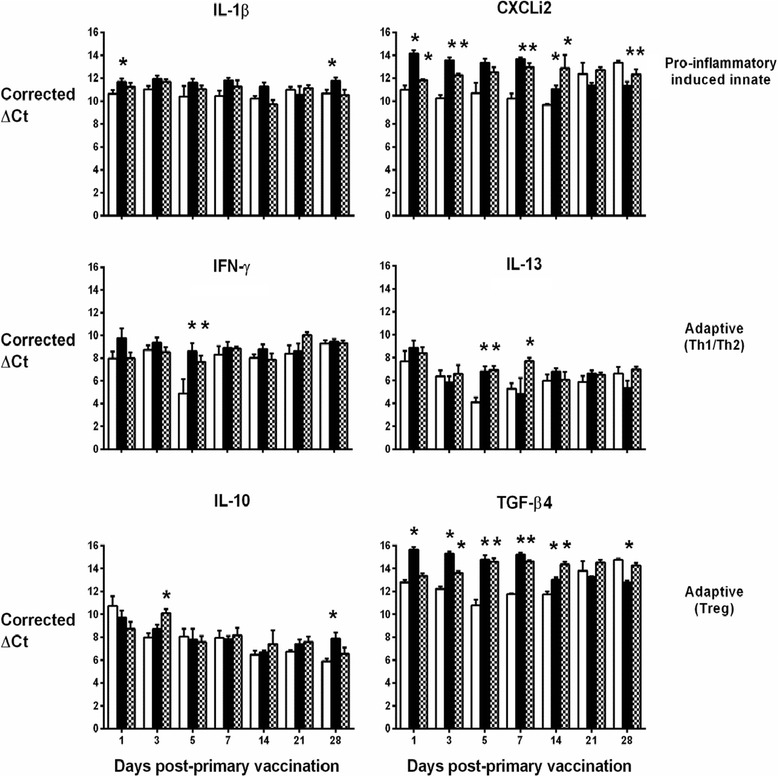
Levels of cytokine transcripts in the livers of vaccinated turkeys as measured by real-time qRT-PCR. Details are as in the legend to Figure 2.
Figure 4
Figure 4
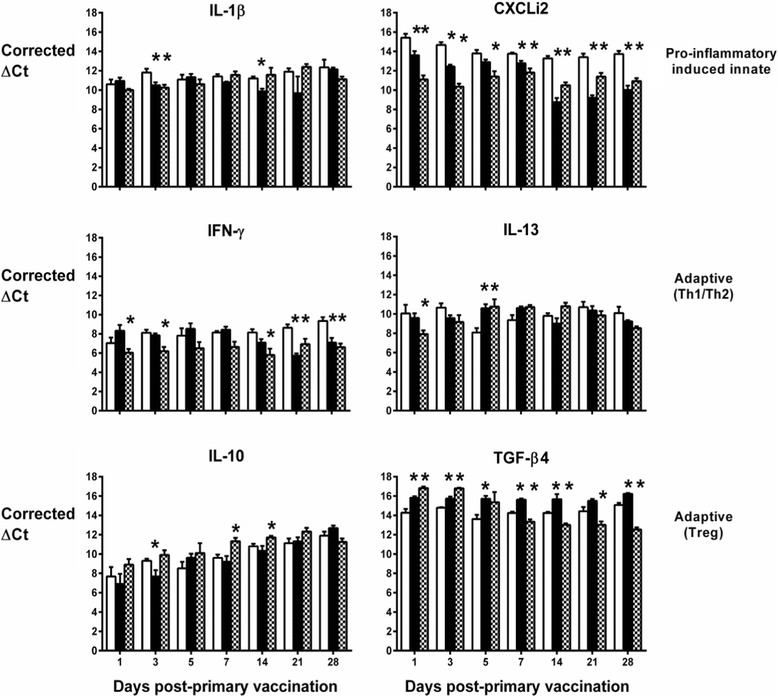
Levels of cytokine transcripts in the lungs of vaccinated turkeys as measured by real-time qRT-PCR. Details are as in the legend to Figure 2.
Figure 5
Figure 5
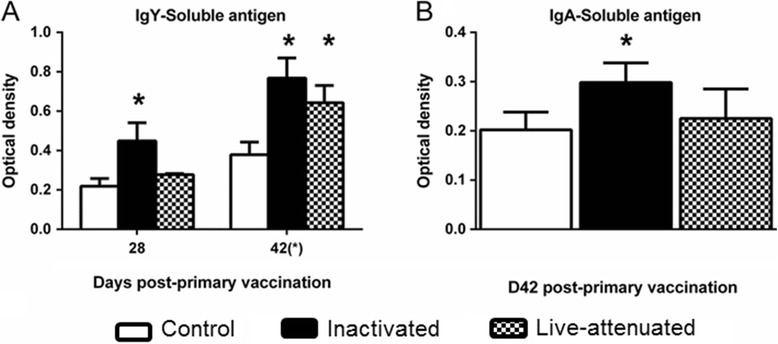
APEC-specific antibody responses in vaccinated turkeys before and after challenge. Turkey poults were given sterile saline (mock) as a coarse spray (open bars), a formalin-inactivated vaccine based on the parent strain EC34195 formulated in aluminium hydroxide adjuvant via the subcutaneous route (black bars) or Poulvac® E. coli as a coarse spray (checked black and white bars) starting at one day-old. Five birds from each group were sampled at day 28 post-primary vaccination and 10 birds per group at day 42 post-primary vaccination (24 h after intra-airsac challenge with EC34195nalR) and serum IgY (A) and bile IgA (B) levels determined by an APEC-specific ELISA. *denotes P ≤ 0.05 relative to mock-vaccinated controls.
Figure 6
Figure 6
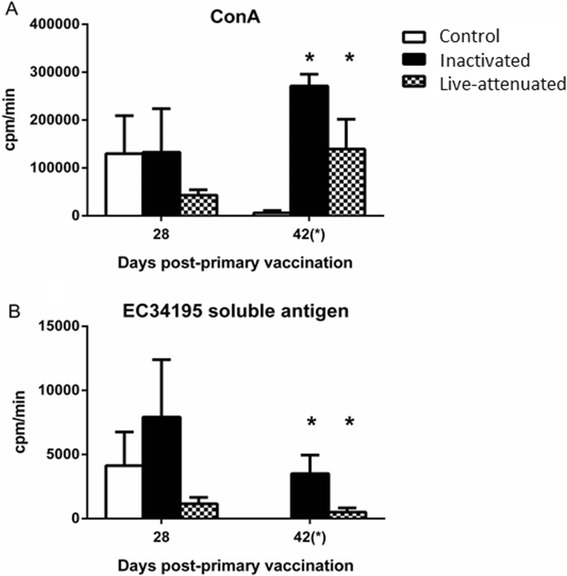
Turkey splenocyte proliferation responses to Concanavalin A and EC34195 soluble lysate in vaccinated turkeys before and after challenge. Turkey poults were given sterile saline (mock) as a coarse spray (open bars), a formalin-inactivated vaccine based on the parent strain EC34195 formulated in aluminium hydroxide adjuvant via the subcutaneous route (black bars) or Poulvac® E. coli as a coarse spray (checked black and white bars) starting at one day-old. Five birds were sampled from each group at each time and splenocytes re-stimulated with ConA (A) or EC43195 soluble lysate (B). The data are presented as mean counts per minute ± standard error of the mean. *denotes P ≤ 0.05 relative to mock-vaccinated controls.
Figure 7
Figure 7
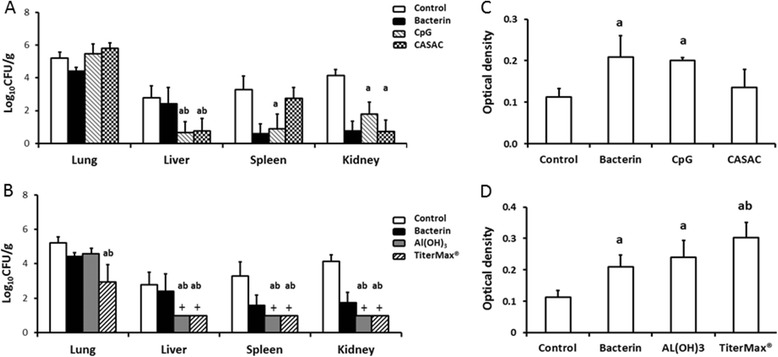
Recoveries of strain EC34195nal R from organs of turkeys vaccinated with a formalin-inactivated bacterin formulated with different adjuvants at 24 h post-challenge. Turkey poults were given sterile saline (negative control), an EC34915-based inactivated bacterin without adjuvant, or formulated with adjuvants that promote a Th1 response (CASAC or CpG-oligonucleotides (A)), or Th2 response (Titermax® Gold or aluminium hydroxide (B)). All vaccines were given by the subcutaneous route at 1 day-old and boosted at day 14. All the birds were challenged at day 41 post-primary vaccination via the intra-airsac route with EC34195nalR and sampled after 24 h. The data are presented as mean log10 CFU/g tissue ± standard error of the mean. APEC-specific serum IgY levels for corresponding birds at post-mortem examination were measured by ELISA compared to mock- and bacterin-vaccinated groups, Th1- (C) and Th2-stimulating adjuvants (D). + denotes value of EC34195nalR after enrichment. “a” denotes P ≤ 0.05 relative to turkey poults that received sterile saline (mock-vaccinated group), “b” denotes P ≤ 0.05 relative to bacterin alone, and “ab” is significance relative to both mock- and bacterin-vaccinated groups.

References

    1. Kemmett K, Williams NJ, Chaloner G, Humphrey S, Wigley P, Humphrey T. The contribution of systemic Escherichia coli infection to the early mortalities of commercial broiler chickens. Avian Pathol. 2014;43:37–42. doi: 10.1080/03079457.2013.866213. - DOI - PubMed
    1. Kemmett K, Humphrey T, Rushton S, Close A, Wigley P, Williams NJ. A longitudinal study simultaneously exploring the carriage of APEC virulence associated genes and the molecular epidemiology of faecal and systemic E. coli in commercial broiler chickens. PLoS One. 2013;8:e67749. doi: 10.1371/journal.pone.0067749. - DOI - PMC - PubMed
    1. Dziva F, Stevens MP. Colibacillosis in poultry: unravelling the molecular basis of virulence of avian pathogenic Escherichia coli in their natural hosts. Avian Pathol. 2008;37:355–366. doi: 10.1080/03079450802216652. - DOI - PubMed
    1. Dziva F, Hauser H, Connor TR, van Diemen PM, Prescott G, Langridge GC, Eckert S, Chaudhuri RR, Ewers E, Mellata M, Mukhopadhyay S, Curtiss R, 3rd, Dougan G, Wieler LH, Thomson NR, Pickard DJ, Stevens MP. Sequencing and functional annotation of avian pathogenic Escherichia coli serogroup O78 strains reveal the evolution of E. coli lineages pathogenic for poultry via distinct mechanisms. Infect Immun. 2013;81:838–849. doi: 10.1128/IAI.00585-12. - DOI - PMC - PubMed
    1. Mellata M, Maddux JT, Nam T, Thomson N, Hauser H, Stevens MP, Mukhopadhyay S, Sarker S, Crabbé A, Nickerson CA, Santander J, Curtiss R., III New insights into the bacterial fitness-associated mechanisms revealed by the characterization of large plasmids of an avian pathogenic E. coli. PLoS One. 2012;7:e29481. doi: 10.1371/journal.pone.0029481. - DOI - PMC - PubMed

Publication types

MeSH terms