


Review
doi: 10.1038/emm.2014.84.
Epstein-Barr virus latent genes
Affiliations
- PMID: 25613728
- PMCID: PMC4314583
- DOI: 10.1038/emm.2014.84
Item in Clipboard
Review
Epstein-Barr virus latent genes
Exp Mol Med.
.
Abstract
Latent Epstein-Barr virus (EBV) infection has a substantial role in causing many human disorders. The persistence of these viral genomes in all malignant cells, yet with the expression of limited latent genes, is consistent with the notion that EBV latent genes are important for malignant cell growth. While the EBV-encoded nuclear antigen-1 (EBNA-1) and latent membrane protein-2A (LMP-2A) are critical, the EBNA-leader proteins, EBNA-2, EBNA-3A, EBNA-3C and LMP-1, are individually essential for in vitro transformation of primary B cells to lymphoblastoid cell lines. EBV-encoded RNAs and EBNA-3Bs are dispensable. In this review, the roles of EBV latent genes are summarized.
Figures
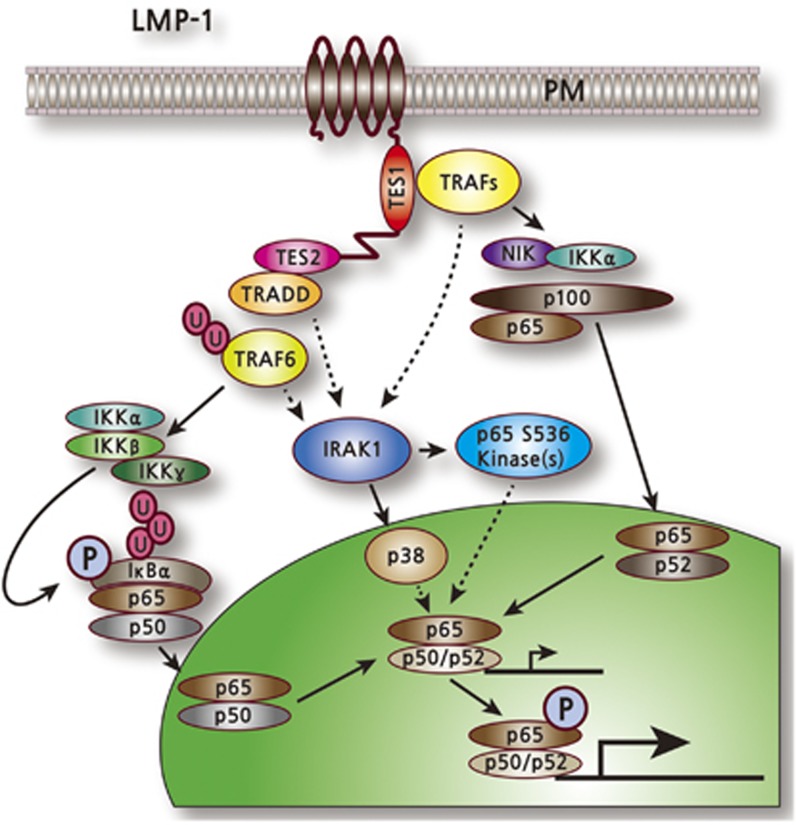
Latent membrane protein-1 (LMP1)-mediated activation of natural factor-κB (NF-κB) signaling.
References
-
- Epstein M, Achong B, Barr Y. Virus particles in cultured lymphoblasts from Burkitt's lymphoma. Lancet. 1964;1:702–703. - PubMed
-
- Henle G, Henle W. Observations on childhood infections with the Epstein–Barr virus. J Infect Dis. 1970;121:303–310. - PubMed
-
- Henle G, Henle W, Clifford P, Diehl V, Kafuko GW, Kirya BG, et al. Antibodies to Epstein–Barr virus in Burkitt's lymphoma and control groups. J Natl Cancer Inst. 1969;43:1147–1157. - PubMed
-
- Henle W, Henle G. The relation of the Epstein–Barr virus to Burkitt's lymphoma. Zentralbl Bakteriol (Orig A) 1972;220:40–46. - PubMed
Publication types
MeSH terms
Substances
LinkOut - more resources
Full Text Sources
Other Literature Sources
