


Survival of rhinoviruses on human fingers
- PMID: 25614158
- PMCID: PMC7129024
- DOI: 10.1016/j.cmi.2014.12.002
Survival of rhinoviruses on human fingers
Abstract
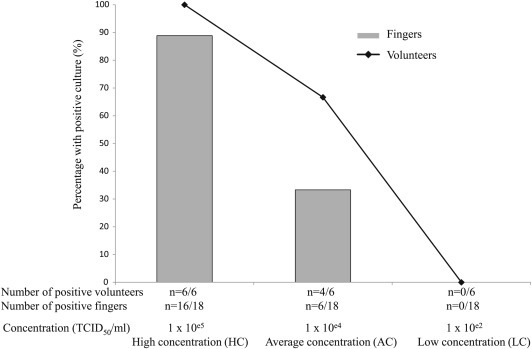
Rhinovirus is the main cause of the common cold, which remains the most frequent infection worldwide among humans. Knowledge and understanding of the rhinovirus transmission route is important to reduce morbidity as only preventive measures are effective. In this study, we investigated the potential of rhinovirus to survive on fingers. Rhinovirus-B14 was deposited on fingers for 30, 60, 90 and 120 min. Survival was defined as the ability of the virus to grow after 7 days, confirmed by immunofluorescence. Rhinovirus survival was not dependent on incubation time on fingers. Droplet disruption had no influence on survival. Survival was frequent with high rhinovirus concentrations, but rare with low-concentration droplets, which corresponded to the usual rhinovirus concentrations in mucus observed in children and adults, respectively. Our study confirms that rhinovirus infectiousness is related to the viral concentration in droplets and suggests that children represent the main transmission source, which occurs only rarely via adults. It confirms also that rhinovirus hand-related transmission is possible and supports hand hygiene as a key prevention measure.
Keywords: Fingers; hand hygiene; picornavirus; rhinovirus; survival; transmission.
Copyright © 2014 European Society of Clinical Microbiology and Infectious Diseases. Published by Elsevier Ltd. All rights reserved.
Figures
References
-
- Alper C.M., Winther B., Mandel E.M., Doyle W.J. Temporal relationships for cold-like illnesses and otitis media in sibling pairs. Pediatr Infect Dis J. 2007;26:778–781. - PubMed
-
- Winther B., Hayden F.G., Hendley J.O. Picornavirus infections in children diagnosed by RT-PCR during longitudinal surveillance with weekly sampling: association with symptomatic illness and effect of season. J Med Virol. 2006;78:644–650. - PubMed
-
- D'Alessio D.J., Peterson J.A., Dick C.R., Dick E.C. Transmission of experimental rhinovirus colds in volunteer married couples. J Infect Dis. 1976;133:28–36. - PubMed
-
- Winther B., Gwaltney J.M., Jr., Mygind N., Turner R.B., Hendley J.O. Sites of rhinovirus recovery after point inoculation of the upper airway. JAMA. 1986;256:1763–1767. - PubMed
Publication types
MeSH terms
LinkOut - more resources
Full Text Sources
Other Literature Sources
