


Growth Hormone Deficiency and Lysinuric Protein Intolerance: Case Report and Review of the Literature
- PMID: 25614305
- PMCID: PMC4501240
- DOI: 10.1007/8904_2014_362
Growth Hormone Deficiency and Lysinuric Protein Intolerance: Case Report and Review of the Literature
Erratum in
-
Erratum to: Growth Hormone Deficiency and Lysinuric Protein Intolerance: Case Report and Review of the Literature.JIMD Rep. 2015;19:1. doi: 10.1007/8904_2015_433. Epub 2015 Apr 5. JIMD Rep. 2015. PMID: 25842048 Free PMC article.
Abstract
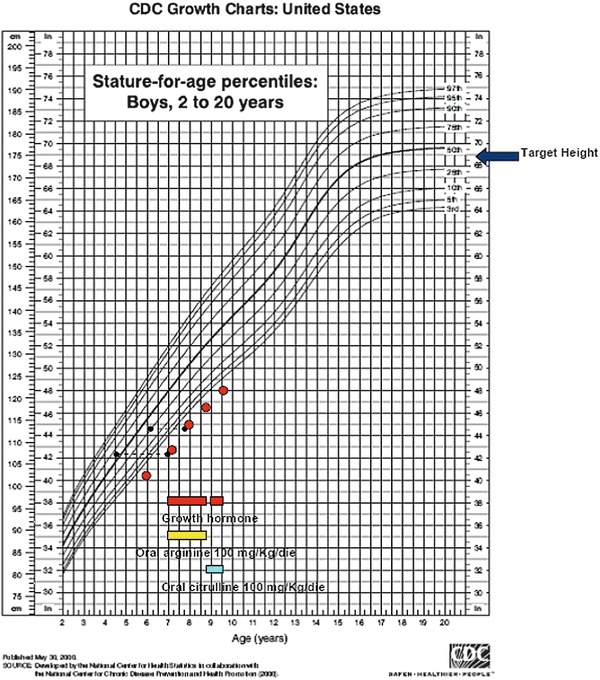
Background: Lysinuric protein intolerance (LPI; MIM# 222700) is a rare metabolic disorder caused by a defective cationic amino acids (CAA) membrane transport leading to decreased circulating plasma CAA levels and resulting in dysfunction of the urea cycle. Short stature is commonly observed in children with LPI and has been associated with protein malnutrition. A correlation between LPI and growth hormone deficiency (GHD) has also been postulated because of the known interaction between the AA arginine, ornithine, and lysine and growth hormone (GH) secretion. Our report describes a case of GHD in an LPI patient, who has not presented a significant increase in growth velocity with recombinant-human GH (rhGH) therapy, suggesting some possible pathogenic mechanisms of growth failure.
Case presentation: The proband was a 6-year-old boy, diagnosed as suffering from LPI, erythrophagocytosis (HP) in bone marrow, and short stature. Two GH provocative tests revealed GHD. The patient started rhGH therapy and a controlled-protein diet initially with supplementation of oral arginine and then of citrulline. At 3-year follow-up, no significant increase in growth velocity and in insulin-like growth factor-1 (IGF-1) levels was observed. Inadequate nutrition and low plasmatic levels of arginine, ornithine, lysine, and HP may have contributed to his poor growth.
Conclusion: Our case suggests that growth failure in patients with GHD and LPI treated with rhGH could have a complex and multifactorial pathogenesis. Persistently low plasmatic levels of lysine, arginine, and ornithine, associated with dietary protein and caloric restriction and systemic inflammation, could determine a defect in coupling GH to IGF-1 production explaining why GH replacement therapy is not able to significantly improve growth impairment. We hypothesize that a better understanding of growth failure pathophysiology in these patients could lead to the development of more rational strategies to treat short stature in patients with LPI.
Figures
References
LinkOut - more resources
Full Text Sources
Other Literature Sources
Research Materials
Miscellaneous
