


Innate lymphoid cells: new insights into function and development
- PMID: 25615701
- PMCID: PMC4648536
- DOI: 10.1016/j.coi.2015.01.004
Innate lymphoid cells: new insights into function and development
Abstract
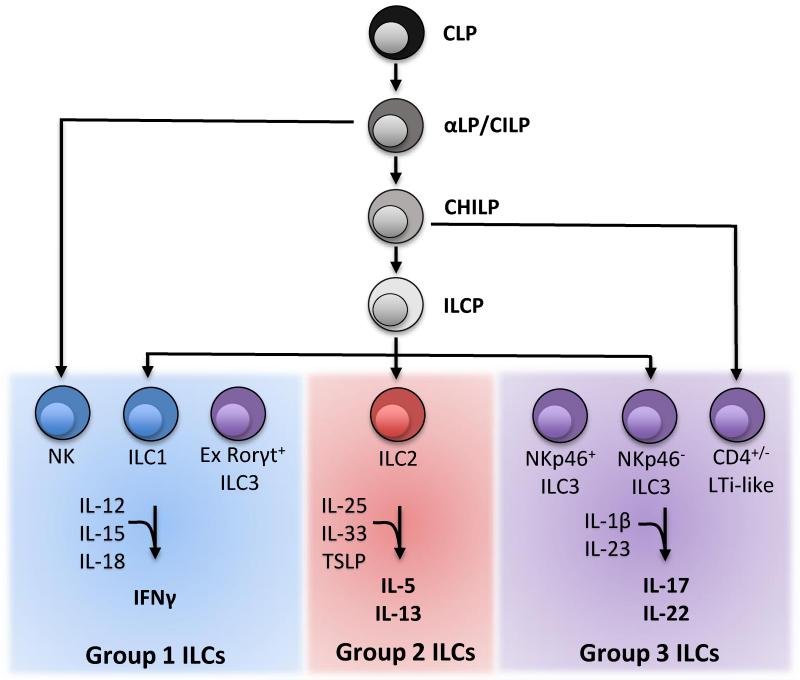
Here, we illustrate the complexity of ILC subsets and discuss novel functions, focusing on emerging mechanisms of crosstalk with other immune cells and the microbiota. Furthermore, we highlight recent insights into the development of ILCs, including the common pathways they share as well as points of divergence between ILC groups and subsets.
Copyright © 2015 Elsevier Ltd. All rights reserved.
Figures
References
-
- McKenzie AN, Spits H, Eberl G. Innate lymphoid cells in inflammation and immunity. Immunity. 2014;41:366–374. - PubMed
-
-
Klose CS, Flach M, Möhle L, Rogell L, Hoyler T, Ebert K, Fabiunke C, Pfeifer D, Sexl V, Fonseca-Pereira D, et al. Differentiation of type 1 ILCs from a common progenitor to all helper-like innate lymphoid cell lineages. Cell. 2014;157:340–356. This study identifies an ILC progenitor, the CHILP, lineage restricted to ILC1, ILC2, and ILC3 but not NK cells.
-
-
-
Daussy C, Faure F, Mayol K, Viel S, Gasteiger G, Charrier E, Bienvenu J, Henry T, Debien E, Hasan UA, et al. T-bet and Eomes instruct the development of two distinct natural killer cell lineages in the liver and in the bone marrow. J Ex Med. 2014;211(3):563–577. This work shows that T-bet+Eomes− cells do not give rise to T-bet+Eomes+ NK cells, demonstrating they are not immature NK cells but a distinct population, the ILC1.
-
Publication types
MeSH terms
Grants and funding
LinkOut - more resources
Full Text Sources
Other Literature Sources
