


Association of the invasion ability of Porphyromonas gingivalis with the severity of periodontitis
- PMID: 25616643
- PMCID: PMC4601282
- DOI: 10.1080/21505594.2014.1000764
Association of the invasion ability of Porphyromonas gingivalis with the severity of periodontitis
Abstract
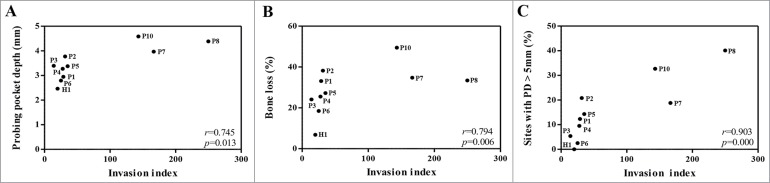
Porphyromonas gingivalis is one of the well-characterized periodontal pathogens involved in periodontitis. The invasive and proteolytic activities of P. gingivalis clinical isolates have been shown to be associated with heterogenic virulence, as determined in a mouse abscess model. The aims of the present study were to identify a P. gingivalis strain with a low virulence among clinical isolates, based on its invasive ability and cytokine proteolytic activities, and to explore the preferential degradation of a certain cytokine by P. gingivalis. P. gingivalis ATCC 33277, W50, and 10 clinical isolates were used. After incubating bacteria with IL-4, IL-6, IL-10, IL-17A, TNFα, IFNγ, and IL-1α, the amounts of remaining cytokines were determined by ELISA. Invasion ability was measured by a flow cytometric invasion assay. There was inter-strain variability both in the cytokine proteolytic activities and invasion ability. In addition, differential degradation of cytokines by P. gingivalis was observed: while IFNγ and IL-17A were almost completely degraded, inflammatory cytokines TNFα and IL-1α were less susceptible to degradation. Interestingly, the invasion index, but not cytokine proteolytic activities, of P. gingivalis had strong positive correlations with clinical parameters of subjects who harbored the isolates. Therefore, the invasive ability of P. gingivalis is an important virulence factor, and the bacterial invasion step may be a good target for new therapeutics of periodontitis.
Keywords: Porphyromonas gingivalis; cytokine proteolytic activity; invasion ability; periodontitis; severity.
Figures



References
-
- Lamont RJ, Hajishengallis G. Polymicrobial synergy and dysbiosis in inflammatory disease. Trends Mol Med 2014; pii: S1471-4914(14):00196-8; PMID:25498392; http://dx.doi.org/ 10.1016/j.molmed.2014.11.004 - DOI - PMC - PubMed
-
- Socransky SS, Haffajee AD, Cugini MA, Smith C, Kent RL, Jr. Microbial complexes in subgingival plaque. J Clin Periodontol 1998; 25: 134-44. PMID:9495612; http://dx.doi.org/ 10.1111/j.1600-051X.1998.tb02419.x - DOI - PubMed
-
- Holt SC, Kesavalu L, Walker S, Genco CA. Virulence factors of Porphyromonas gingivalis. Periodontol 2000. 1999; 20:168-238; PMID:10522227; http://dx.doi.org/ 10.1111/j.1600-0757.1999.tb00162.x - DOI - PubMed
-
- Imamura T. The role of gingipains in the pathogenesis of periodontal disease. J Periodontol 2003; 74:111-8; PMID:12593605; http://dx.doi.org/ 10.1902/jop.2003.74.1.111 - DOI - PubMed
-
- Potempa J, Sroka A, Imamura T, Travis J. Gingipains, the major cysteine proteinases and virulence factors of Porphyromonas gingivalis: structure, function and assembly of multidomain protein complexes. Curr Protein Pept Sci 2003; 4:397-407; PMID:14683426; http://dx.doi.org/ 10.2174/1389203033487036 - DOI - PubMed
Publication types
MeSH terms
Substances
LinkOut - more resources
Full Text Sources
Other Literature Sources
Molecular Biology Databases
