


Genetic engineering of Francisella tularensis LVS for use as a novel live vaccine platform against Pseudomonas aeruginosa infections
- PMID: 25617059
- PMCID: PMC4601302
- DOI: 10.1080/21655979.2015.1011033
Genetic engineering of Francisella tularensis LVS for use as a novel live vaccine platform against Pseudomonas aeruginosa infections
Abstract
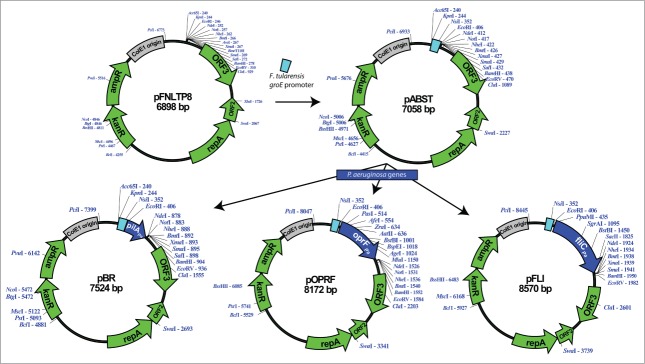
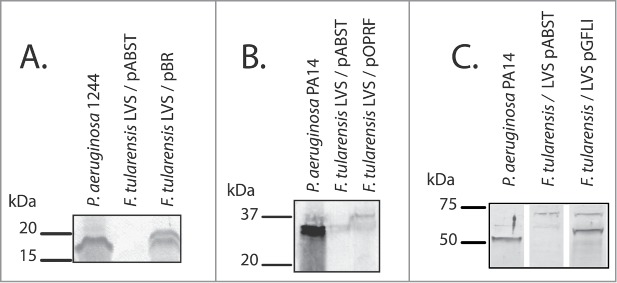
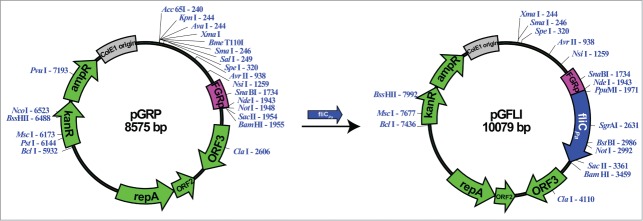
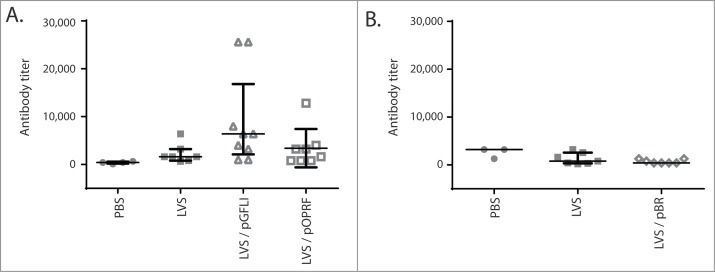
Francisella tularensis LVS (Live Vaccine Strain) is an attenuated bacterium that has been used as a live vaccine. Patients immunized with this organism show a very long-term memory response (over 30 years post vaccination) evidenced by the presence of indicators of robust cell-mediated immunity. Because F. tularensis LVS is such a potent vaccine, we hypothesized that this organism would be an effective vaccine platform. First, we sought to determine if we could genetically modify this strain to produce protective antigens of a heterologous pathogen. Currently, there is not a licensed vaccine against the important opportunistic bacterial pathogen, Pseudomonas aeruginosa. Because many P. aeruginosa strains are also drug resistant, the need for effective vaccines is magnified. Here, F. tularensis LVS was genetically modified to express surface proteins PilAPa, OprFPa, and FliCPa of P. aeruginosa. Immunization of mice with LVS expressing the recombinant FliCPa led to a significant production of antibodies specific for P. aeruginosa. However, mice that had been immunized with LVS expressing PilAPa or OprFPa did not produce high levels of antibodies specific for P. aerugionsa. Therefore, the recombinant LVS strain engineered to produce FliCPa may be able to provide immune protection against a P. aeruginosa challenge. However for future use of this vaccine platform, selection of the appropriate recombinant antigen is critical as not all recombinant antigens expressed in this strain were immunogenic.
Keywords: FliC; Francisella; OprF; PilA; Pseudomonas; flagellum; pilus; recombinant DNA; vaccine.
Figures
References
-
- Ellis J, Oyston PC, Green M, Titball RW. Tularemia. Clin Microbiol Rev 2002; 15(4):631-46; PMID:12364373; http://dx.doi.org/ 10.1128/CMR.15.4.631-646.2002 - DOI - PMC - PubMed
-
- Wayne Conlan J, Oyston PC. Vaccines against Francisella tularensis. Ann N Y Acad Sci 2007; 1105:325-50; PMID:17395730; http://dx.doi.org/ 10.1196/annals.1409.012 - DOI - PubMed
-
- El Sahly HM, Atmar RL, Patel SM, Wells JM, Cate T, Ho M, Guo K, Pasetti MF, Lewis DE, Sztein MB, et al . Safety, reactogenicity and immunogenicity of Francisella tularensis live vaccine strain in humans. Vaccine 2009; 27(36):4905-11; PMID:19567246; http://dx.doi.org/ 10.1016/j.vaccine.2009.06.036 - DOI - PMC - PubMed
-
- Eneslätt K, Rietz C, Rydén P, Stöven S, House RV, Wolfraim LA, Tärnvik A, Sjöstedt A. Persistence of cell-mediated immunity three decades after vaccination with the live vaccine strain of Francisella tularensis. Eur J Immunol 2011; 41(4):974-80; http://dx.doi.org/ 10.1002/eji.201040923 - DOI - PMC - PubMed
-
- Sharma A, Krause A, Worgall S. Recent developments for Pseudomonas vaccines. Hum Vaccin 2011; 7(10):999-1011; PMID:21941090; http://dx.doi.org/ 10.4161/hv.7.10.16369 - DOI - PMC - PubMed
Publication types
MeSH terms
Substances
Grants and funding
LinkOut - more resources
Full Text Sources
Other Literature Sources
