


A controlled examination of two coping skills for daily alcohol use and PTSD symptom severity among dually diagnosed individuals
- PMID: 25617814
- PMCID: PMC4346423
- DOI: 10.1016/j.brat.2014.12.013
A controlled examination of two coping skills for daily alcohol use and PTSD symptom severity among dually diagnosed individuals
Abstract
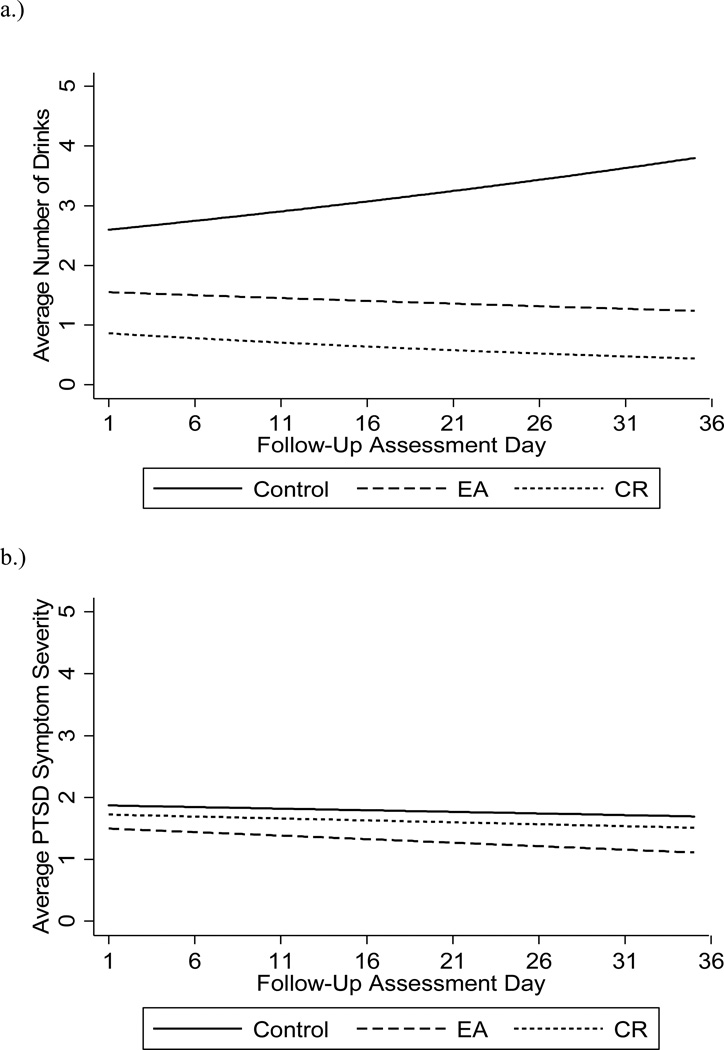
Investigations of targeted coping skills could help guide initial treatment decisions for individuals with co-occurring posttraumatic stress disorder (PTSD) and alcohol dependence (AD) who often endorse worse coping skills than those with AD but not PTSD. Although improvement in coping skills is associated with enhanced alcohol use outcomes, no study has evaluated the utility of teaching specific coping skills in the context of comorbid PTSD/AD. We compared the effects of teaching two coping skills (cognitive restructuring [CR] and experiential acceptance [EA]) or an attention control condition on drinking and PTSD symptoms among 78 men and women with comorbid PTSD/AD during a 5-week daily follow-up assessment. Both CR and EA skills were associated with decreased drinking compared to control, and that change in drinking over time did not significantly differ between those who received CR and EA. Individuals who received CR skills, however, consumed less alcohol on a given day than those who received EA skills. Neither CR nor EA was associated with a decrease in PTSD symptom severity. These results provide preliminary support for clinicians to prioritize CR and EA skills during initial treatment sessions when working with individuals with PTSD/AD, and offer ideas for continued investigation and intervention refinement.
Keywords: Alcohol dependence; Cognitive restructuring; Coping behavior; Dual diagnosis; Experiential acceptance; Posttraumatic stress disorder.
Copyright © 2014 Elsevier Ltd. All rights reserved.
Conflict of interest statement
All authors declare that they have no conflicts of interest.
Figures

References
-
- Abramowitz JS, Tolin DF, Street GP. Paradoxical effects of thought suppression: A meta-analysis of controlled studies. Clinical Psychology Review. 2001;21:683–703. - PubMed
-
- Allison PD. Missing data. In: Millsap RE, Maydeu-Olivares A, editors. The SAGE Handbook of Quantitative Methods in Psychology. Thousand Oaks, CA: SAGE Publications Inc; 2009. pp. 72–89.
-
- American Psychiatric Association. Diagnostic and Statistical Manual of Mental Disorders. 4th Ed. Washington DC: Author; 1994.
-
- Baer RA. Mindfulness training as a clinical intervention: A conceptual and empirical review. Clinical Psychology: Science and Practice. 2003;10:125–143.
-
- Bandura A. Social learning of moral judgments. Journal of Personality and Social Psychology. 1969;11:275–279. - PubMed
Publication types
MeSH terms
Grants and funding
LinkOut - more resources
Full Text Sources
Other Literature Sources
Medical
