


A comparative study on the expression profile of MCTs and HSPs in Ghungroo and Large White Yorkshire breeds of pigs during different seasons
- PMID: 25618330
- PMCID: PMC4406938
- DOI: 10.1007/s12192-014-0569-5
A comparative study on the expression profile of MCTs and HSPs in Ghungroo and Large White Yorkshire breeds of pigs during different seasons
Abstract
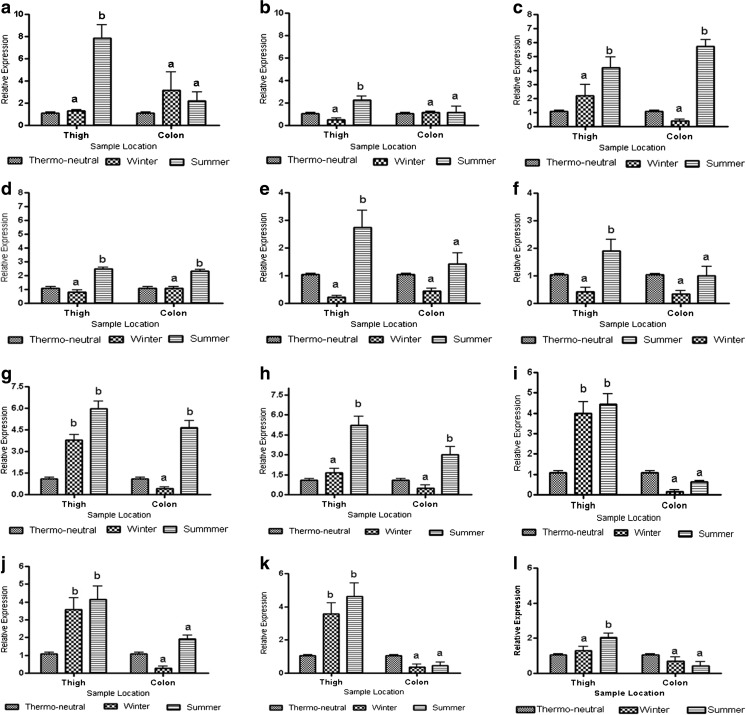
Thermal stress has a significant adverse effect on commercial swine production but it is not easy to measure. Animals may adapt to stress conditions by an alteration in the expression of stress-related genes such as heat shock proteins (HSPs) and monocarboxylate transporters (MCTs). The present study presents a comparative analysis of seasonally varied effects on the expression profiles of HSPs (27, 70, and 90) and MCTs (1, 2, and 4) transcripts in thigh muscle and colon tissue of Ghungroo and Large White Yorkshire (LWY) breeds of pig. By real-time polymerase chain reaction, the mRNA expression of HSP27 and HSP90 genes was found to be higher in both thigh muscle and colon tissue in Ghungroo compared to Large White Yorkshire pigs during the summer. However, the relative expression of HSP70 was significantly higher (P < 0.01) in Ghungroo compared to Large White Yorkshire pigs during both seasons in both thigh muscle and colon tissue. The expression of HSP90 was higher in Ghungroo when compared to LWY though the variation was non-significant (P > 0.05) in the colon during different seasons. However, in Ghungroo, the mRNA expression of MCT1 was found to be significantly (P < 0.05) higher in thigh muscle and colon regions during the summer compared to LWY, whereas MCT2 was expressed more in the colon in LWY compared to Ghungroo during the summer. The relative expression of mRNA of MCT4 was found to be significantly (P < 0.05) higher in thigh region in both summer and winter in Ghungroo compared with LWY. Thus, the study demonstrated that both HSPs and MCTs gene expression during thermal stress suggests the possible involvement of these genes in reducing the deleterious effect of thermal stress, thus maintaining cellular integrity and homeostasis in pigs. These genes could be used as suitable markers for the assessment of stress in pigs.
Figures
References
-
- Argenzio RA, Southworth M. Sites of organic acid production and absorption in the gastrointestinal tract of the pig. Am J Physiol. 1974;228:454–460. - PubMed
-
- Arvans DL, Vavricka SR, Ren HY, Musch MW, Kang L, Rocha FG, Lucioni A, Turner JR, Alverdy J, Chang EB. Luminal bacterial flora determines physiological expression of intestinal epithelial cytoprotective heat shock proteins 25 and 72. Am J Physiol Gastrointest Liver Physiol. 2005;288:G696–G704. doi: 10.1152/ajpgi.00206.2004. - DOI - PubMed
-
- Beecher GR, Kastenschmidt LL, Hoeksta WG, Cassens RG, Briskey EJ. Energy metabolites in red and white striated muscles of the pig. J Agric Food Chem. 1969;17:29–33. doi: 10.1021/jf60161a009. - DOI
Publication types
MeSH terms
Substances
LinkOut - more resources
Full Text Sources
Other Literature Sources
Research Materials
Miscellaneous
