. 2015 Jun;180(3):520-30.
doi: 10.1111/cei.12591. Epub 2015 Apr 19.

Citrate modulates lipopolysaccharide-induced monocyte inflammatory responses

Affiliations

Citrate modulates lipopolysaccharide-induced monocyte inflammatory responses

M J Ashbrook et al. Clin Exp Immunol. 2015 Jun.

Abstract

Citrate, a central component of cellular metabolism, is a widely used anti-coagulant due to its ability to chelate calcium. Adenosine triphosphate (ATP)-citrate lyase, which metabolizes citrate, has been shown to be essential for inflammation, but the ability of exogenous citrate to impact inflammatory signalling cascades remains largely unknown. We hypothesized that citrate would modulate inflammatory responses as both a cellular metabolite and calcium chelator, and tested this hypothesis by determining how clinically relevant levels of citrate modulate monocyte proinflammatory responses to lipopolysaccharide (LPS) in a human acute monocytic leukaemia cell line (THP-1). In normal medium (0.4 mM calcium), citrate inhibited LPS-induced tumour necrosis factor (TNF)-α and interleukin (IL)-8 transcripts, whereas in medium supplemented with calcium (1.4 mM), TNF-α and IL-8 levels increased and appeared independent of calcium chelation. Using an IL-8-luciferase plasmid construct, the same increased response was observed in the activation of the IL-8 promoter region, suggesting transcriptional regulation. Tricarballylic acid, an inhibitor of ATP-citrate lyase, blocked the ability of citrate to augment TNF-α, linking citrate's augmentation effect with its metabolism by ATP-citrate lyase. In the presence of citrate, increased histone acetylation was observed in the TNF-α and IL-8 promoter regions of THP-1 cells. We observed that citrate can both augment and inhibit proinflammatory cytokine production via modulation of inflammatory gene transactivation. These findings suggest that citrate anti-coagulation may alter immune function through complex interactions with the inflammatory response.

Keywords: citrate; epigenetics; inflammation; monocytes.


Figures

Fig 1
Fig 1
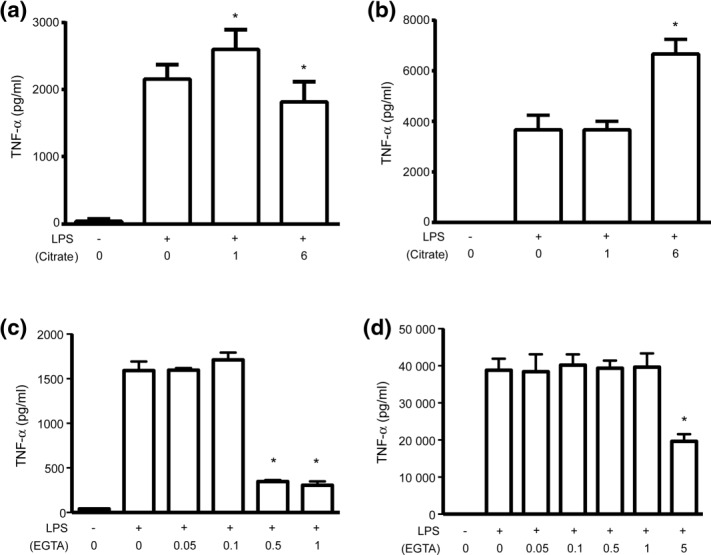
Citrate augments and inhibits tumour necrosis factor (TNF)-α protein production. Human acute monocytic leukaemia cell line (THP-1) cells were incubated (30 min) with varying concentrations of citrate (a,b) or ethylene glycol tetraacetic acid (EGTA) (c,d) prior to stimulation with lipopolysaccharide (LPS) (6 h). TNF-α protein production was determined by enzyme-linked immunosorbent assay (ELISA) in normal medium (0·4 mM calcium, a,c) and in supplemental calcium medium (1·4 mM, b,d) (*<0·05, n.s. = not significant).
Fig 2
Fig 2
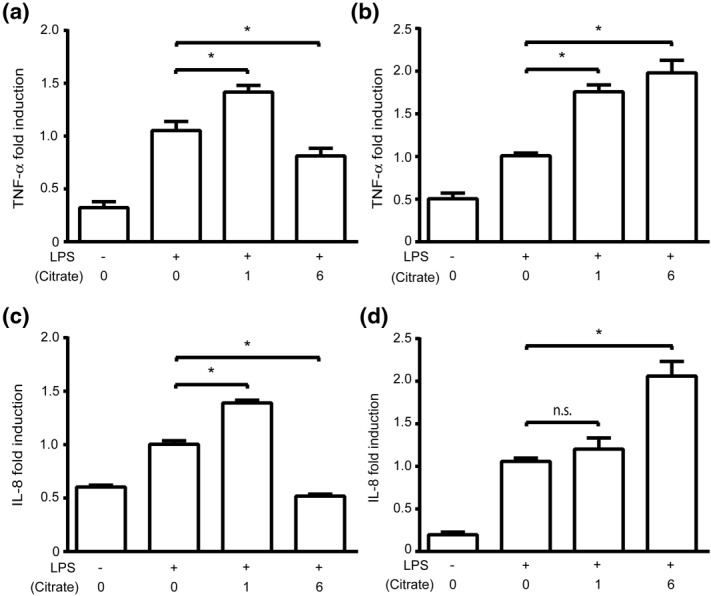
Citrate augments and inhibits proinflammatory cytokine mRNA production. Human acute monocytic leukaemia cell line (THP-1) cells were incubated (30 min) with varying concentrations of citrate prior to stimulation with lipopolysaccharide (LPS) (2 h). mRNA was isolated and subsequently analysed by quantitative polymerase chain reaction (qPCR). (a) Tumour necrosis factor (TNF)-α mRNA production in normal calcium medium (0·4 mM). (b) TNF-α mRNA production in supplemental calcium medium (1·4 mM). (c) IL-8 mRNA production in normal calcium medium (0·4 mM). (d) IL-8 mRNA production in supplemental calcium medium (1·4 mM). Data were normalized to the LPS-stimulated sample with no citrate (*P<0·05, n.s. = not significant).
Fig 3
Fig 3
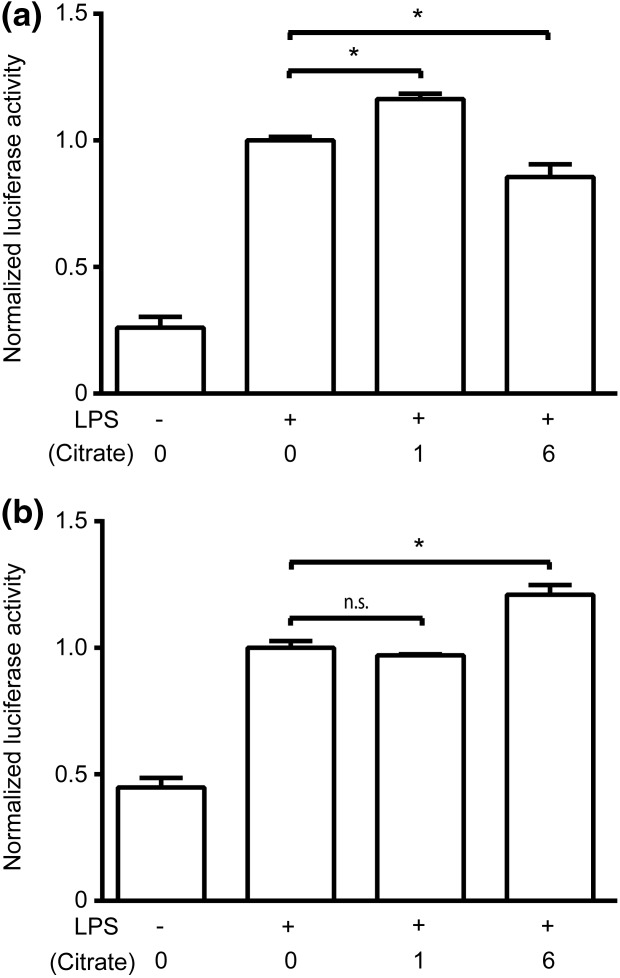
Citrate affects transactivation of the interleukin (IL)-8 promoter. Human acute monocytic leukaemia cell line (THP-1) cells were transiently transfected with a −162/+44 hIL-8 luc plasmid. Cells were stimulated with lipopolysaccharide (LPS) for 4 h following preincubation with varying concentrations of citrate in either (a) normal medium (0·4 mM calcium) or (b) supplemental calcium medium (1·4 mM). Luciferase activity was measured using a Luciferase Assay System (Promega) and a Spectramax M3 spectrophotometer (Molecular Devices). Data were normalized to the LPS-stimulated sample with no citrate (*P<0·05, n.s. = not significant).
Fig 4
Fig 4
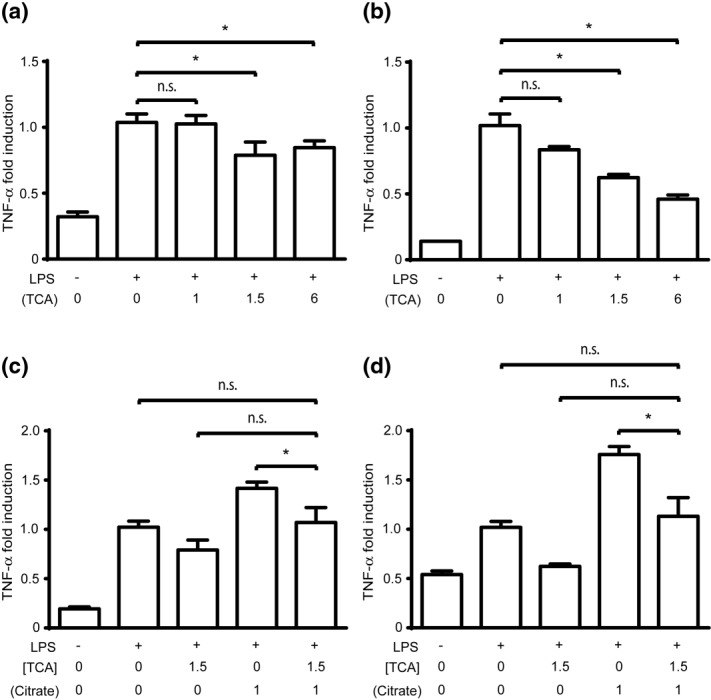
Tricarballylic acid (TCA) inhibits monocyte inflammatory responses. (a,b) Human acute monocytic leukaemia cell line (THP-1) cells were stimulated with lipopolysaccharide (LPS) (2 h) following preincubation with varying concentrations of TCA to determine tumour necrosis factor (TNF)-α mRNA production in (a) normal calcium (0·4 mM) or (b) supplemental calcium (1·4 mM) media. (c,d) THP-1 cells were pretreated (0·5 h) with TCA (1·5 mM) alone, citrate (1 mM) alone, or co-incubated with citrate and TCA prior to LPS stimulation to determine TNF-α mRNA production (2 h) in (c) normal calcium (0·4 mM) or (d) supplemental calcium (1·4 mM) media. Data were normalized to the LPS-stimulated sample with no citrate or TCA (*P<0·05, n.s. = not significant).
Fig 5
Fig 5
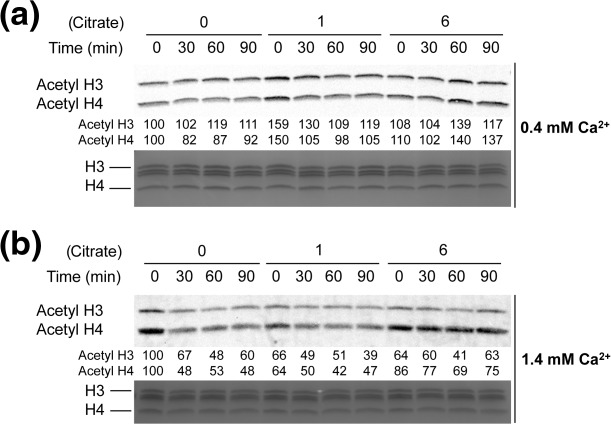
Citrate modulates global histone acetylation. Changes in histone H3 and H4 global acetylation were determined by Western blot in acid-extracted lysates of human acute monocytic leukaemia cell line (THP-1) cells. Cells were preincubated with varying concentrations of citrate (0, 1, 6 mM) prior to stimulation with lipopolysaccharide (LPS) (0–90 min) in (a) normal calcium (0·4 mM) or (b) supplemental calcium (1·4 mM) media. Relative band intensity is represented by the numbers below the Western blots with the no citrate time zero condition assigned a relative value of 100.
Fig 6
Fig 6
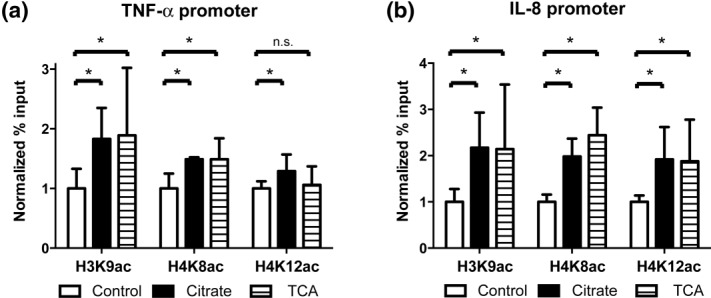
Citrate increases histone lysine acetylation at inflammatory gene promoters. Chromatin immunoprecipitation (ChIP) assays were performed in a human acute monocytic leukaemia cell line (THP-1) with antibodies against histone H3K9ac, H4K8ac and H4K12ac following preincubation with citrate (1 mM) or tricarballylic acid (TCA) (1·5 mM) in supplemental calcium medium (1·4 mM). The efficiency of the experimental ChIP for the specified genomic locus was calculated from quantitative polymerase chain reaction (qPCR) data as a percentage of starting material with the same primer set (% input) and then normalized to control conditions. (a) Tumour necrosis factor (TNF)-α. (b) Interleukin (IL)-8. Error bars represent standard deviation calculated from at least three separate experiments. (*P<0·01, n.s. = not significant).

References

    1. Garcia DA, Baglin TP, Weitz JI, Samama MM American College of Chest Physicians. Parenteral anticoagulants: antithrombotic therapy and prevention of thrombosis, 9th edn. American College of Chest Physicians evidence-based clinical practice guidelines. Chest. 2012;141:e24S–43S. - PMC - PubMed
    1. Kao GS, Kim HT, Daley H, et al. Validation of short-term handling and storage conditions for marrow and peripheral blood stem cell products. Transfusion. 2011;51:137–47. - PubMed
    1. Tolwani A, Wille KM. Advances in continuous renal replacement therapy: citrate anticoagulation update. Blood Purif. 2012;34:88–93. - PubMed
    1. Engstad CS, Gutteberg TJ, Osterud B. Modulation of blood cell activation by four commonly used anticoagulants. Thromb Haemost. 1997;77:690–6. - PubMed
    1. Chadha V, Garg U, Warady BA, Alon US. Citrate clearance in children receiving continuous venovenous renal replacement therapy. Pediatr Nephrol. 2002;17:819–24. - PubMed

Publication types

MeSH terms