Review
. 2015 Mar;185(3):602-9.
doi: 10.1016/j.ajpath.2014.10.027. Epub 2015 Jan 22.

Functional role of cellular senescence in biliary injury

Affiliations
Review

Functional role of cellular senescence in biliary injury

Luke Meng et al. Am J Pathol. 2015 Mar.

Abstract

Cellular senescence is a state of irreversible cell cycle arrest that has been involved in many gastrointestinal diseases, including human cholestatic liver disorders. Senescence may play a role in biliary atresia, primary sclerosing cholangitis, cellular rejection, and primary biliary cirrhosis, four liver diseases affecting cholangiocytes and the biliary system. In this review, we examine proposed mechanisms of senescence-related biliary diseases, including hypotheses associated with the senescence-associated phenotype, induction of senescence in nearby cells, and the depletion of stem cell subpopulations. Current evidence for the molecular mechanisms of senescence in the previously mentioned diseases is discussed in detail, with attention to recent advances on the role of pathways associated with senescence-associated phenotype, stress-induced senescence, telomere dysfunction, and autophagy.


Figures

Figure 1
Figure 1
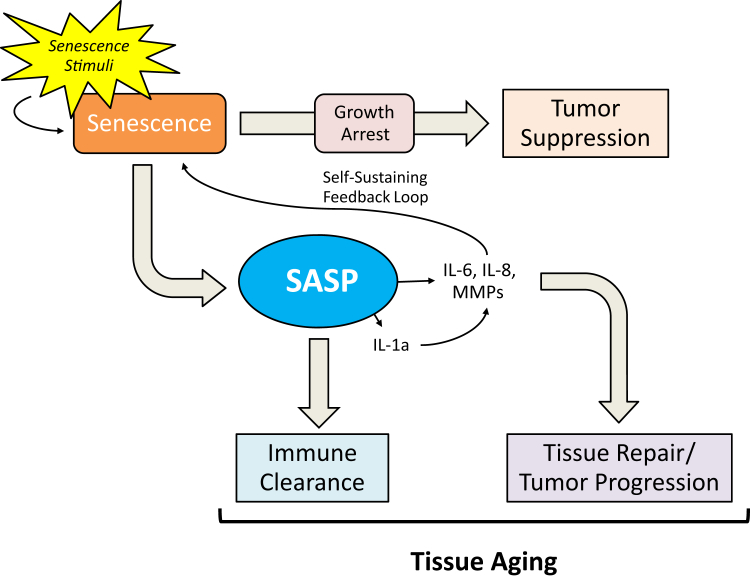
The senescence-associated secretory phenotype (SASP) during aging, cancer development, and progression. Cellular senescence has dual effects on human health during the progression of aging and various human disorders. The beneficial effects include tumor suppression and tissue repair after injury; the deleterious effects include tumor and aging promotion that involve several key SASP molecules, including IL-6, IL-8, matrix metalloproteinases (MMPs), and specific miRNAs.
Figure 2
Figure 2
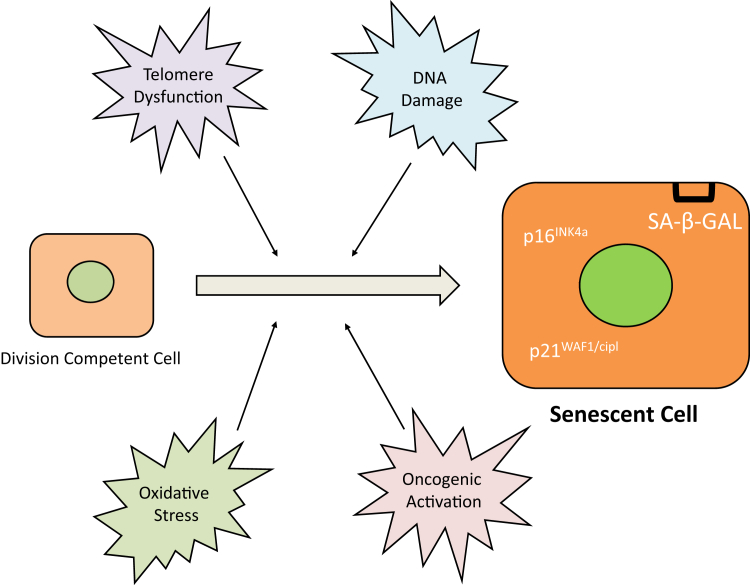
Overview of senescence. Various factors, such as telomeric dysfunction, DNA damage, oncogenic activation, and oxidative stress, induce senescence in division competent cells. On becoming senescent, the cell and its nucleus become enlarged and begin to express p16INK4a, p21WAF1/Cip1, and senescence-associated β-galactosidase (SA-β-GAL). Senescent cells present a large flattened morphology and build up a SA-β-GAL activity that distinguishes them from most quiescent cells.
Figure 3
Figure 3
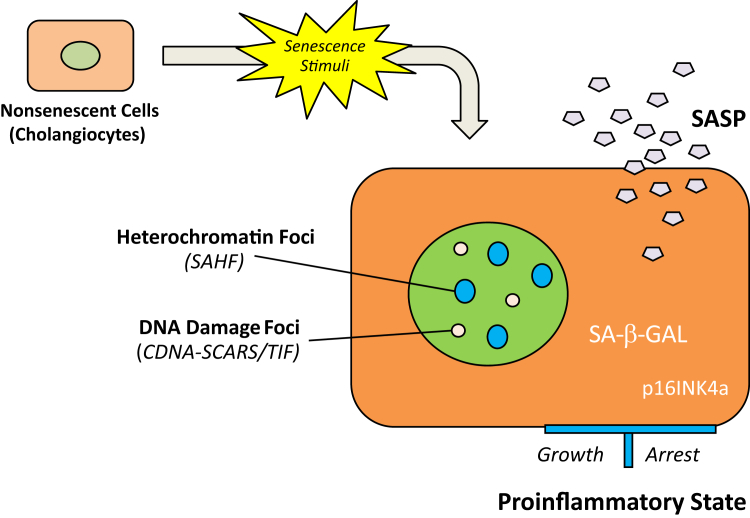
Formation of senescence-associated secretory phenotype (SASP). Senescent cells/cholangiocytes display different phenotypes from quiescent or terminally differentiated cells (nondividing), whereas the definite feature of the senescent phenotype is notably defined. The significant markers of senescent cells/cholangiocytes include an essentially irreversible growth arrest; expression of senescence-associated β-galactosidase (SA-β-GAL) and p16INK4a; nuclear foci containing DNA damage response proteins (DNA-SCARS/TIF) or senescence-associated heterochromatin foci (SAHF); and robust secretion of various growth factors, cytokines (proinflammatory), proteases, and other proteins, such as SASP. Proinflammatory SASP mediators (C-X-C chemokine receptor 2, IL-6, and IL-6 receptor) can reinforce cellular senescence in an autocrine or paracrine manner. The secretion of SASP is the most significant of these effects because it turns senescent cells/cholangiocytes into a proinflammatory state that has the ability to promote disease progression. SCARS, segments with chromatin alterations reinforcing senescence; TIF, telomere dysfunction-induced foci.
Figure 4
Figure 4
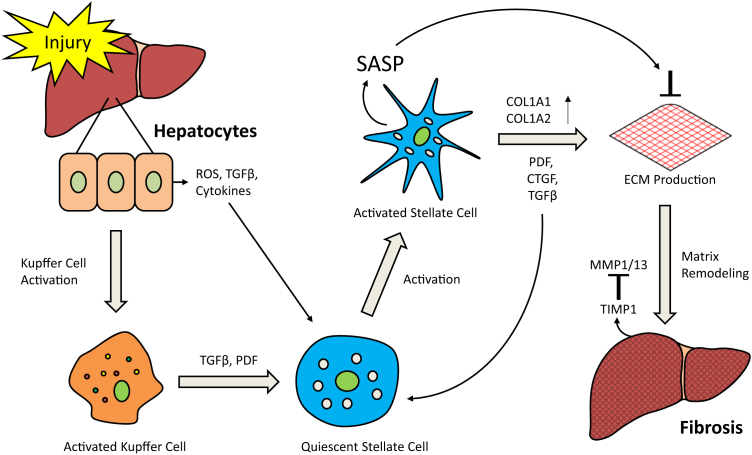
Recovery effect of hepatic stellate cells drives the senescence-associated secretory phenotype (SASP) during liver fibrosis. The secretion of SASP by activated stellate cells can prevent further proliferation of extracellular matrix (ECM)-producing cells, promote ECM degradation, and accelerate clearance of activated hepatic stellate cells from the site of liver injury/fibrosis. COL1A1, type I collagen; COL1A2, collagen 1 chain type II; CTGF, connective tissue growth factor; MMP, matrix metalloproteinases; PDF, pigment-dispersing factor; ROS, reactive oxygen species; TGF, transforming growth factor; TIMP, tissue inhibitor of metalloproteinases.

References

    1. Rodier F., Campisi J. Four faces of cellular senescence. J Cell Biol. 2011;192:547–556. - PMC - PubMed
    1. Sasaki M., Nakanuma Y. Novel approach to bile duct damage in primary biliary cirrhosis: participation of cellular senescence and autophagy. Int J Hepatol. 2012;2012:452143. - PMC - PubMed
    1. Yildiz G., Arslan-Ergul A., Bagislar S., Konu O., Yuzugullu H., Gursoy-Yuzugullu O., Ozturk N., Ozen C., Ozdag H., Erdal E., Karademir S., Sagol O., Mizrak D., Bozkaya H., Ilk H.G., Ilk O., Bilen B., Cetin-Atalay R., Akar N., Ozturk M. Genome-wide transcriptional reorganization associated with senescence-to-immortality switch during human hepatocellular carcinogenesis. PLoS One. 2013;8:e64016. - PMC - PubMed
    1. Krizhanovsky V., Xue W., Zender L., Yon M., Hernando E., Lowe S.W. Implications of cellular senescence in tissue damage response, tumor suppression, and stem cell biology. Cold Spring Harb Symp Quant Biol. 2008;73:513–522. - PMC - PubMed
    1. Ozturk M., Arslan-Ergul A., Bagislar S., Senturk S., Yuzugullu H. Senescence and immortality in hepatocellular carcinoma. Cancer Lett. 2009;286:103–113. - PubMed

Publication types

LinkOut - more resources