


Comparison of dehydroepiandrosterone (DHEA) and pregnanolone with existing pharmacotherapies for alcohol abuse on ethanol- and food-maintained responding in male rats
- PMID: 25620274
- PMCID: PMC4514518
- DOI: 10.1016/j.alcohol.2014.07.024
Comparison of dehydroepiandrosterone (DHEA) and pregnanolone with existing pharmacotherapies for alcohol abuse on ethanol- and food-maintained responding in male rats
Abstract
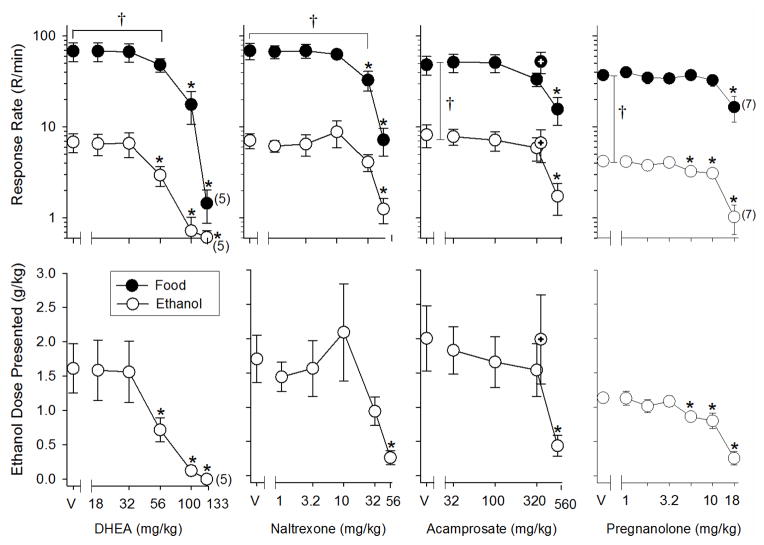
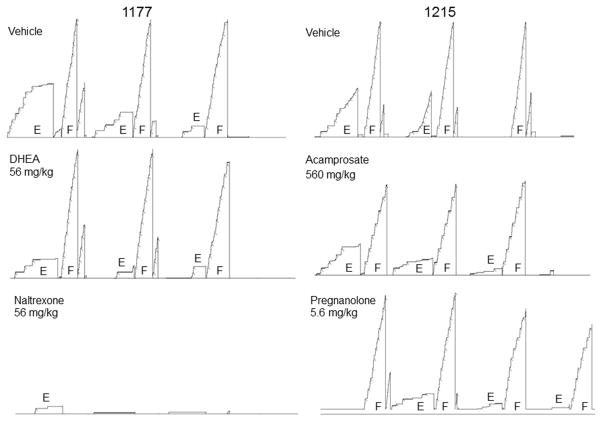
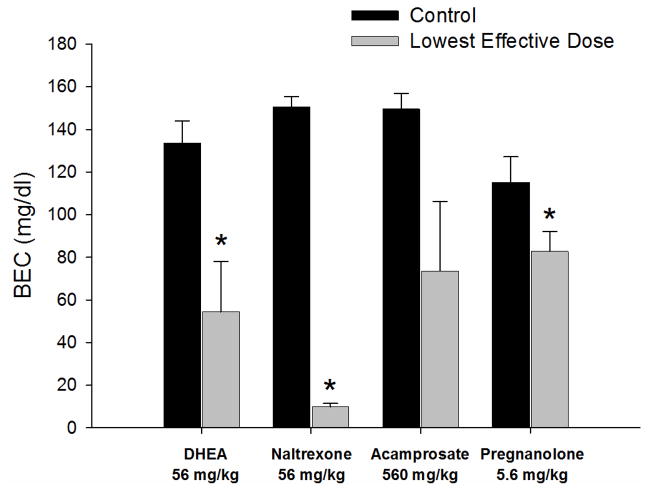
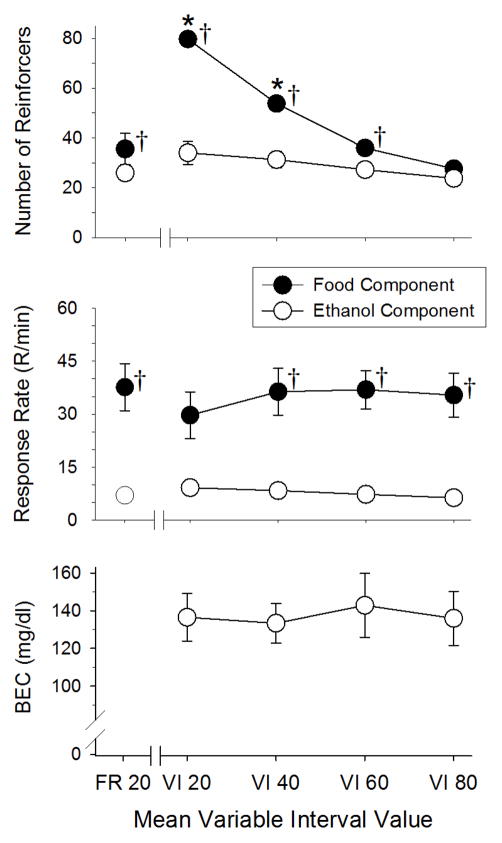
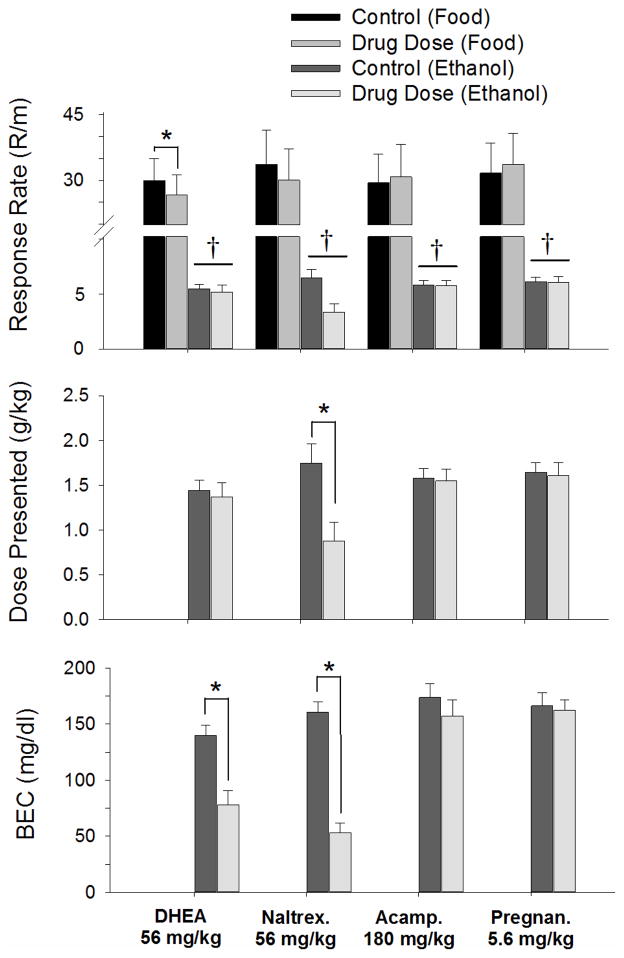
The present study compared two putative pharmacotherapies for alcohol abuse and dependence, dehydroepiandrosterone (DHEA) and pregnanolone, with two Food and Drug Administration (FDA)-approved pharmacotherapies, naltrexone and acamprosate. Experiment 1 assessed the effects of different doses of DHEA, pregnanolone, naltrexone, and acamprosate on both ethanol- and food-maintained responding under a multiple fixed-ratio (FR)-10 FR-20 schedule, respectively. Experiment 2 assessed the effects of different mean intervals of food presentation on responding for ethanol under a FR-10 variable-interval (VI) schedule, whereas Experiment 3 assessed the effects of a single dose of each drug under a FR-10 VI-80 schedule. In Experiment 1, all four drugs dose-dependently decreased response rate for both food and ethanol, although differences in the rate-decreasing effects were apparent among the drugs. DHEA and pregnanolone decreased ethanol-maintained responding more potently than food-maintained responding, whereas the reverse was true for naltrexone. Acamprosate decreased responding for both reinforcers with equal potency. In Experiment 2, different mean intervals of food presentation significantly affected the number of food reinforcers obtained per session; however, changes in the number of food reinforcements did not significantly affect responding for ethanol. Under the FR-10 VI-80 schedule in Experiment 3, only naltrexone significantly decreased both the dose of alcohol presented and blood ethanol concentration (BEC). Acamprosate and pregnanolone had no significant effects on any of the dependent measures, whereas DHEA significantly decreased BEC, but did not significantly decrease response rate or the dose presented. In summary, DHEA and pregnanolone decreased ethanol-maintained responding more potently than food-maintained responding under a multiple FR-10 FR-20 schedule, and were more selective for decreasing ethanol self-administration than either naltrexone or acamprosate under that schedule. Experiment 2 showed that ethanol intake was relatively independent of the interval of reinforcement in the food-maintained component, and Experiment 3 showed that naltrexone was the most effective drug at the doses tested when the interval for food reinforcement was low and maintained under a variable-interval schedule.
Keywords: Acamprosate; DHEA; Ethanol; Multiple schedules; Naltrexone; Pregnanolone.
Copyright © 2015 Elsevier Inc. All rights reserved.
Conflict of interest statement
All authors also deny any financial, personal, or other conflicts of interest that may inappropriately affect or influence the presentation or interpretation of the findings described in this manuscript. Finally, the authors would like to express their gratitude for the expert assistance of Mr. Peter B. Lewis.
Figures
References
-
- Akk G, Li P, Manion BD, Evers AS, Steinbach JH. Ethanol modulates the interaction of the endogenous neurosteroid allopregnanolone with the alpha1beta2gamma2L GABAA receptor. Molecular Pharmacology. 2007;71:461–472. - PubMed
-
- American Psychiatric Association. Diagnostic and Statistical Manual of Mental Disorders, Text Revision. 4. Washington, DC: American Psychiatric Association; 2000.
-
- Anker JJ, Carroll ME. Females are more vulnerable to drug abuse than males: evidence from preclinical studies and the role of ovarian hormones. Current Topics in Behavioral Neurosciences. 2011;8:73–96. - PubMed
Publication types
MeSH terms
Substances
Grants and funding
LinkOut - more resources
Full Text Sources
Other Literature Sources
Medical
