


Newborn screening and diagnosis of mucopolysaccharidoses: application of tandem mass spectrometry
- PMID: 25620850
- PMCID: PMC4303184
Newborn screening and diagnosis of mucopolysaccharidoses: application of tandem mass spectrometry
Abstract
Mucopolysaccharidoses (MPS) are a group of lysosomal storage disorders caused by the deficiency of lysosomal enzymes. The enzymes are required to break down glycosaminoglycans (GAGs) that help build bone, cartilage, tendons, corneas, skin and connective tissue. In patients with MPS, a missing enzyme leads to the accumulation of GAGs in the cells, blood, connective tissues, and multiple organs. The consequence is permanent, with progressive cellular damage affecting patients' appearance, physical abilities, organ and system function, and skeletal and mental development. The measurement of each specific GAG in a variety of specimens is required to establish the correlation between GAGs and physiological status of patients and/or prognosis and pathogenesis of the disease and to separate the patients with MPS from the healthy controls. We have developed a highly accurate, sensitive, and cost-effective liquid chromatography tandem mass spectrometry (LC-MS/MS) method for measurements of disaccharides derived from four specific GAGs [chondroitin sulfate (CS), dermatan sulfate (DS), heparan sulfate (HS), and keratan sulfate (KS)]. Disaccharides were produced by specific enzyme digestion of each GAG, and subsequently, quantified by negative ion mode of multiple reaction monitoring. Subclasses of GAGs with the same molecular weights can be separated by liquid chromatography. We have also developed another GAG assay by high-throughput mass spectrometry (HT-MS/MS). The HT-MS/MS consists of an integrated solid phase extraction robot that binds and de-salts samples from assay plates and directly injects them into a MS/MS detector, reducing sample processing time to within ten seconds. HT-MS/MS consequently yields much faster throughput than conventional LC-MS/MS-based methods; however, the HT-MS/MS system does not use a chromatographic step, and therefore, cannot separate GAGs that have the same molecular weights. Both techniques can be applied to the analysis of dried blood spots, blood, and urine specimens. In this review, we describe the assay methods for GAGs and the application to newborn screening and diagnosis of MPS.
Keywords: diagnosis; glycosaminoglycans; mucopolysaccharidoses; newborn screening; tandem mass spectrometry.
Figures
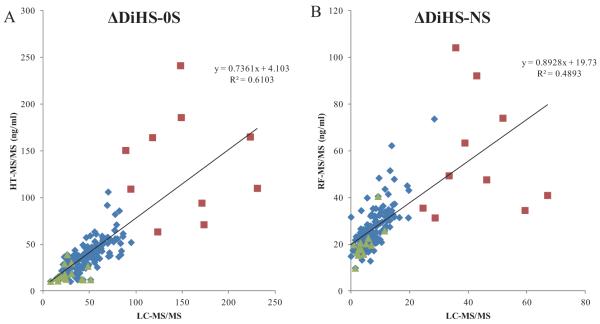
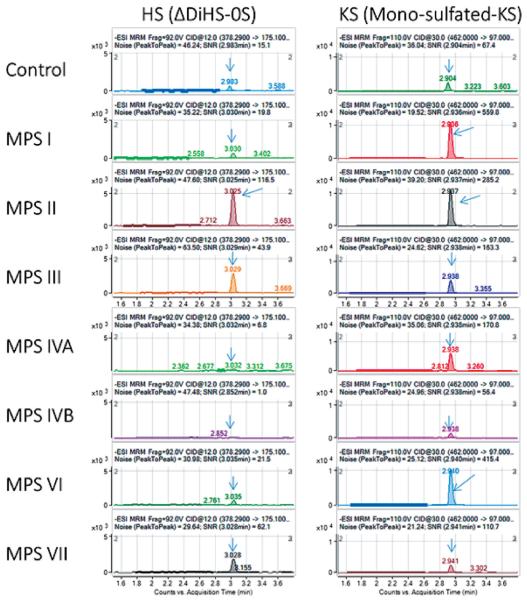
ΔDiHS-NS concentration. Correlation in blood (plasma or serum) ΔDiHS-NS of human subjects between LC-MS/MS and HT-MS/MS is significant (Control n = 187, MPS IVA n = 17, MPS II n = 10, p<0.0001).
ΔDiHS-0S concentration. Correlation in blood (plasma or serum) ΔDiHS-0S of human subjects between LC-MS/MS and HT-MS/MS is significant (Control n = 187, MPS IVA n = 17, MPS II n = 10, p<0.0001).
References
-
- Auclair D, Hopwood JJ, Brooks DA, Lemontt JF, Crawley AC. Replacement therapy in Mucopolysaccharidosis type VI: advantages of early onset of therapy. Mol. Genet. Metab. 2003;78:163–174. - PubMed
-
- Baldo G, Mayer FQ, Martinelli BZ, et al. Enzyme replacement therapy started at birth improves outcome in difficult-to-treat organs in mucopolysaccharidosis I mice. Mol. Genet. Metab. 2013;109:33–40. - PubMed
Grants and funding
LinkOut - more resources
Full Text Sources