


Diversification practices reduce organic to conventional yield gap
- PMID: 25621333
- PMCID: PMC4286047
- DOI: 10.1098/rspb.2014.1396
Diversification practices reduce organic to conventional yield gap
Abstract
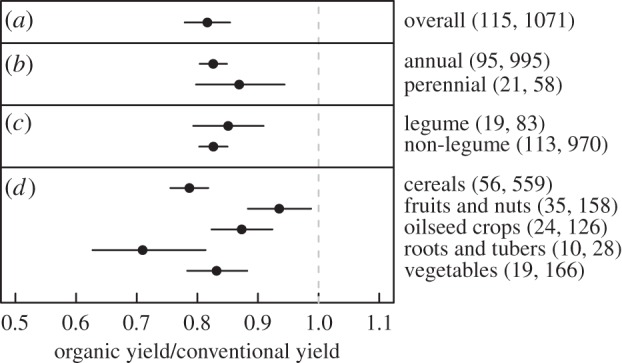
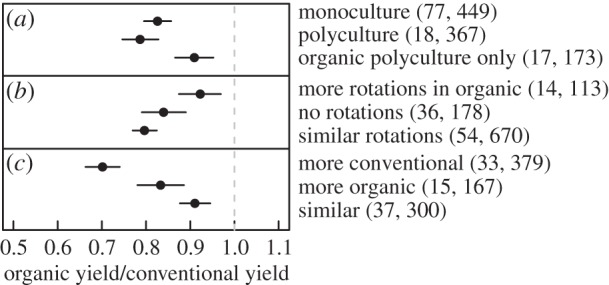
Agriculture today places great strains on biodiversity, soils, water and the atmosphere, and these strains will be exacerbated if current trends in population growth, meat and energy consumption, and food waste continue. Thus, farming systems that are both highly productive and minimize environmental harms are critically needed. How organic agriculture may contribute to world food production has been subject to vigorous debate over the past decade. Here, we revisit this topic comparing organic and conventional yields with a new meta-dataset three times larger than previously used (115 studies containing more than 1000 observations) and a new hierarchical analytical framework that can better account for the heterogeneity and structure in the data. We find organic yields are only 19.2% (±3.7%) lower than conventional yields, a smaller yield gap than previous estimates. More importantly, we find entirely different effects of crop types and management practices on the yield gap compared with previous studies. For example, we found no significant differences in yields for leguminous versus non-leguminous crops, perennials versus annuals or developed versus developing countries. Instead, we found the novel result that two agricultural diversification practices, multi-cropping and crop rotations, substantially reduce the yield gap (to 9 ± 4% and 8 ± 5%, respectively) when the methods were applied in only organic systems. These promising results, based on robust analysis of a larger meta-dataset, suggest that appropriate investment in agroecological research to improve organic management systems could greatly reduce or eliminate the yield gap for some crops or regions.
Figures
Comment in
-
Current approaches neglect possible agricultural cutback under large-scale organic farming. A comment to Ponisio et al.Proc Biol Sci. 2016 Feb 10;283(1824):20151623. doi: 10.1098/rspb.2015.1623. Proc Biol Sci. 2016. PMID: 26842565 Free PMC article. No abstract available.
References
-
- Raudsepp-Hearne C, Peterson GD, Tengö M, Bennett EM, Holland T, Benessaiah K, MacDonald GK, Pfeifer L. 2010. Untangling the environmentalist's paradox: why is human well-being increasing as ecosystem services degrade? BioScience 60, 576–589. ( 10.1525/bio.2010.60.8.4) - DOI
Publication types
MeSH terms
Substances
LinkOut - more resources
Full Text Sources
Other Literature Sources
Miscellaneous
