. 2015 Feb 26;58(4):1846-61.
doi: 10.1021/jm501680m. Epub 2015 Feb 4.

Bis-aryl urea derivatives as potent and selective LIM kinase (Limk) inhibitors

Affiliations

Bis-aryl urea derivatives as potent and selective LIM kinase (Limk) inhibitors

Yan Yin et al. J Med Chem. .

Abstract

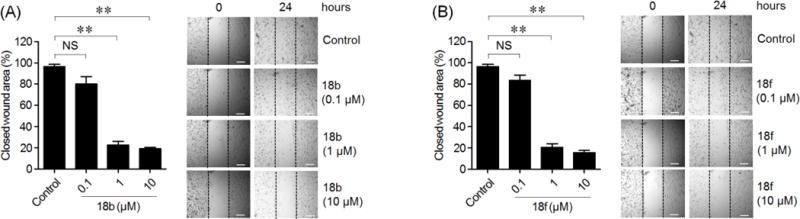
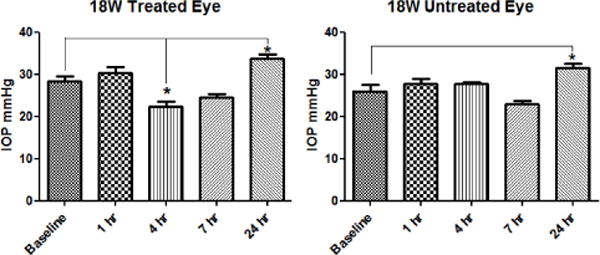
The discovery/optimization of bis-aryl ureas as Limk inhibitors to obtain high potency and selectivity and appropriate pharmacokinetic properties through systematic SAR studies is reported. Docking studies supported the observed SAR. Optimized Limk inhibitors had high biochemical potency (IC50 < 25 nM), excellent selectivity against ROCK and JNK kinases (>400-fold), potent inhibition of cofilin phosphorylation in A7r5, PC-3, and CEM-SS T cells (IC50 < 1 μM), and good in vitro and in vivo pharmacokinetic properties. In the profiling against a panel of 61 kinases, compound 18b at 1 μM inhibited only Limk1 and STK16 with ≥80% inhibition. Compounds 18b and 18f were highly efficient in inhibiting cell-invasion/migration in PC-3 cells. In addition, compound 18w was demonstrated to be effective on reducing intraocular pressure (IOP) on rat eyes. Taken together, these data demonstrated that we had developed a novel class of bis-aryl urea derived potent and selective Limk inhibitors.


Figures
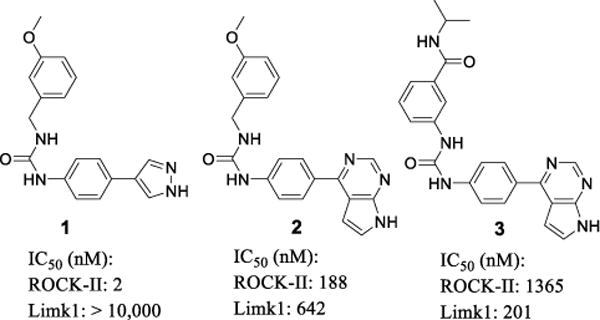
Figure 1
Figure 1
Transition from ROCK inhibition to Limk inhibition for the phenyl urea based scaffold of kinase inhibitors.
Figure 2
Figure 2
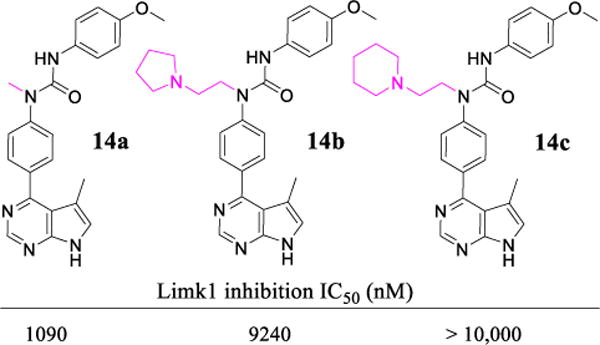
Substitutions on the urea NH attached to the central phenyl group were not tolerated.
Figure 3
Figure 3
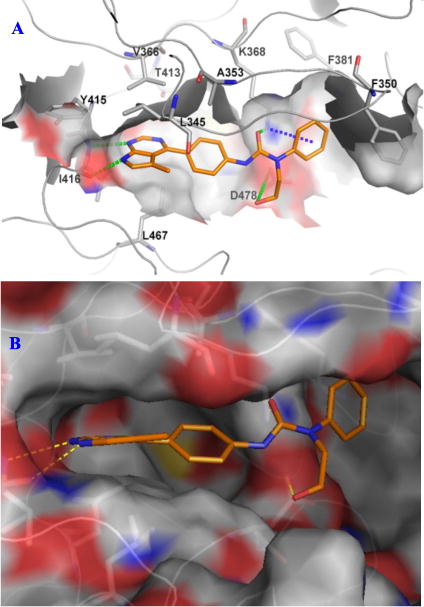
Docking of 18b to the crystal structure of Limk1 (PDB ID 3S95). A) Schematic view showing key interactions. B) Surface view showing the binding pockets.
Figure 4
Figure 4
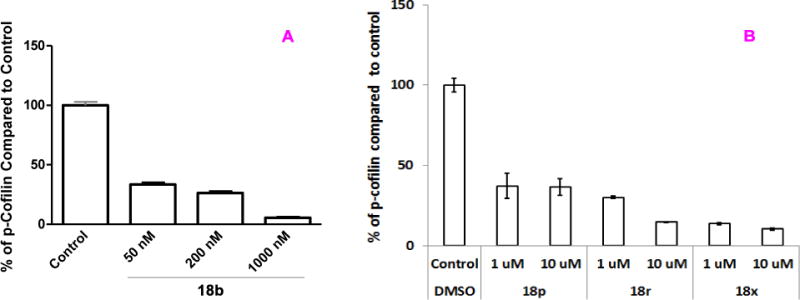
A: Western blot analysis of p-cofilin in PC-3 prostate cancer cell lines stimulated by HGF treated with 18b. Similar cell potency was also observed for compound 18f in PC-3 cells. B: Western blot analysis of p-cofilin in CEM-SS T cell lines for 18p, 18r, and 18x.
Figure 5
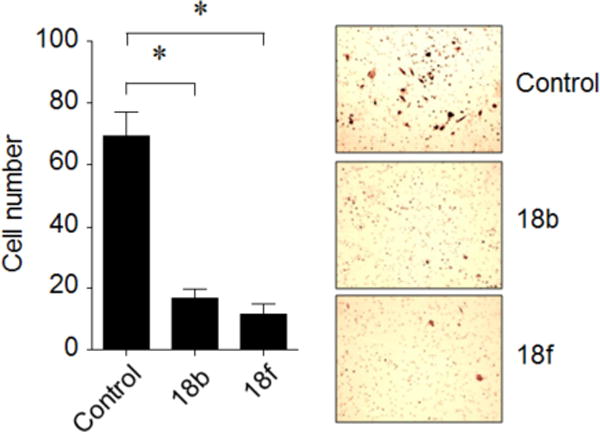
Figure 5. Effect of Limk inhibitors on invasion of PC-3 cell
Comparison of cell invasion (left panel) and phase contrast images (right panel) by treatment of 18b (1 μM) or 18f (1 μM) for 48 hours in PC-3 cells. The results are shown as mean ± SD of one representative experiment (from three independent experiments) performed in triplicate. Statically significant differences are indicated (*) p < 0.05.
Figure 6
Figure 6. Effect of Limk1 inhibitors on migration of PC-3 cells
Comparison of the average (%) of wound closure (left panel) and phase contrast images (right panel) by treatment with indicated concentration of 18b (A) or 18f (B) for 24 hours in PC-3 cells. The results are shown as mean ± SD of one representative experiment (from three independent experiments) performed in triplicate. Statically significant differences are indicated (NS) no significance, and (*) p < 0.01. Scale bar: 20 μm.
Figure 7
Figure 7
IOP lowering effect of 18w on rat eyes. Topical dosing at 50 μg. Data were averaged from 6 determinations (based on 6 rats).
Scheme 1
Scheme 1
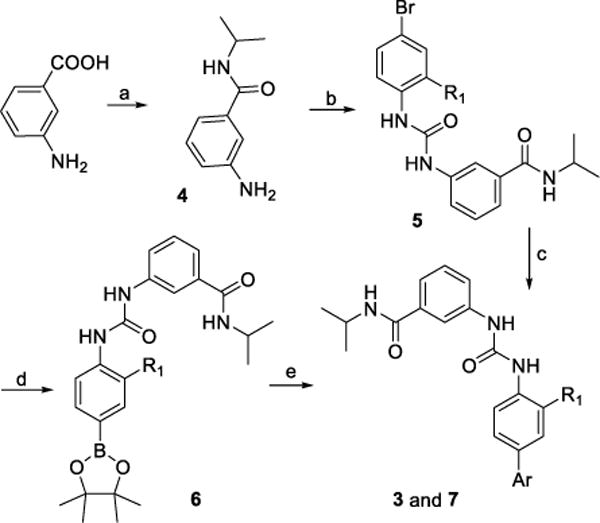
Synthesis of inhibitors 3 and 7. Reagents and conditions: (a) Propan-2-amine, HATU, DIEA, DMF, rt; (b) Isocyanatobenzene derivatives, DCM; (c) Boronic acid pinacol ester, Pd(PPh3)4, Dioxane/H2O, 95 °C; (d) Bis(pinacolato)diboron, PdCl2dppf, Dioxane, reflux; (e) Ar-Cl, Pd(PPh3)4, Dioxane/H2O, 95 °C.
Scheme 2
Scheme 2
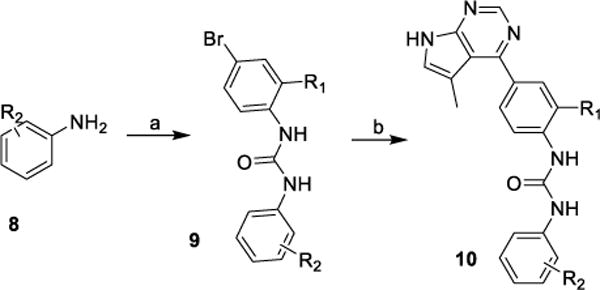
Synthesis of inhibitor 10. Reagents and conditions: (a) Isocyanatobenzene derivatives, DCM, rt; (b) (i) Bis(pinacolato)diboron, PdCl2dppf, Dioxane, reflux; (ii) 4-Chloro-5-methyl-7H-pyrrolo[2,3-d ]pyrimidine, Pd(PPh3)4, Dioxane/H2O, 95 °C.
Scheme 3
Scheme 3
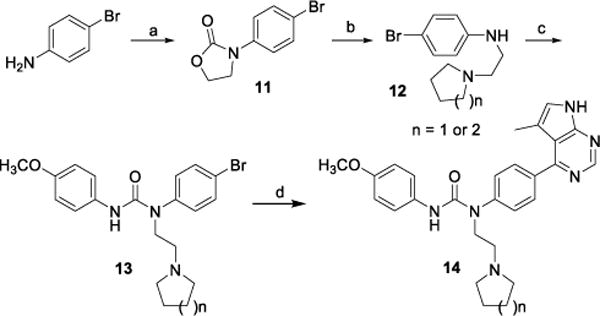
Synthesis of inhibitor 14. Reagents and conditions: (a) 2-Chloroethyl carbonochloridate, K2CO3, CH3CN, reflux; (b) Pyrrolidine or piperidine, DMSO, microwave, 110 °C, 1h; (c) 1-Isocyanato-4-methoxybenzene, DCM; (d) (i) Bis(pinacolato)diboron, PdCl2dppf, Dioxane, reflux; (ii) 4-Chloro-5-methyl-7H-pyrrolo[2,3-d]pyrimidine, Pd(PPh3)4, Dioxane/H2O, 95 °C.
Scheme 4
Scheme 4
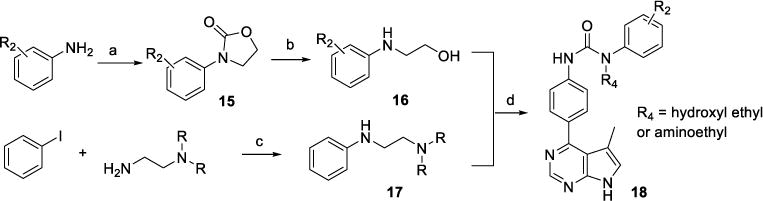
Synthesis of inhibitor 18. Reagents and conditions: (a) 2-Chloroethyl carbonochloridate, Py., DCM, rt; (b) KOH, EtOH, reflux; (c) Pd(dba)2, BINAP, Cs2CO3, Dioxane; (d) (i) 1-Bromo-4-isocyanatobenzene, DCM, rt; (ii) Bis(pinacolato)diboron, PdCl2dppf, Dioxane, reflux; (iii) 4-Chloro-5-methyl-7H-pyrrolo[2,3-d]pyrimidine, Pd(PPh3)4, Dioxane/H2O, 95 °C.

References

    1. Bernard O, Ganiatsas S, Kannourakis G, Dringen R. Kiz-1, a protein with LIM zinc finger and kinase domains, is expressed mainly in neurons. Cell Growth Differ. 1994;5:1159–1171. - PubMed
    1. Stanyon CA, Bernard O. LIM-kinase1. Int J Biochem Cell Biol. 1999;31:389–394. - PubMed
    1. Mizuno K, Okana I, Ohashi K, Nunoue K, Kuma K, Miyata T, Nakamura T. Identification of a human cDNA encoding a novel protein kinase with two repeats of the LIM/double Zinc finger motif. Oncogene. 1994;9:1605–1612. - PubMed
    1. Osada H, Hasada K, Inazawa J, Uchida K, Ueda R, Takahashi T, Takahashi T. Subcellular localization and protein interaction of the human LIMK2 gene expressing alternative transcripts with tissue-specific regulation. Biochem Biophys Res Commun. 1996;229:582–589. - PubMed
    1. Bernard O. Lim kinases, regulators of actin dynamics. Int J Biochem Cell Biol. 2007;39:1071–1076. - PubMed

Publication types