A randomized clinical trial of family therapy in juvenile drug court
- PMID: 25621927
- PMCID: PMC4917204
- DOI: 10.1037/fam0000053
A randomized clinical trial of family therapy in juvenile drug court
Abstract
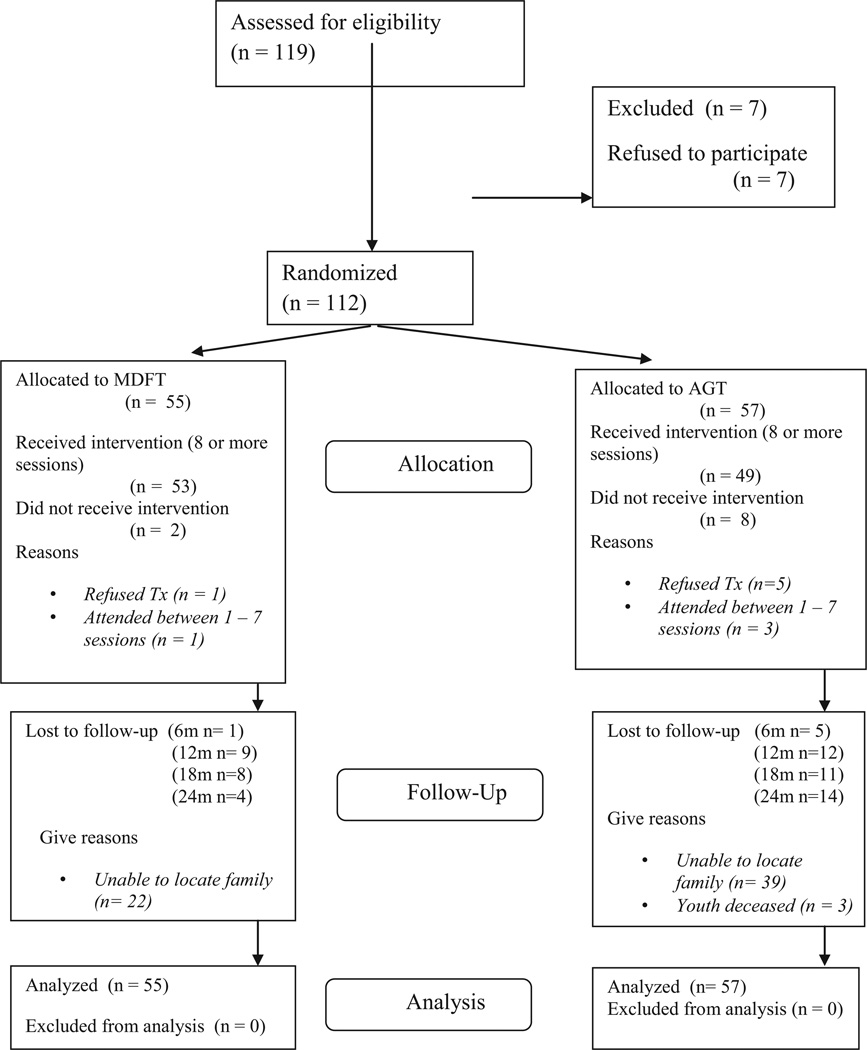
The objective of this article is to examine the effectiveness of 2 theoretically different treatments delivered in juvenile drug court--family therapy represented by multidimensional family therapy (MDFT) and group-based treatment represented by adolescent group therapy (AGT)--on offending and substance use. Intent-to-treat sample included 112 youth enrolled in juvenile drug court (primarily male [88%], and Hispanic [59%] or African American [35%]), average age 16.1 years, randomly assigned to either family therapy (n = 55) or group therapy (n = 57). Participants were assessed at baseline and 6, 12, 18 and 24 months following baseline. During the drug court phase, youth in both treatments showed significant reduction in delinquency (average d = .51), externalizing symptoms (average d = 2.32), rearrests (average d = 1.22), and substance use (average d = 4.42). During the 24-month follow-up, family therapy evidenced greater maintenance of treatment gains than group-based treatment for externalizing symptoms (d = 0.39), commission of serious crimes (d = .38), and felony arrests (d = .96). There was no significant difference between the treatments with respect to substance use or misdemeanor arrests. The results suggest that family therapy enhances juvenile drug court outcomes beyond what can be achieved with a nonfamily based treatment, especially with respect to what is arguably the primary objective of juvenile drug courts: reducing criminal behavior and rearrests. More research is needed on the effectiveness of juvenile drug courts generally and on whether treatment type and family involvement influence outcomes.
Trial registry name: Clinical Trials.gov, Identified NCT01668303.
(c) 2015 APA, all rights reserved).
References
-
- Aarons GA, Brown SA, Hough RL, Garland AF, Wood PA. Prevalence of adolescent substance use disorders across five sectors of care. Journal of the American Academy of Child & Adolescent Psychiatry. 2001;40:419–426. http://dx.doi.org/10.1097/00004583-200104000-00010. - DOI - PubMed
-
- Achenbach TM. Manual for the Youth Self-Report and 1991 Profile. Burlington, VT: University of Vermont, Department of Psychiatry; 1991.
-
- American Psychiatric Association. Diagnostic and statistical manual of mental disorders. 3rd. Washington, DC: Author; 1987. text rev.
-
- Becker SJ, Curry JF. Outpatient interventions for adolescent substance abuse: A quality of evidence review. Journal of Consulting and Clinical Psychology. 2008;76:531–543. http://dx.doi.org/10.1037/0022-006X.76.4.531. - DOI - PubMed
-
- Belenko S, Dembo R. Treating adolescent substance abuse problems in the juvenile drug court. International Journal of Law and Psychiatry. 2003;26:87–110. http://dx.doi.org/10.1016/S0160-2527(02)00205-4. - DOI - PubMed
Publication types
MeSH terms
Associated data
Grants and funding
LinkOut - more resources
Full Text Sources
Other Literature Sources
Medical
Miscellaneous