


Hyperlipidemia in early adulthood increases long-term risk of coronary heart disease
- PMID: 25623155
- PMCID: PMC4370230
- DOI: 10.1161/CIRCULATIONAHA.114.012477
Hyperlipidemia in early adulthood increases long-term risk of coronary heart disease
Abstract
Background: Many young adults with moderate hyperlipidemia do not meet statin treatment criteria under the new American Heart Association/American College of Cardiology cholesterol guidelines because they focus on 10-year cardiovascular risk. We evaluated the association between years of exposure to hypercholesterolemia in early adulthood and future coronary heart disease (CHD) risk.
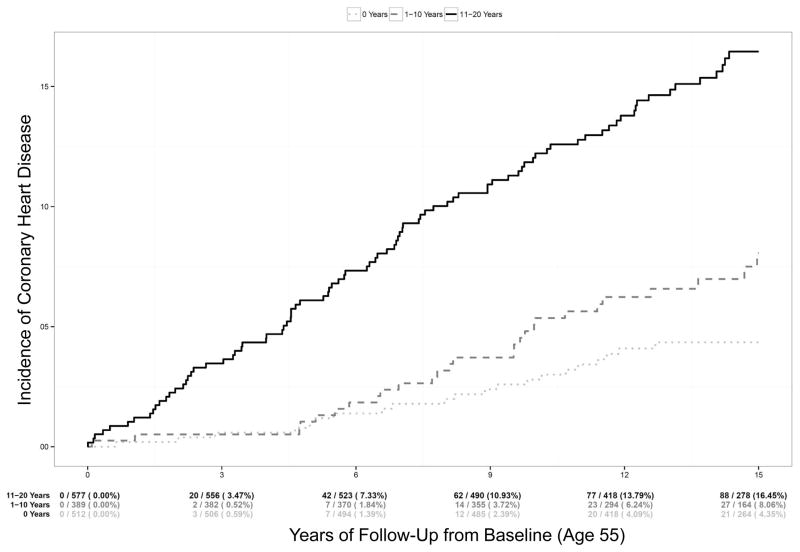
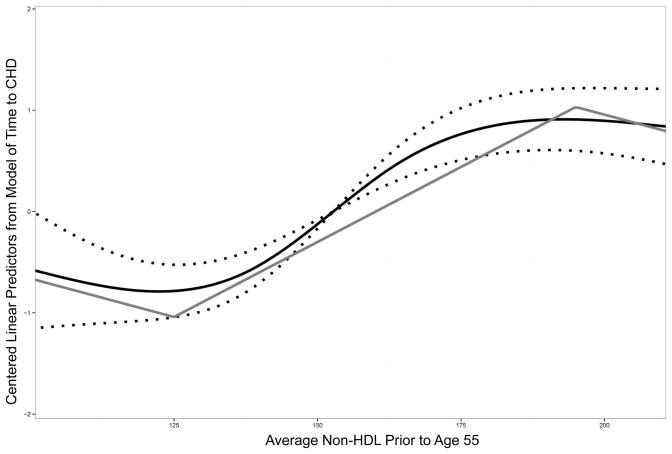
Methods and results: We examined Framingham Offspring Cohort data to identify adults without incident cardiovascular disease to 55 years of age (n=1478), and explored the association between duration of moderate hyperlipidemia (non-high-density lipoprotein cholesterol ≥ 160 mg/dL) in early adulthood and subsequent CHD. At median 15-year follow-up, CHD rates were significantly elevated among adults with prolonged hyperlipidemia exposure by 55 years of age: 4.4% for those with no exposure, 8.1% for those with 1 to 10 years of exposure, and 16.5% for those with 11 to 20 years of exposure (P<0.001); this association persisted after adjustment for other cardiac risk factors including non-high-density lipoprotein cholesterol at 55 years of age (hazard ratio, 1.39; 95% confidence interval, 1.05-1.85 per decade of hyperlipidemia). Overall, 85% of young adults with prolonged hyperlipidemia would not have been recommended for statin therapy at 40 years of age under current national guidelines. However, among those not considered statin therapy candidates at 55 years of age, there remained a significant association between cumulative exposure to hyperlipidemia in young adulthood and subsequent CHD risk (adjusted hazard ratio, 1.67; 95% confidence interval, 1.06-2.64).
Conclusions: Cumulative exposure to hyperlipidemia in young adulthood increases the subsequent risk of CHD in a dose-dependent fashion. Adults with prolonged exposure to even moderate elevations in non-high-density lipoprotein cholesterol have elevated risk for future CHD and may benefit from more aggressive primary prevention.
Keywords: coronary disease; hyperlipidemias; risk.
© 2015 American Heart Association, Inc.
Conflict of interest statement
Figures

Comment in
-
Mapping hyperlipidemia in young adulthood to coronary risk: importance of cumulative exposure and how to stay young.Circulation. 2015 Feb 3;131(5):445-7. doi: 10.1161/CIRCULATIONAHA.114.014433. Epub 2015 Jan 26. Circulation. 2015. PMID: 25623154 Free PMC article. No abstract available.
-
Letter by Hayward Regarding Article, "Hyperlipidemia in Early Adulthood Increases Long-Term Risk of Coronary Heart Disease".Circulation. 2015 Oct 20;132(16):e202. doi: 10.1161/CIRCULATIONAHA.115.016019. Circulation. 2015. PMID: 26481568 No abstract available.
References
-
- Pencina MJ, Navar-Boggan AM, D’Agostino RB, Sr, Williams K, Neely B, Sniderman AD, Peterson ED. Application of new cholesterol guidelines to a population-based sample. N Engl J Med. 2014;370:1422–1431. - PubMed
-
- Goff DC, Jr, Lloyd-Jones DM, Bennett G, Coady S, D’Agostino RB, Gibbons R, Greenland P, Lackland DT, Levy D, O’Donnell CJ, Robinson J, Schwartz JS, Shero ST, Smith SC, Jr, Sorlie P, Stone NJ, Wilson PW. 2013 ACC/AHA Guideline on the Assessment of Cardiovascular Risk: a report of the American College of Cardiology/American Heart Association Task Force on Practice Guidelines. Circulation. 2014;129:S49–73. - PubMed
-
- Hopkins PN, Heiss G, Ellison RC, Province MA, Pankow JS, Eckfeldt JH, Hunt SC. Coronary artery disease risk in familial combined hyperlipidemia and familial hypertriglyceridemia: a case-control comparison from the National Heart, Lung, and Blood Institute Family Heart Study. Circulation. 2003;108:519–523. - PubMed
-
- Cohen JC, Boerwinkle E, Mosley TH, Jr, Hobbs HH. Sequence variations in PCSK9, low LDL, and protection against coronary heart disease. N Engl J Med. 2006;354:1264–1272. - PubMed
-
- Ference BA, Yoo W, Alesh I, Mahajan N, Mirowska KK, Mewada A, Kahn J, Afonso L, Williams KA, Sr, Flack JM. Effect of long-term exposure to lower low-density lipoprotein cholesterol beginning early in life on the risk of coronary heart disease: a Mendelian randomization analysis. J Am Coll Cardiol. 2012;60:2631–2639. - PubMed
Publication types
MeSH terms
Substances
Grants and funding
LinkOut - more resources
Full Text Sources
