


[Risk factors associated with structural postural changes in the spinal column of children and adolescents]
- PMID: 25623725
- PMCID: PMC4436959
- DOI: 10.1016/j.rpped.2014.11.012
[Risk factors associated with structural postural changes in the spinal column of children and adolescents]
Abstract
OBJECTIVE:: To investigate the association between behavioral risk factors, specifically postural habits, with the presence of structural changes in the spinal column of children and adolescents.
METHODS:: 59 students were evaluated through the self-reporting Back Pain and Body Posture Evaluation Instrument and spinal panoramic radiographic examination. Spine curvatures were classified based on Cobb angles, as normal or altered in the saggital plane and as normal or scoliotic in the frontal plane. Data were analyzed using SPSS 18.0, based on descriptive statistics and chi-square association test (a=0,05).
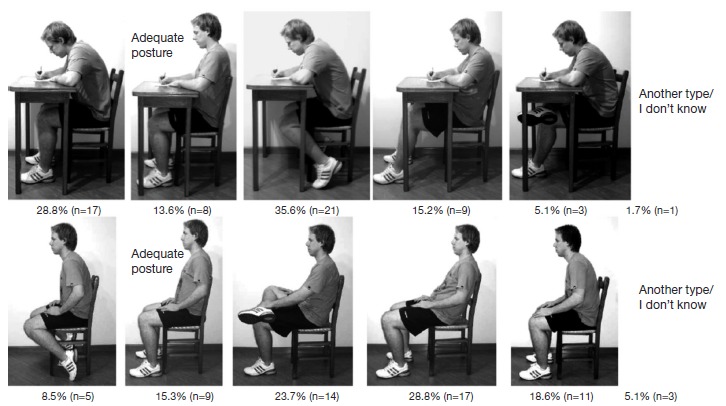
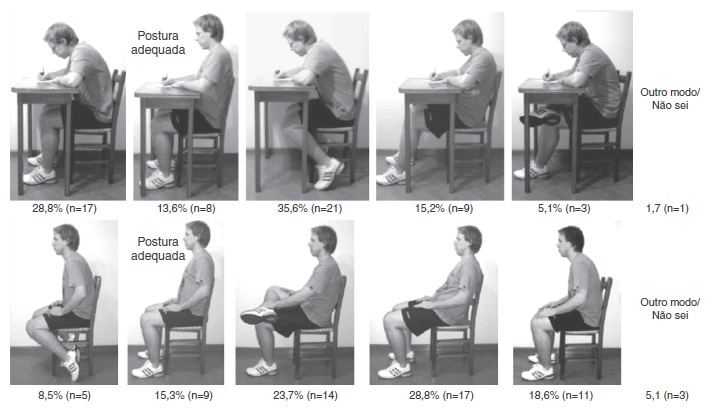
RESULTS:: The prevalence of postural changes was 79.7% (n=47), of which 47.5% (n=28) showed frontal plane changes and 61% (n=36) sagital plane changes. Significant association was found between the presence of thoracic kyphosis and female gender, practice of physical exercises only once or twice a week, sleep time greater than 10 hours, inadequate postures when sitting on a seat and sitting down to write, and how school supplies are carried. Lumbar lordosis was associated with the inadequate way of carrying the school backpack (asymmetric); and scoliosis was associated wuth the practice of competitive sports and sleep time greater than 10 hours.
CONCLUSIONS:: Lifestyle may be associated with postural changes. It is important to develop health policies in order to reduce the prevalence of postural changes, by decreasing the associated risk factors.
Keywords: Adolescent; Adolescente; Child; Coluna vertebral/anormalidades; Criança; Epidemiologia; Epidemiology; Fatores de risco; Postura; Posture; Risk factors; Spine/abnormalities.
Copyright © 2014 Associação de Pediatria de São Paulo. Publicado por Elsevier Editora Ltda. All rights reserved.
Conflict of interest statement
Figures
References
-
- Braccialli LM, Vilarta R. Aspectos a serem considerados na elaboração de programas de prevenção e orientação de problemas posturais. Rev Paul Educ Fis. 2000;14:16–18.
-
- De Vitta A, Martinez MG, Piza NT, Simeão SF, Ferreira NP. Prevalence of lower back pain and associated factors in students. Cad Saude Publica. 2011;27:1520–1528. - PubMed
-
- Guedes DP, Guedes JE, Barbosa DS, de Oliveira JA. Levels of regular physical activity in adolescents. Rev Bras Med Esporte. 2001;7:187–199.
MeSH terms
LinkOut - more resources
Full Text Sources
Other Literature Sources
Medical
