Review
. 2015 May;467(5):1013-25.
doi: 10.1007/s00424-015-1689-1. Epub 2015 Jan 28.

TASK channels in arterial chemoreceptors and their role in oxygen and acid sensing

Affiliations
Review

TASK channels in arterial chemoreceptors and their role in oxygen and acid sensing

Keith J Buckler. Pflugers Arch. 2015 May.

Abstract

Arterial chemoreceptors play a vital role in cardiorespiratory control by providing the brain with information regarding blood oxygen, carbon dioxide, and pH. The main chemoreceptor, the carotid body, is composed of sensory (type 1) cells which respond to hypoxia or acidosis with a depolarising receptor potential which in turn activates voltage-gated calcium entry, neurosecretion and excitation of adjacent afferent nerves. The receptor potential is generated by inhibition of Twik-related acid-sensitive K(+) channel 1 and 3 (TASK1/TASK3) heterodimeric channels which normally maintain the cells' resting membrane potential. These channels are thought to be directly inhibited by acidosis. Oxygen sensitivity, however, probably derives from a metabolic signalling pathway. The carotid body, isolated type 1 cells, and all forms of TASK channel found in the type 1 cell, are highly sensitive to inhibitors of mitochondrial metabolism. Moreover, type1 cell TASK channels are activated by millimolar levels of MgATP. In addition to their role in the transduction of chemostimuli, type 1 cell TASK channels have also been implicated in the modulation of chemoreceptor function by a number of neurocrine/paracrine signalling molecules including adenosine, GABA, and serotonin. They may also be instrumental in mediating the depression of the acute hypoxic ventilatory response that occurs with some general anaesthetics. Modulation of TASK channel activity is therefore a key mechanism by which the excitability of chemoreceptors can be controlled. This is not only of physiological importance but may also offer a therapeutic strategy for the treatment of cardiorespiratory disorders that are associated with chemoreceptor dysfunction.


Figures
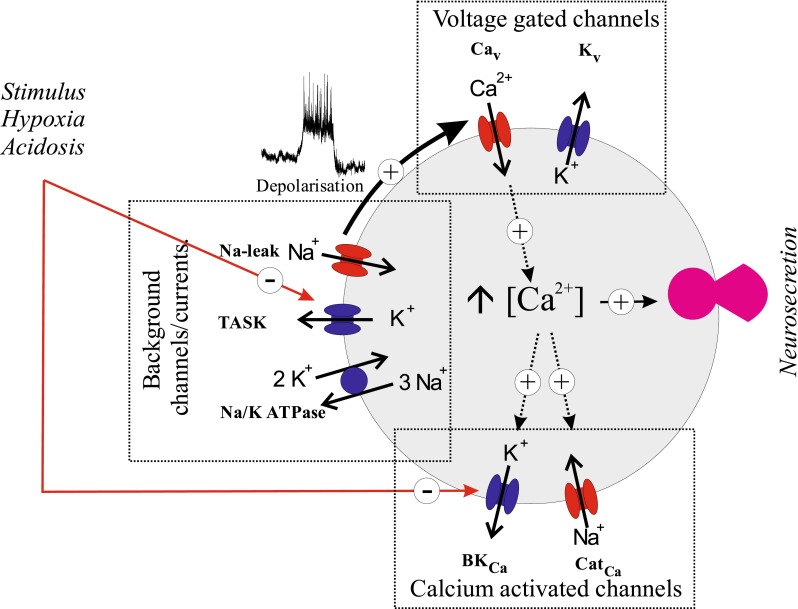
Fig. 1
Fig. 1
Ion channels and electrical signalling in type 1 cells. Putative summary model of key ion channels/currents in rat type 1 cells. Background channels and currents setting the resting potential include TASK, predominantly TASK1/TASK3 heterodimers plus some contribution from TASK1 and TASK3 homodimers; Na-leak, an uncharacterised background Na+-leak conductance; and Na/K ATPase, an Na/K pump current presumed to be present in order to maintain intracellular Na+ homeostasis. Voltage-gated channels mediating electrical activity (action potentials) in the rat type 1 cell include Ca V, voltage-gated calcium channels including L-type and N-type channels; K V, voltage-gated, delayed rectifier type, potassium channels (other species may also have voltage gated Na+ channels). Calcium-activated channels include BK Ca, a large conductance calcium-activated potassium channel (note this channel is also voltage sensitive) and Cat Ca, a calcium-activated cation channel permeable to Na+ ions. Signalling pathway for both hypoxia and acidosis involves inhibition of TASK channels (all three forms) and maxi-K+ channels. Inhibition of TASK leads to membrane depolarisation, followed by activation of voltage-gated Ca+ channels generating Ca2+ influx and upstroke of action potentials; KV is assumed to mediate action potential repolarisation. The resulting rise in [Ca2+]i not only promotes neurosecretion but also activates a non-selective cation channel which reinforces the depolarising effect of TASK channel inhibition. Ca2+-dependent activation of maxi-K channels would be expected to repolarise the type 1 cell and limit Ca2+ influx were it not also inhibited by hypoxia/acidosis [102, 103]. Channels in red mediate inward (depolarising) current, those in blue mediate outward (repolarising/hyperpolarising) current
Fig. 2
Fig. 2
Metabolic regulation of TASK channels. Effects of cyanide (2 mM) on TASK channel activity in cell-attached patches from mouse type 1 cells. Wild-type cells show primarily TASK1/TASK3 heterodimer channel activity. KCNK9 −/− cells (Task3 KO) show TASK1-like activity. KCNK3 −/− cells (Task1 KO) show TASK3-like activity. Note that all forms of TASK channel activity are suppressed by cyanide. Similar effects were also seen for hypoxia and the mitochondrial uncoupler FCCP, see [129]
Fig. 3
Fig. 3
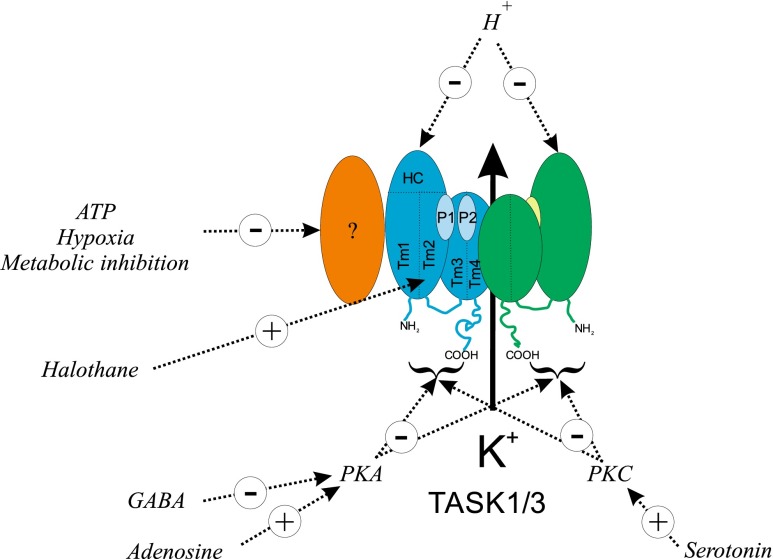
Schematic of TASK channel regulation in type 1 cells of the carotid body. Cartoon depicts key regions of the TASK channels including transmembrane spanning domains Tm1, Tm2, Tm3 and Tm4, pore loops P1 + P2, the extracellular helical cap between Tm1 and P1, and N- and C-terminal domains. Hypoxia/metabolic inhibition/cytosolic ATP signalling is presumed to involve some unknown intermediary, e.g. an accessory subunit (?), see text. Modulation by extracellular acidosis probably involves a histidine residue (H98) in the helical cap region (HC). Gaseous inhalational anaesthetics, e.g. halothane, may bind to a region in/near the C-terminal end of the M2 segment [2]. Site of action of the protein kinases PKA and PKC is unknown but is assumed to involve cytoplasmic domains

References

    1. Abdala AP, McBryde FD, Marina N, Hendy EB, Engelman ZJ, Fudim M, Sobotka PA, Gourine AV, Paton JF. Hypertension is critically dependent on the carotid body input in the spontaneously hypertensive rat. J Physiol. 2012;590:4269–4277. - PMC - PubMed
    1. Andres-Enguix I, Caley A, Yustos R, Schumacher MA, Spanu PD, Dickinson R, Maze M, Franks NP. Determinants of the anesthetic sensitivity of two-pore domain acid-sensitive potassium channels: molecular cloning of an anesthetic-activated potassium channel from Lymnaea stagnalis. J Biol Chem. 2007;282:20977–20990. - PubMed
    1. Anichkov S, Belen'kii M. Pharmacology of the carotid body chemoreceptors. Oxford: Pergamon; 1963.
    1. Barbe C, Al-Hashem F, Conway AF, Dubuis E, Vandier C, Kumar P. A possible dual site of action for carbon monoxide-mediated chemoexcitation in the rat carotid body. J Physiol. 2002;543:933–945. - PMC - PubMed
    1. Bin Jaliah I, Maskell PD, Kumar P. Indirect sensing of insulin-induced hypoglycaemia by the carotid body in the rat. J Physiol. 2004;556:255–266. - PMC - PubMed

Publication types

LinkOut - more resources