


Help seeking for cancer 'alarm' symptoms: a qualitative interview study of primary care patients in the UK
- PMID: 25624313
- PMCID: PMC4325458
- DOI: 10.3399/bjgp15X683533
Help seeking for cancer 'alarm' symptoms: a qualitative interview study of primary care patients in the UK
Abstract
Background: Delay in help seeking for cancer 'alarm' symptoms has been identified as a contributor to delayed diagnosis.
Aim: To understand people's help-seeking decision making for cancer alarm symptoms, without imposing a cancer context.
Design and setting: Community-based, qualitative interview study in the UK, using purposive sampling by sex, socioeconomic status, and prior help seeking, with framework analysis of transcripts.
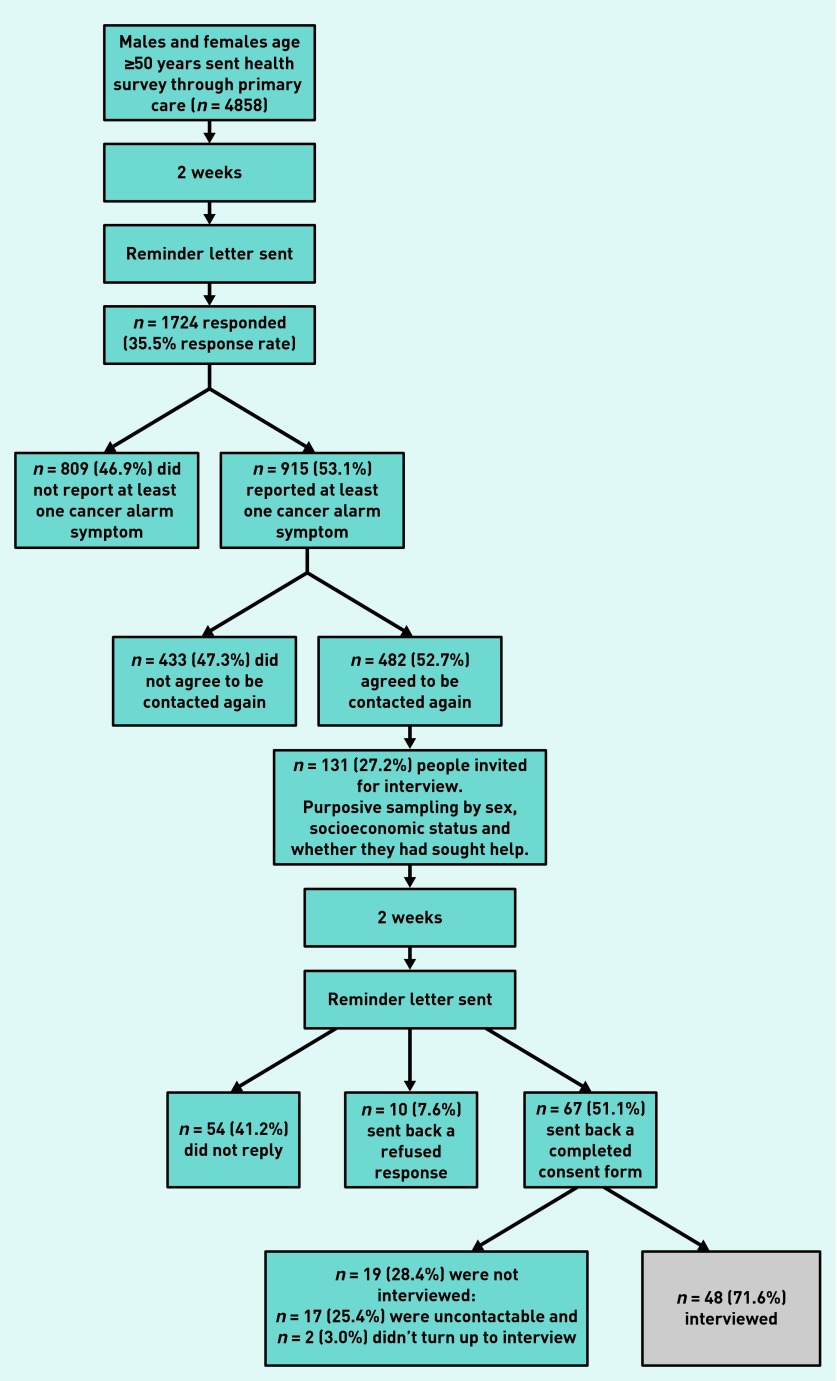
Method: Interviewees (n = 48) were recruited from a community-based sample (n = 1724) of adults aged ≥50 years who completed a health survey that included a list of symptoms. Cancer was not mentioned. Participants reporting any of 10 cancer alarm symptoms (n = 915) and who had consented to contact (n = 482) formed the potential pool from which people were invited to an interview focusing on their symptom experiences.
Results: Reasons for help seeking included symptom persistence, social influence, awareness/fear of a link with cancer, and 'just instinct'. Perceiving the symptom as trivial or 'normal' was a deterrent, as was stoicism, adopting self-management strategies, and fear of investigations. Negative attitudes to help seeking were common. Participants did not want to be seen as making a fuss, did not want to waste the doctor's time, and were sometimes not confident that the GP could help.
Conclusion: Decision making about cancer alarm symptoms was complex. Recognition of cancer risk almost always motivated help seeking (more so than the fear of cancer being a deterrent), assisted by recent public-awareness campaigns. As well as symptom persistence motivating help seeking, it could also have the reverse effect. Negative attitudes to help seeking were significant deterrents.
Keywords: awareness; cancer; fear; general practice; help-seeking; ‘alarm’ symptoms.
© British Journal of General Practice 2015.
References
-
- Berrino F, De Angelis R, Sant M, et al. Survival for eight major cancers and all cancers combined for European adults diagnosed in 1995–99: results of the EUROCARE-4 study. Lancet Oncol. 2007;8(9):773–783. - PubMed
-
- Scott SE, Walter FM, Webster A, et al. The model of pathways to treatment: conceptualization and integration with existing theory. Br J Health Psychol. 2013;18(1):45–65. - PubMed
Publication types
MeSH terms
Grants and funding
LinkOut - more resources
Full Text Sources
Research Materials
