


Phase II study of everolimus and letrozole in patients with recurrent endometrial carcinoma
- PMID: 25624430
- PMCID: PMC4348638
- DOI: 10.1200/JCO.2014.58.3401
Phase II study of everolimus and letrozole in patients with recurrent endometrial carcinoma
Abstract
Purpose: The phosphoinositol-3 kinase (PI3K) pathway is frequently dysregulated in endometrial cancer (EC). Hormonal manipulation leads to response in some patients with EC, but resistance derived from PI3K pathway activation has been documented. Targeting mammalian target of rapamycin (mTOR) may overcome endocrine resistance. We conducted a two-institution phase II trial of everolimus and letrozole in women with recurrent EC.
Patients and methods: Patients were considered incurable, had measurable disease, and were treated with up to two prior cytotoxic regimens. Everolimus was administered orally at 10 mg daily and letrozole was administered orally at 2.5 mg daily. Each cycle consisted of 4 weeks of therapy. Patients were treated until progression, toxicity, or complete response (CR). The primary end point was the clinical benefit rate (CBR), which was defined as CR, partial response, or stable disease (≥ 16 weeks) by RECIST 1.0 criteria. Translational studies were performed to correlate biomarkers with response.
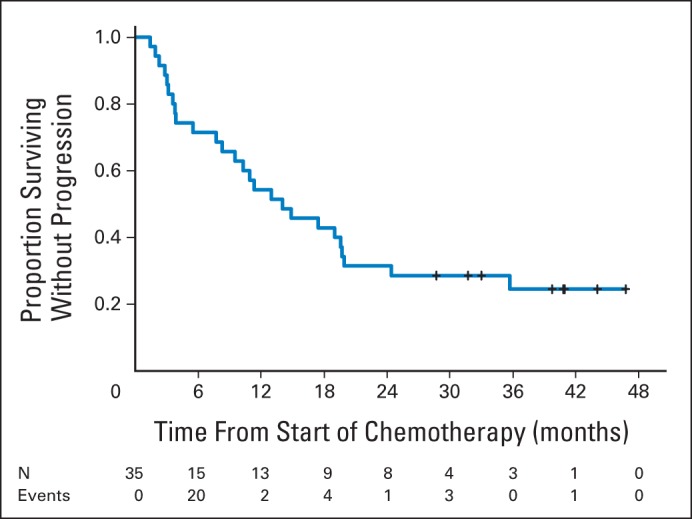
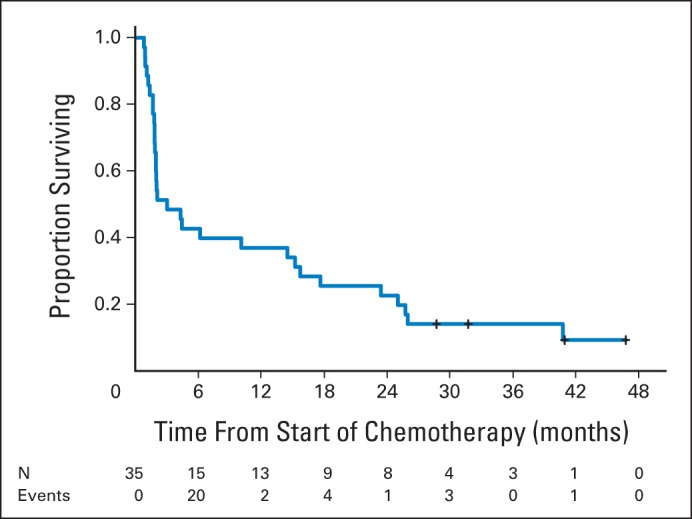
Results: Thirty-eight patients were enrolled (median age, 62 years; range, 24 to 82 years). Thirty-five patients were evaluable for response. The CBR was 40% (14 of 35 patients); the median number of cycles among responders was 15 (range, seven to 29 cycles). The confirmed objective response rate (RR) was 32% (11 of 35 patients; nine CRs and two partial responses; median, 15 cycles; range, eight to 29 cycles). Twenty percent of patients (seven of 35 patients) were taken off treatment after a prolonged CR and at the discretion of the treating clinician. None of the patients discontinued treatment as a result of toxicity. Serous histology was the best predictor of lack of response. Patients with endometrioid histology and CTNNB1 mutations responded well to everolimus and letrozole.
Conclusion: Everolimus plus letrozole results in a high CBR and RR in patients with recurrent EC. Further development of this combination in recurrent endometrioid EC is under way.
Trial registration: ClinicalTrials.gov NCT01068249.
© 2015 by American Society of Clinical Oncology.
Conflict of interest statement
Authors' disclosures of potential conflicts of interest are found in the article online at
Figures
Comment in
-
Treatment of Recurrent Endometrial Carcinoma: Progress Toward a More Personalized Approach.J Clin Oncol. 2015 Oct 20;33(30):3516. doi: 10.1200/JCO.2015.61.4636. Epub 2015 Aug 3. J Clin Oncol. 2015. PMID: 26240220 No abstract available.
-
Reply to G. Bogani et al.J Clin Oncol. 2015 Oct 20;33(30):3516. doi: 10.1200/JCO.2015.62.5632. Epub 2015 Aug 3. J Clin Oncol. 2015. PMID: 26240222 No abstract available.
References
-
- Catasus L, D'Angelo E, Pons C, et al. Expression profiling of 22 genes involved in the PI3K-AKT pathway identifies two subgroups of high-grade endometrial carcinomas with different molecular alterations. Mod Pathol. 2010;23:694–702. - PubMed
-
- Abe K, Abe T, Adachi I, et al. Observation of chi(c2) production in B meson decay. Phys Rev Lett. 2002;89 011803. - PubMed
-
- Mackay H, Welch S, Tsao MS, et al. Phase II study of oral ridaforolimus in patients with metastatic and/or locally advanced recurrent endometrial cancer. J Clin Oncol. 2011;(suppl):29. abstr 5013.
Publication types
MeSH terms
Substances
Associated data
Grants and funding
LinkOut - more resources
Full Text Sources
Other Literature Sources
Medical
Miscellaneous
