


Model for individualized prediction of breast cancer risk after a benign breast biopsy
- PMID: 25624442
- PMCID: PMC4348637
- DOI: 10.1200/JCO.2014.55.4865
Model for individualized prediction of breast cancer risk after a benign breast biopsy
Abstract
Purpose: Optimal early detection and prevention for breast cancer depend on accurate identification of women at increased risk. We present a risk prediction model that incorporates histologic features of biopsy tissues from women with benign breast disease (BBD) and compare its performance to the Breast Cancer Risk Assessment Tool (BCRAT).
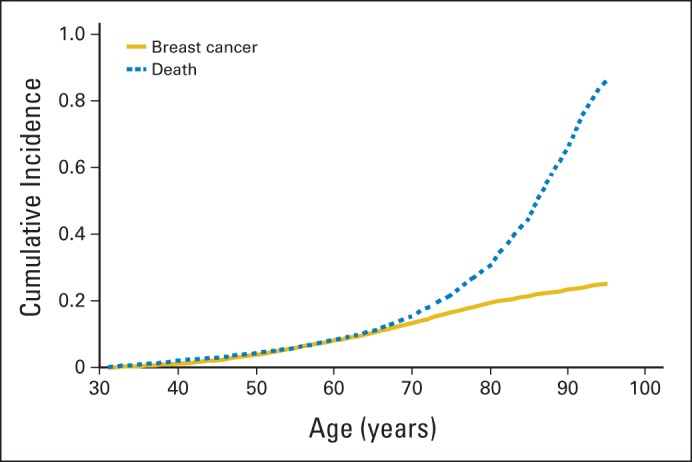
Methods: We estimated the age-specific incidence of breast cancer and death from the Mayo BBD cohort and then combined these estimates with a relative risk model derived from 377 patient cases with breast cancer and 734 matched controls sampled from the Mayo BBD cohort to develop the BBD-to-breast cancer (BBD-BC) risk assessment tool. We validated the model using an independent set of 378 patient cases with breast cancer and 728 matched controls from the Mayo BBD cohort and compared the risk predictions from our model with those from the BCRAT.
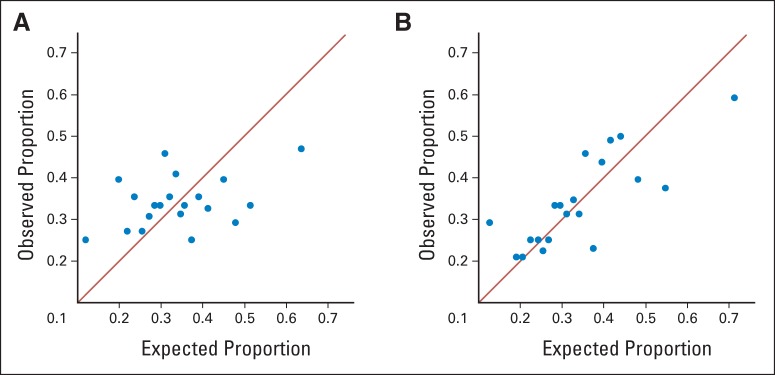
Results: The BBD-BC model predicts the probability of breast cancer in women with BBD using tissue-based and other risk factors. The concordance statistic from the BBD-BC model was 0.665 in the model development series and 0.629 in the validation series; these values were higher than those from the BCRAT (0.567 and 0.472, respectively). The BCRAT significantly underpredicted breast cancer risk after benign biopsy (P = .004), whereas the BBD-BC predictions were appropriately calibrated to observed cancers (P = .247).
Conclusion: We developed a model using both demographic and histologic features to predict breast cancer risk in women with BBD. Our model more accurately classifies a woman's breast cancer risk after a benign biopsy than the BCRAT.
© 2015 by American Society of Clinical Oncology.
Conflict of interest statement
Authors' disclosures of potential conflicts of interest are found in the article online at
Figures
Comment in
-
Is the Benign Breast Disease Breast Cancer Model Well Calibrated?J Clin Oncol. 2015 Sep 1;33(25):2829-30. doi: 10.1200/JCO.2015.61.6177. Epub 2015 Jul 27. J Clin Oncol. 2015. PMID: 26215936 No abstract available.
-
Reply to M.H. Gail et al.J Clin Oncol. 2015 Sep 1;33(25):2830-1. doi: 10.1200/JCO.2015.62.5756. Epub 2015 Jul 27. J Clin Oncol. 2015. PMID: 26215951 No abstract available.
References
-
- American Cancer Society. How many women get breast cancer? http://www.cancer.org/cancer/breastcancer/overviewguide/breast-cancer-ov....
-
- Costantino JP, Gail MH, Pee D, et al. Validation studies for models projecting the risk of invasive and total breast cancer incidence. J Natl Cancer Inst. 1999;91:1541–1548. - PubMed
-
- Gail MH, Brinton LA, Byar DP, et al. Projecting individualized probabilities of developing breast cancer for white females who are being examined annually. J Natl Cancer Inst. 1989;81:1879–1886. - PubMed
-
- Rockhill B, Spiegelman D, Byrne C, et al. Validation of the Gail et al. model of breast cancer risk prediction and implications for chemoprevention. J Natl Cancer Inst. 2001;93:358–366. - PubMed
-
- Gutwein LG, Ang DN, Liu H, et al. Utilization of minimally invasive breast biopsy for the evaluation of suspicious breast lesions. Am J Surg. 2011;202:127–132. - PubMed
Publication types
MeSH terms
Grants and funding
LinkOut - more resources
Full Text Sources
Medical
